
Why Getting a Mortgage Reboot Feels Impossible When You Are Your Own Boss
Getting a home loan as a freelancer usually feels like trying to speak a foreign language to a brick wall. You make great money, your business is thriving, but the moment you tell a bank you work for yourself, they treat you like a huge risk. Let's fix that. Here is exactly how to set up your paperwork so underwriters actually want to approve your mortgage.
But every single bank I talked to looked at my self-employed status like it was a massive red flag. They wanted safe, predictable W-2 pay stubs, which I obviously did not have to give them. It felt like I was being heavily punished simply for being an entrepreneur.
I would spend hours on the phone trying to explain my business structure to loan officers who simply did not understand. They looked at my tax write-offs and suddenly treated my profitable business like it was making zero money. I felt completely defeated and incredibly stressed out.
The daily reality for independent contractors and business owners is actually quite exhausting when dealing with traditional banks. You work incredibly hard to build a life for your family, but the financial system is built for regular employees. This invisible barrier creates a deep sense of anxiety and frustration that regular employees just never experience.
It is incredibly unfair that your hard work and entrepreneurial spirit are viewed as a financial liability by underwriters. The endless cycle of sending profit and loss statements, only to be told it is not enough, can make anyone want to quit trying entirely.

Before You Read: 3 Quick Takeaways
- Banks calculate your income based on what is left after your tax write-offs, not your total gross revenue.
- Do not change your business structure (like switching from Sole Proprietor to LLC) right before you apply for a loan.
- You must keep your business money and personal money in totally separate checking accounts to get approved quickly.
Decoding the Underwriter’s Secret Checklist
You need to understand exactly how the bank views your money before you submit a single piece of paper. Traditional lenders are naturally afraid of income that goes up and down every single month. They want to be one hundred percent sure you can pay them back, even if your business hits a rough patch.
Think of your business income like a roller coaster, while a regular salary is like a slow-moving train. Banks love the train because they always know exactly when it will arrive at the station. To get them comfortable with your roller coaster, you have to show them a strong safety harness.
That safety harness is your average income over a specific period of time. Most traditional lenders will require at least two full years of self-employment history to even consider your application. They will take your total net income over those twenty-four months and divide it by twenty-four to find your monthly average.
Myth vs. Fact: How Banks See Your Money
- The Myth: Banks look at how much gross revenue your clients paid you this year.
- The Fact: Banks only look at your net profit (what is left after you pay your business expenses and take tax deductions) and they usually average it out over the last 24 months.
The Big Trap of Tax Deductions
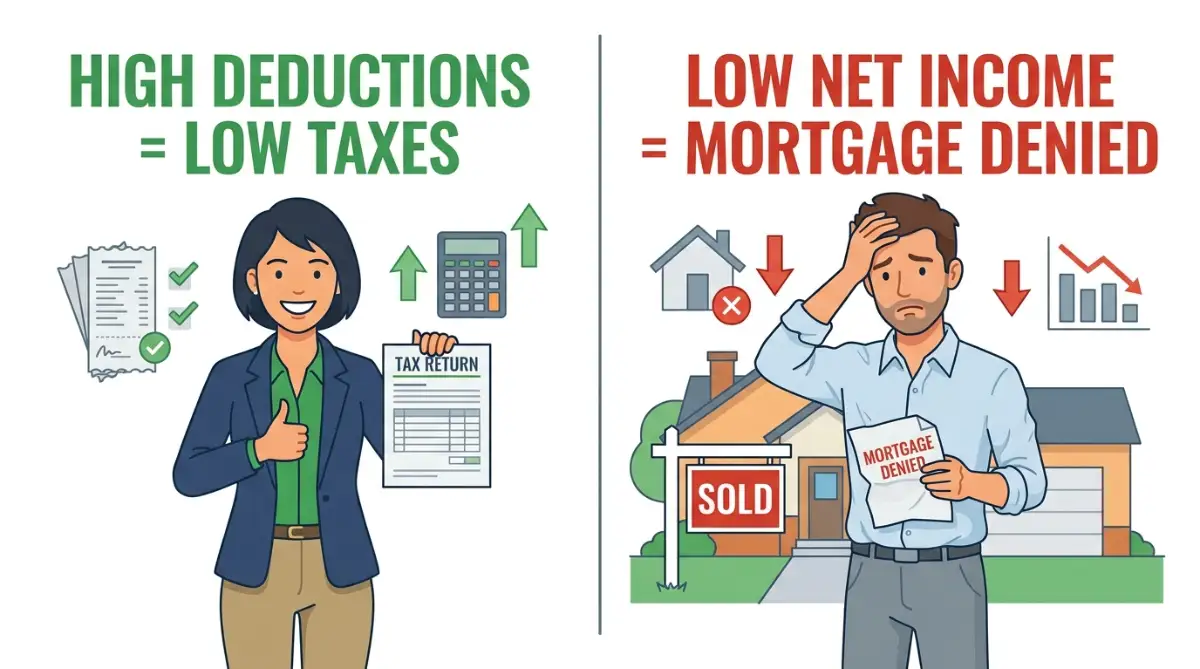
This is where almost every single business owner makes a huge mistake that ruins their chances. As an entrepreneur, your accountant probably works very hard to write off as many expenses as possible. The goal is to lower your taxable income so you do not hand all your money over to the government.
However, the bank uses that exact same lowered number to calculate how much house you can afford. If your business made one hundred thousand dollars, but you wrote off sixty thousand dollars, the bank thinks you only made forty thousand dollars. This tiny detail destroys countless refinance applications every single day.
I learned this lesson the hardest way possible during my first attempt at securing a better rate.
I realized that my aggressive tax strategies were completely destroying my borrowing power. From that point on, I sat down with my CPA a full year before applying to adjust my write-offs. I chose to pay a little more in taxes that year just to show a higher net income on paper, and it completely saved my mortgage application.
Crafting Your Perfect Financial Story
Since you do not have standard pay stubs, your tax documents become your absolute best friend. You must gather your complete personal and business tax returns for the last two years. Make sure every single page is included, even the blank ones, because underwriters are incredibly picky about missing pages.
You will also need to prepare a very detailed Profit and Loss (P&L) statement for your current year. This document shows the bank exactly how your business is performing right now, after your last tax filing. Do not try to create this document yourself if you are not good at accounting. Have your Certified Public Accountant (CPA) prepare and sign it for you to build maximum trust with the lender.
A Quick Comparison: Traditional vs. Self-Employed Applicants
You must treat your application like you are building a legal case to prove your financial stability. The more organized you are from day one, the less painful the entire review process will be. Create a clean digital folder on your computer with your business license, bank statements, and tax forms clearly labeled.
Exploring Alternative Loan Options for Entrepreneurs
If your tax returns simply do not show enough income, you are definitely not out of luck. The mortgage industry has created special programs specifically designed for business owners with heavy tax write-offs. These are often called Non-QM (Non-Qualified Mortgage) loans, and they play by completely different rules.
The most popular option in this category is the Bank Statement Loan. Instead of looking at your tax returns, the lender will ask for twelve to twenty-four months of your business bank statements. They will calculate your income based entirely on the actual cash deposits flowing into your business accounts.
This is a massive game changer for freelancers and independent contractors who move a lot of money but claim high expenses.
Watch This Helpful Breakdown on Alternative Mortgages:
Before you give up on lowering your interest rate, you really need to understand how these alternative programs work. This short video explains exactly how Bank Statement Loans can save your application when traditional banks say no.
Keep in mind that these flexible alternative loans usually come with a slightly higher interest rate. The lender is taking on a bit more risk by ignoring your official tax returns, so they charge for that convenience. You will need to sit down and do the math to see if the higher rate still saves you money compared to your current mortgage.
Another great option is a 1099-only loan for independent contractors who do not have massive business expenses. The lender will simply look at your 1099 forms from your clients to figure out your average yearly income. This skips the painful process of digging through every single receipt and business expense you had all year.
Mastering Your Debt-to-Income Ratio (DTI)
Your Debt-to-Income ratio is the most important number in your entire financial profile when applying for a new loan. It is a simple calculation that compares how much money you owe every month to how much money you earn. Banks generally want to see a DTI of forty-three percent or lower to comfortably approve your file.
Because your self-employed income might appear lower due to tax deductions, your DTI can easily spike into dangerous territory. You have to be incredibly careful about taking on any new debts before you apply for your new mortgage. This means no buying a new car for the business, and absolutely no maxing out your business credit cards.
If you have personal debts that you are paying through your business account, you need to document that properly. Sometimes an underwriter will exclude a car payment from your personal DTI if you can prove the business pays for it. You will need twelve months of canceled checks from your business account to prove this is a true business expense.
Quick DTI Math Example:
Let's say your personal debts (like car loans and credit cards) total $1,500 a month, and you want a home with a $2,500 monthly mortgage. That means your total monthly debt is $4,000.
To hit a safe 40% Debt-to-Income (DTI) ratio, your taxable net income needs to be at least $10,000 a month. If you write off too many business expenses, your paper income might fall short of that $10,000 mark!
It is highly recommended to aggressively pay down your personal credit card balances a few months before you apply. Lowering your required minimum monthly payments gives your DTI a quick and very healthy boost. Even paying off a small personal loan can create enough breathing room to get your file across the finish line.
Separating Business from Personal Finances
One of the biggest reasons independent contractors get denied is because their money is completely mixed together. If you are depositing client checks into your personal checking account, you are making a massive mistake. Underwriters absolutely hate trying to figure out which grocery trip was personal and which one was for an office meeting.
You must set up a dedicated business checking account immediately if you do not already have one. Every single dollar you earn from your clients must flow into this specific business account first. From there, you can easily transfer a set "salary" over to your personal checking account to pay your home bills.
This clean separation shows the bank that you treat your work like a real, stable enterprise. It also makes reading your bank statements incredibly easy for the person reviewing your loan file. A confused underwriter will always say no, so your job is to make their life as easy as possible.
When the lender asks for your personal bank statements, they only want to see clean transfers coming from your business. They do not want to see massive cash deposits or random Venmo transfers from friends mixed in with your income. Keep your personal accounts extremely boring and highly predictable while you are going through this journey.

Managing the Cash Reserve Requirement
Because self-employment is seen as slightly risky, traditional banks often want an extra safety net from you. They will usually ask you to show "cash reserves" sitting comfortably in your savings or investment accounts. Reserves are basically extra months of mortgage payments that you have saved up just in case your business slows down.
Depending on your credit score and the loan type, you might need anywhere from two to six months of reserves. If your new mortgage payment will be two thousand dollars a month, they might want to see twelve thousand dollars sitting in savings. This money does not go to the bank; it just has to sit in your account to prove you are financially secure.
Do not try to borrow this reserve money from a friend at the last minute. Lenders track every large deposit in your bank accounts for the last sixty days, and they will ask you where the money came from. If it is a new loan or an unexplainable gift, they will not count it toward your reserves.
Your retirement accounts, like an IRA or a Solo 401(k), can usually count toward this safety net requirement. You just need to provide the most recent quarterly statement showing the current balance of your investments. Knowing this small detail can save you from trying to hoard unnecessary amounts of cash in a regular checking account.
Finding the Right Mortgage Broker
Walking straight into a massive retail bank is usually the worst move a freelancer can make. The loan officers sitting in those shiny branches are trained to process easy, standard W-2 applications all day long. When they see a complicated tax return, they often get confused and simply reject the file to save time.
You need to find an independent mortgage broker who specifically specializes in helping business owners. A skilled broker has relationships with dozens of different wholesale lenders across the entire country. They know exactly which banks are currently friendly to freelancers and which ones to completely avoid.
Do not be afraid to interview your broker before you let them pull your credit report. Ask them directly how many self-employed loans they have successfully closed in the last six months. If they hesitate or try to dodge the question, politely end the conversation and go find someone else.
A great broker will review your tax returns upfront and tell you exactly what your chances are before you officially apply. They will act as your financial translator, explaining your unique business model to the underwriter in a way that makes sense. Having this expert on your side completely changes the entire experience from a stressful nightmare into a smooth journey.
Expert Moves to Make Lenders Love Your Application
Now that you have a basic understanding of how underwriters view your file, we need to talk about playing offense. You do not just want to barely get approved; you want the absolute best terms available. Getting a great deal requires thinking two steps ahead of the person reviewing your paperwork.
When you hand your file to a mortgage broker, you want it to look so clean that the bank has zero reasons to hesitate. Most independent contractors just dump a massive pile of receipts and forms onto their broker's desk. We are going to take a much smarter, highly organized approach.
I always tell my freelancer friends to treat their mortgage application like a high-level pitch to a new investor. You are basically asking the bank to invest hundreds of thousands of dollars into your personal stability. If your financial story makes sense instantly, you have a massive advantage over everyone else.
If you want to understand exactly how the system sets these numbers behind the scenes, you should really learn how do mortgage rates work from the ground up. This knowledge gives you incredible leverage when discussing terms with your lending officer.
The Magic of the CPA Comfort Letter
One of the most powerful tools you can bring to the table is something called a "CPA Comfort Letter." Banks get very nervous when they see you moving money around from a business account to a personal one. They constantly worry that taking money out of the business will cause your company to collapse.
To solve this fear, you simply ask your accountant to write a formal letter to the bank. This letter just needs to state that withdrawing your personal income does not negatively impact the daily operations of your business. It sounds like a tiny detail, but underwriters absolutely love seeing this official reassurance.
Having a certified professional vouch for your financial health instantly removes a huge layer of doubt. The bank feels safe because a licensed tax expert has officially signed off on your cash flow situation.
Mastering the Art of Asset Seasoning
Lenders have a strict rule about where your money comes from right before you close on a loan. They want to see that your cash reserves and closing costs have been sitting in your account for at least sixty days. In the banking world, this waiting period is called "seasoning" your money.
If you suddenly transfer twenty thousand dollars from your business to your personal savings right before applying, it triggers alarms. The underwriter will halt everything and demand a massive paper trail to prove that money is actually yours. This annoying delay can sometimes cause you to lose your locked-in interest rate.
To avoid this nightmare, plan your cash movements at least three months before you start the refinance process. Move the exact amount of money you need into your personal savings and let it sit there quietly. This way, when the bank asks for two months of statements, the money is already there and fully seasoned.
Before you start shifting massive amounts of cash, it is very smart to review the official consumer mortgage preparation guidelines provided by the CFPB to ensure you are meeting federal documentation standards. Following these trusted government guidelines ensures you never accidentally trigger a fraud alert on your own accounts.
Timing Your Tax Extensions Perfectly
Business owners love filing tax extensions to give themselves more time to organize their write-offs. However, filing an extension can either save or completely destroy your home refinance application. It all depends on how your business performed compared to your previous tax filings.
If your business made significantly more money this current year, you want the bank to see that higher number immediately. In this scenario, you should completely avoid filing an extension and submit your taxes as early as possible. You want that new, higher income on official government paper so the lender can use it to approve a bigger loan.
On the other hand, if your business had a slightly slower year, an extension might be your best friend. Lenders will generally use your older, more profitable tax returns if the current filing deadline has not passed yet. By filing an extension, you legally delay showing them the lower income while you lock in your new mortgage.
Fixing Your Credit Utilization Ratio Early
Your credit score plays a massive role in the interest rate you are offered, and it is heavily influenced by your credit utilization. This ratio measures how much credit you are currently using compared to your total available limits.
Many entrepreneurs use personal credit cards to fund short-term business expenses, which spikes their utilization sky-high. Even if you pay the balance off at the end of the month, the credit bureaus might pull your score on a day when the card is maxed out. This instantly tanks your credit score right when the mortgage underwriter is checking it.
You need to pay down your balances to under ten percent of your limit at least two months before applying. If you are currently juggling multiple debts, you must read up on managing unsecured loans without credit damage so your score stays perfectly intact. Keep those balances extremely low until the loan is completely funded and closed.

The Hidden Pitfalls That Trigger Instant Denials
The road to getting a better home loan is filled with invisible traps specifically designed for entrepreneurs. Even the smartest business owners accidentally ruin their own applications by making sudden financial moves. When you are under the microscope of a mortgage underwriter, boring consistency is your absolute best defense.
You might think you are making a smart business decision, but the bank might see it as a massive sign of instability. Let us talk about the specific mistakes that cause lending officers to immediately hit the reject button. Knowing what not to do is just as important as knowing what documents to gather.
If you ever want to see exactly what goes on behind the scenes, you need to understand the overlooked factors underwriters check before they approve a file. Knowing their exact playbook helps you completely avoid their traps.
Trap 1: Changing Your Legal Business Entity
This is by far the most heartbreaking mistake I see independent contractors make. Let us say you have been operating successfully as a Sole Proprietor for five straight years. Your accountant advises you to switch to an LLC or an S-Corp to save money on self-employment taxes.
Do not make this switch if you plan to refinance soon!
To a traditional bank, changing your business structure means you just started a brand new company. Even if you have the exact same clients and the exact same income, they reset your two-year work history clock back to zero. They will tell you to come back in two years when your "new" business has enough tax history.
If you read the strict self-employed income calculation rules from Fannie Mae, you will see exactly how aggressively they view these structural changes. Wait until your new loan is completely closed and funded before you upgrade your business entity.
Trap 2: The Sudden Write-Off Spree
Imagine you are having an incredibly profitable quarter, and you decide to buy a new heavy-duty truck for the business. You write off the entire purchase on your taxes to bring your tax bill down to zero. You feel like a financial genius until you call your mortgage broker the next week.
Because you wiped out all your net profit on paper, the bank thinks you cannot afford your monthly payments. Taking on large vehicle debts right before a home application is a massive red flag. If you are already struggling with auto debts, you need to know what to do right now if you can't make your car payment before the lender sees a missed payment on your report.
You have to choose between saving money on your tax bill or showing enough income to get a cheap home loan. You cannot have both at the same exact time when dealing with traditional lending guidelines. If a home refinance is your main goal, you must intentionally skip the massive tax write-offs for a little while.
Trap 3: Co-Signing for Friends or Family
Because entrepreneurs often have good credit scores, family members constantly ask them to co-sign on car loans or apartments. You might think this is harmless since you are not actually making the payments yourself. However, the mortgage underwriter sees this completely differently.
When you co-sign a loan, the bank assumes you are one hundred percent responsible for that entire debt. They immediately add that monthly payment to your personal Debt-to-Income ratio. This extra debt can easily push you over the maximum limit, causing your own home application to be denied.
Never put your name on someone else's financial paperwork while you are trying to secure a lower rate for your own family. You must aggressively protect your personal credit profile from outside risks.
Trap 4: Falling for the Consolidation Illusion
Many business owners try to clean up their credit reports by rapidly consolidating multiple business debts into one massive personal loan. They mistakenly believe that having only one monthly payment looks much better to a traditional bank.
While this sounds great in theory, underwriters dig deep into the origins of every single loan. If you do not understand the rules, you really should read about debunking common myths about debt consolidation loans before you make a move. Opening a brand new, massive personal loan account drops your credit score and scares the underwriter right before closing.
Your Winning Blueprint for the Next 90 Days
Getting a new home loan as an entrepreneur does not have to be a painful, tear-inducing nightmare. It simply requires you to shift your mindset from being a fast-moving business owner to a highly methodical record keeper. You are completely capable of beating this system if you play by their exact rules.
Start by having a deeply honest conversation with your accountant about your true financial goals. Tell them you want to prioritize showing strong net income rather than hiding every single penny from the government. This small shift in strategy will open up doors to lending programs you never thought were possible.
Once your taxes are aligned, focus heavily on keeping your business and personal money strictly separated. Clean bank statements are the absolute fastest way to an underwriter's heart. Make their job incredibly easy, and they will reward you with the approval stamp you deserve.
It is also highly recommended to study the official business structure classifications by the IRS so you know exactly how the government—and your lender—categorizes your daily income.
Frequent Roadblocks Entrepreneurs Ask About
Can I get approved using just one year of my tax returns?
Yes, it is definitely possible, but your business must be incredibly stable. Lenders usually require you to have been self-employed for at least five straight years to qualify for the one-year return exception. If you have less history, they will almost always demand a full two-year average.
Do mortgage banks look at my gross business revenue or my net profit?
Traditional banks only care about your net profit, which is the money left over after all your business expenses are deducted. This is exactly why heavy tax write-offs hurt your borrowing power so much. If you need them to look at gross deposits, you must apply for a specific Bank Statement Loan instead.
Will changing my business from a Sole Proprietor to an LLC hurt my current application?
Absolutely, changing your legal entity will severely damage your chances if you do it right before applying. The bank will view your LLC as a brand new business with zero track record, even if your actual work never changed. Always wait until your new mortgage is completely closed before upgrading your business structure.
How can I possibly prove my income if I write everything off legally?
If your tax returns show very little profit, you need to abandon traditional conventional loans entirely. You should immediately ask a mortgage broker about Non-QM alternative programs. These flexible lenders will use your actual bank deposits or client 1099 forms to calculate your true cash flow.
Is it a bad idea to pay off my business credit cards with my personal savings?
Mixing personal savings to pay off a business debt creates a massive paperwork headache for the underwriter. They will have to track the source of those funds and recalculate your personal debt ratios all over again. If you need to pay down a business card, use money directly from your official business checking account.
Disclaimer: The information provided in this article is for educational and informational purposes only and does not constitute financial, legal, or tax advice. Mortgage guidelines change frequently, and individual lending criteria may vary heavily based on personal circumstances. Always consult with a licensed mortgage broker, certified public accountant (CPA), or financial advisor before making any major financial decisions regarding your home loan or tax filings.