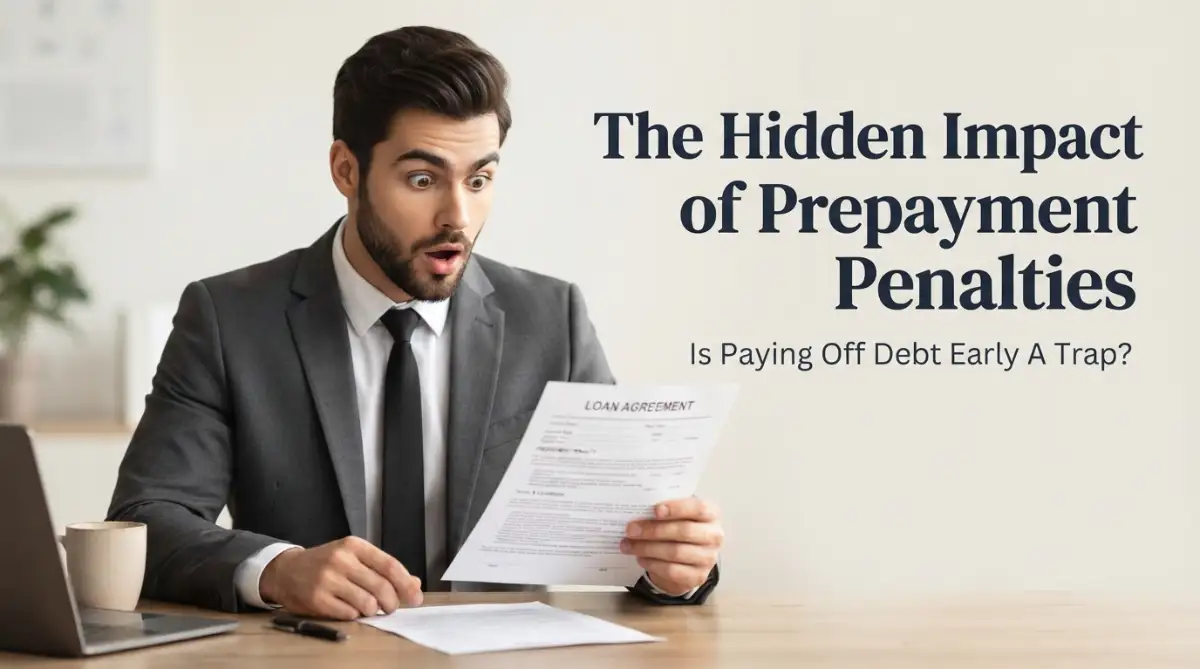
The Shocking Moment I Was Punished for Doing the Right Thing
You think handing over a giant check to clear your debt would get you a high-five from your bank, right? That is exactly what I thought until a teller hit me with a ridiculous "early payoff" fee. Let me show you how I accidentally fell into this expensive trap, and how you can safely dodge it.
My goal was simple. I just wanted to experience the amazing feeling of being completely debt-free.
I proudly walked into the bank branch, ready to hand over my hard-earned check. I expected a handshake, a smile, and a massive sense of relief.
Instead, the bank teller looked at her computer screen and told me I owed an extra fee. I was totally confused and asked her what the charge was for.
She calmly explained that because I was paying off my loan ahead of schedule, I had to pay a hidden fee. I was literally being punished for being responsible with my own money.
My heart sank into my stomach. I felt completely betrayed by the financial system I trusted.

The sad reality is that my story is not unique. Every single day, thousands of hardworking people face this exact same nightmare.
You do everything right. You budget your groceries, you stop eating out, and you aggressively attack your loan balances.
You think you are saving money on interest. But deep inside the fine print of your loan contract, a massive trap is waiting for you.
For the average person, this hidden fee completely destroys their peace of mind. Imagine working tirelessly for months, only to realize the bank is taking away a huge chunk of your savings.
This hidden trap causes massive emotional stress, anxiety, and a deep feeling of hopelessness. You try to take a step forward, but the bank forces you two steps back.
Many people completely give up on their financial goals after getting hit by these unexpected charges. They just accept defeat and continue paying the minimum balance every month.
But I refuse to let that happen to you. I want to share exactly what these fees are, why banks hide them, and how you can protect your hard-earned money.
The Short Version (If You Are in a Hurry):
- Banks often penalize you for paying off loans early simply because they lose out on years of expected interest profit.
- Always check the "Truth in Lending" box on your original paperwork to spot hidden early settlement fees.
- You can easily outsmart the system by paying down 99% of your balance and letting a tiny amount sit until the final due date.
- Never trust a verbal promise from a bank teller—always get your final payoff quote in writing.
Unmasking the Secret Trap of Early Payoffs
When we talk about paying off what we owe, we naturally assume the lender will be happy to get their money back quickly. That is how normal human interactions work.
If you borrow ten dollars from a friend and pay them back the next day, they are thrilled. But banks and massive financial institutions do not think like your friends.
They do not just want their initial money back. They want the guaranteed profit they planned to make off you over many years.
When you sign a financing agreement, the lender calculates exactly how much interest they will collect over the full term. They count on that specific amount of profit to fund their own investments.
If you decide to clear your balance early, you are essentially cutting off their expected income stream. To make up for their lost profit, they slap you with a heavy penalty.
This is exactly why you need to understand the hidden mechanics of your financial agreements. If you do not know the rules of the game, you will always lose.
Quick Math: The Hidden Cost of Paying Early
Let’s say you have a $15,000 auto loan at 6% interest with 3 years left.
- Interest saved by paying it off today: ~$1,400
- Typical 2% Prepayment Penalty: $300
- Your Real Net Savings: $1,100
- Always run this simple math before you write that final check! You want to make sure the penalty does not eat up all your savings.
Spotting the Danger Before It Strikes
The absolute best way to protect yourself is to know exactly where these traps are hidden. Most people never read the tiny text at the very bottom of their financial contracts.
Lenders know this, which is why they bury the most dangerous terms in paragraphs no one wants to read. You need to become a detective when looking at your own financial documents.
Grab a highlighter and a cup of coffee. Sit down with your original paperwork and start scanning for specific trigger words.

You are looking for terms like "early settlement fee," "precomputed interest," or "payoff penalty." If you see any of these words, red flags should immediately go up in your mind.
Sometimes, lenders are sneaky and use confusing legal jargon to hide the true meaning. They might call it a "yield maintenance fee" to make it sound incredibly complicated and boring.
Do not let big words intimidate you. If a sentence mentions an extra cost for clearing your balance before the final date, you have found the trap.
"Are you tired of feeling confused by bank jargon? This quick video explains exactly where to look in your contract to find hidden traps."
Breaking Down the Real Cost of Your Strategy
Finding the trap is only the first part of your journey. Now, you need to figure out exactly how much this hidden fee might actually cost you.
Not all penalties are created equal. Some are just a mild annoyance, while others can completely wipe out any savings you hoped to achieve.
Lenders use a few different math formulas to calculate how much they will charge you for being responsible. Let us break them down into simple terms.
The most common method is the percentage-based fee. The bank will simply charge you a flat percentage of your remaining balance.
For example, if you owe ten thousand dollars and the fee is two percent, you will have to pay an extra two hundred dollars just to close the account. This might not sound like a huge deal, but it adds up quickly on massive balances.
Another tricky method is the "months of interest" penalty. The lender might force you to pay the equivalent of six months of interest, even if you clear the debt today.
To give you a clear picture, I have put together a simple breakdown below.
Understanding these different methods is an absolute must. You have to compare the penalty cost against the interest you would save by clearing the debt early.
If the penalty is higher than your potential savings, your brilliant payoff strategy is actually a terrible financial move. You always want the math to work in your favor.
My biggest mistake was assuming my local credit union had the exact same rules as the massive national bank I used before. I realized too late that every single institution has completely different policies, so you can never just assume you are safe. Always ask for a printed copy of the payoff terms before you write a large check.
Exposing the Biggest Financial Myths
There is a lot of terrible advice floating around the internet right now. People who mean well often share financial tips that are completely outdated or just plain wrong.
One of the biggest myths is that all lenders have stopped charging these fees because of new consumer protection laws. This is a very dangerous assumption to make.
While certain laws have heavily restricted these fees on specific types of home loans, they are still very common in other areas. Personal loans, auto financing, and private business funding often have zero restrictions on these hidden traps.
Another massive myth is that you can just talk your way out of the fee if you have a good relationship with your bank branch. People think a friendly smile and a long history with the bank will save them.
The reality is that local branch workers usually have absolutely no power to waive these contract fees. The computer system automatically generates the charge, and the headquarters makes the final call.
You have to rely on cold, hard facts instead of wishful thinking. Never base your financial strategy on a myth you read on a random social media post.
Always verify the rules directly with your specific lender. Get everything in writing so they cannot change the story later.
Safe Paths to Financial Freedom
So, what are you supposed to do if you find a penalty hiding in your paperwork? Do you just give up and pay the slow way?
Absolutely not. You just have to get a little bit creative with how you attack your balance.
Many lenders have a specific allowance that lets you pay a little bit extra without triggering the punishment. This is often called an annual overpayment allowance.
For example, your contract might allow you to pay off up to twenty percent of your original balance each year without any extra charges. This is a massive opportunity for you.
Instead of saving up for one giant lump-sum payment at the very end, you can make strategic extra payments throughout the year. You stay under the radar, avoid the fees, and still save a huge amount of money on interest.
Another smart workaround is to time your final payment perfectly. Some contracts state that the penalty completely disappears during the final year of the agreement.
If you are only a few months away from that penalty-free window, it makes perfect sense to just wait. Put your extra cash into a high-yield savings account for a little while.
Once the magical date arrives, you can transfer the money and clear the debt completely free of charge. Patience can literally save you thousands of dollars in this exact scenario.
You might also want to look into refinancing options if your current terms are incredibly toxic. Sometimes, moving your balance to a completely new lender with better terms is the smartest escape route.
Ask yourself these three simple questions before jumping ship:
- Did my credit score jump by at least 40 points since I signed the first loan?
- Will the new lender cover all the transfer and closing costs?
- Does the new contract clearly state "Zero Prepayment Penalties" in the disclosure box?
- If you can answer "yes" to all three, switching is probably a smart financial move.
Just make sure the new lender does not have their own hidden fees waiting for you. Read their contract just as carefully as you read the first one.
The Mental Shift You Need to Make
Dealing with all this fine print can feel incredibly overwhelming at first. It is very easy to feel angry at the system and frustrated by all the roadblocks in your way.
I totally understand that feeling because I lived it myself. But you have to shift your mindset if you want to win this game.
Instead of seeing this as a massive barrier, look at it as a puzzle you need to solve. Every time you find a workaround or avoid a fee, you are keeping your own money right where it belongs.
You are taking back control of your financial future. That is an incredibly powerful position to be in.
The banks expect you to be lazy. They count on you ignoring the paperwork and just blindly paying whatever number they put on the screen.
When you educate yourself, you instantly become their worst nightmare. You become a smart, strategic planner who cannot be taken advantage of easily.
Take a deep breath and give yourself some credit for even trying to get ahead. The fact that you are researching payoff strategies means you are already miles ahead of the average person.
Keep pushing forward, keep asking tough questions, and never hand over your money without understanding exactly why. Your future self will be incredibly thankful for the extra effort you are putting in today.
Advanced Strategies to Outsmart Your Lender
Finding a hidden fee in your contract can feel incredibly discouraging, but you do not have to just accept defeat. There are actually several high-level strategies you can use to protect your money and still reach your financial goals.
You just need to think like a bank to beat them at their own game. I want to share a few pro-level secrets that most lenders pray you never figure out.
These are exact methods people use every day to bypass expensive traps and clear their balances safely.
The Refinance Escape Route
Sometimes, your current contract is so toxic that you cannot possibly pay it off without getting hit by massive fees. When you are stuck in a bad agreement, the smartest move is often to completely replace it.
You can look for a brand-new lender who offers loans with zero early payoff fees. You use this new money to clear your old, toxic account.
Yes, you might have to pay a small penalty to close the original account. However, your new agreement will give you the total freedom to make extra payments whenever you want.
This strategy works incredibly well if your credit score has improved since you signed the original paperwork. You might even score a much lower interest rate in the process.
Just be very careful to read the terms of the new agreement before you sign anything. If you want to learn more about restructuring your debts safely, you can check out this guide on debunking common myths about debt consolidation, which explains how these moves impact your financial profile.
Mastering the Federal Disclosure Box
You do not need to be a lawyer to understand your financial paperwork, but you do need to know where to look. By federal law, lenders are required to provide a specific, easy-to-read summary of your agreement.
This is formally known as the Truth in Lending disclosure. It is usually a clearly marked box right at the very top of your paperwork.
Inside this box, the lender must clearly state if you will face a penalty for settling the account ahead of time. They are not allowed to hide this specific warning in the tiny, microscopic text at the bottom.
According to the official guidelines from the Consumer Financial Protection Bureau, lenders must give you this document before you agree to the loan. If you check this box and see the word "Yes" next to the penalty section, you should immediately ask questions.
If they try to brush it off as a minor detail, that is a huge red flag. Never sign an agreement if you do not feel one hundred percent comfortable with the numbers in that specific box.
The "99 Percent" Payment Trick
Here is a brilliant workaround that many smart borrowers use to beat the system. Some contracts state that the penalty is only triggered if you pay off the absolute final dollar and close the account early.
If your contract is worded this way, you can pay down ninety-nine percent of your balance immediately. You leave a tiny amount, like ten or twenty dollars, sitting in the account.
You then just let the account stay open and pay the normal minimum for the remaining months. Because the balance is so incredibly small, the interest you pay will be basically nothing.
You avoid the massive closure penalty, but you still save a fortune on long-term interest. This is a perfect example of using the bank's own complex rules to your advantage.
You should definitely call your lender anonymously to confirm how their closure process works before trying this. Ask them specifically what happens if a tiny balance remains until the final due date.
Strategic Partial Payments
If you cannot do a massive lump-sum payment, you can still chip away at your balance strategically. Many agreements allow you to make partial extra payments without any punishment at all.
You might be allowed to pay an extra ten or twenty percent of your starting balance every single year. You just have to make sure your extra money goes directly to the principal balance, not next month's regular payment.
You need to explicitly tell the bank, either in writing or through their online portal, that the extra cash is a "principal-only" payment. If you do not specify this, the bank will just hold the money and apply it to your future interest.
If you are currently struggling with auto financing and want to understand your options, learning what to do right now if you can't make your car payment can help you avoid making panicked financial choices. Making smart, calculated partial payments is the safest way to slowly drain your balance without waking up the sleeping giant.

Dangerous Money Traps You Might Fall Into
Knowing the right strategies is only half the battle. The other half is avoiding the catastrophic mistakes that can completely wreck your financial progress.
When people get excited about becoming debt-free, they often rush into making decisions based on pure emotion. I want to walk you through the most dangerous pitfalls I have seen people fall into over and over again.
If you step blindly into these traps, you could easily lose thousands of dollars and completely ruin your monthly budget.
Relying on Verbal Bank Promises
This is easily the most common and most heartbreaking mistake you can make. You walk into your local bank branch, sit down with a friendly teller, and ask about clearing your balance.
The teller smiles, looks at their screen, and tells you there are zero extra fees to worry about. You feel relieved, write the check, and walk away feeling like a winner.
Two weeks later, you receive a massive bill in the mail for a contract violation penalty. When you call the bank to complain, they tell you the local teller made a mistake and did not check the original contract terms.
Because you do not have the teller's promise in writing, you have absolutely zero legal protection. The bank will force you to pay the fee, no matter how much you complain or threaten to leave them.
The Federal Trade Commission clearly warns consumers that written contracts always override verbal promises in the financial world. Never, ever hand over a large sum of money based on a quick conversation with a customer service agent.
Always demand an official, printed "payoff quote" that clearly states the exact total, including all fees, valid for a specific number of days. If they refuse to print it, you refuse to pay it.
Draining Your Emergency Fund for Freedom
The psychological desire to be completely free from payments is incredibly powerful. Sometimes, it is so powerful that people make deeply irrational choices just to feel that immediate relief.
I have seen people completely empty their savings accounts just to clear a loan balance a few years early. They hate the idea of owing money so much that they leave themselves completely financially exposed.
If you drain your emergency savings to pay a penalized loan, you are hurting yourself twice. First, you are paying the bank a ridiculous fee just for the privilege of giving them your money.
Second, if your car breaks down or you have a medical emergency next week, you have zero cash left to handle it. What happens next?
You are forced to borrow money again, usually at a much higher interest rate, just to survive the emergency. This creates a miserable, never-ending cycle of borrowing and paying fees.
Your financial security is always more important than a temporary feeling of relief. Always keep a strong safety net in your savings account, no matter how badly you want to close that loan account.
Ignoring the Toxic "Rule of 78"
If you have never heard of the "Rule of 78," you need to pay very close attention right now. This is an incredibly aggressive accounting method that some lenders use to guarantee their profits.
Normal loans spread the interest out relatively evenly over the life of the agreement. The Rule of 78 forces you to pay almost all of the interest in the very first few months of the term.
If you try to clear this type of loan early, you will be shocked to discover your balance has barely moved. You might have been making payments for a whole year, but all your money went straight to the bank's profit, not your actual debt.
When you ask for a payoff quote, the number will be much higher than you logically expect. The math behind this is heavily skewed against the consumer, which is why many legal experts and consumer advocates strongly advise against signing these specific agreements.
Before you make any extra payments on a new loan, always ask your lender how the interest is calculated. If they mention precomputed interest or the Rule of 78, making extra payments might actually be a complete waste of your cash.
Getting Blinded by Low Initial Rates
Another massive trap is focusing only on the monthly payment and totally ignoring the back-end rules. Lenders know that human beings love a good bargain.
They will advertise an incredibly low monthly rate to get you to sign the paperwork quickly. But to make up for that low rate, they hide massive penalties in the fine print if you try to leave them early.
They lock you into a long-term cage and throw away the key. If you are buying a home, understanding how mortgage rates work is just as important as knowing your exit options.
Never blindly accept a cheap monthly payment without asking what happens if your financial situation improves and you want to pay faster. A slightly higher interest rate with zero penalties is often a much safer choice than a rock-bottom rate with a massive hidden trapdoor.
Your Master Plan for a Debt-Free Future
Navigating the complex world of banking and finance can feel like walking through a minefield blindfolded. The system is intentionally designed to be confusing, frustrating, and heavily tilted in favor of the massive institutions.
But you do not have to be a victim of their hidden rules. By simply reading this far, you have already armed yourself with the knowledge that ninety percent of borrowers completely lack.
You now know how to spot the traps, ask the hard questions, and protect your hard-earned money from unnecessary fees. You understand that paying off debt is not just about writing a big check; it is a strategic game of chess.
Tomorrow morning, I want you to pull out your current loan agreements. Look for the federal disclosure box, scan for words like "early settlement," and find out exactly what rules you are playing by.
If you find a penalty, do not panic. Use the advanced strategies we discussed today to find a smart, safe workaround.
Whether you choose to make small principal-only payments, use the 99 percent trick, or completely refinance, you are now in the driver's seat.
My biggest advice is to never let the fear of complex paperwork stop you from taking control of your own money. You have worked way too hard for your savings to let a bank take it away through a hidden fee, so stay aggressive, read the fine print, and keep pushing toward your financial freedom.
Common Questions About Early Payoff Penalties
Can I negotiate or waive a prepayment penalty with my current lender?
In most cases, standard customer service representatives cannot waive these fees because they are legally binding contract terms baked into the bank's system. However, if you are refinancing another large loan with the exact same bank, a senior branch manager might occasionally waive the fee to keep your long-term business.
Does paying off a loan early hurt my credit score?
Yes, it actually can temporarily drop your credit score by a few points. When you completely close an active credit account, it reduces your overall credit mix and changes your average account age, but your score usually bounces back quickly.
Are prepayment penalties legal on all types of loans?
The laws vary heavily depending on where you live and what kind of financing you have. While federal rules have strictly limited these fees on most modern residential mortgages, they are still completely legal and very common on personal, auto, and commercial loans.
How do I know if my extra payments are actually reducing the principal?
You should always check your monthly statement immediately after making a bonus payment. If your remaining principal balance did not drop by the exact amount of your extra payment, the bank likely applied it to future interest, and you need to call them to correct it.
Disclaimer: The information provided in this article is for educational and informational purposes only and does not constitute financial, legal, or professional advice. Always consult with a certified financial advisor or legal professional before making any major financial decisions, refinancing, or altering your debt repayment strategy. Loan terms and consumer protection laws vary by location and individual agreement.