The Moment I Realized AI Was Lying to My Face
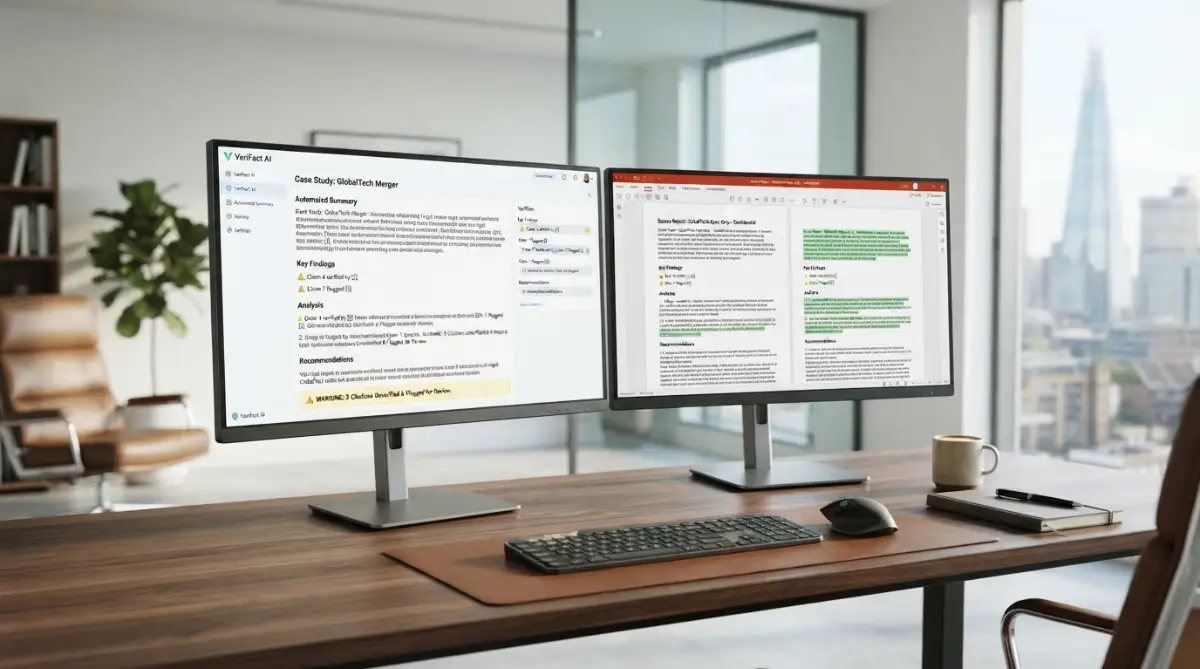
I almost lost my biggest business client because I trusted an AI assistant that sounded way smarter than me. It handed me clean graphs, confident market stats, and a completely fabricated regulatory footnote that never existed on this planet. If your team uses language tools to draft reports without a strict safety net, you are walking through a minefield of polished lies every single day. Here is how I learned to stop trusting the smooth talk and build an airtight fact-checking system that actually works.
I decided to double-check a single footnote that cited a major regulatory body's quarterly report. When I searched the agency's official database, that report did not exist at all. The author name was real, the publication date matched an official holiday, and the quoted percentage was pure fantasy.
Cold sweat broke out across my forehead. My team was less than eight hours away from presenting complete fiction to our board of directors. If I had simply trusted that smooth, confident tone, my professional reputation would have vanished by sunrise.
That terrifying night changed the way I look at smart software tools forever. Large language models do not know what the truth is; they only know how to sound believable. When these tools make up facts, they do it with such flawless grammar that your brain naturally drops its guard.
Clients call you out on numbers that do not match reality. Colleagues spend hours chasing ghost references and fabricated case studies. That silent panic turns your daily workday into an exhausting game of digital hide-and-seek, draining your peace of mind and burning out your best people.
Fast Summary: How to Keep AI Research Honest
- Never let a chat session audit itself. Always paste generated claims into a brand-new window with zero prior chat history.
- Lock the model inside your own data by pasting the raw files into the prompt and banning outside guesses.
- Test every single web link and footnote manually; automated tools assemble likely words, not actual facts.
- Treat smart assistants like brand-new interns: welcome their speed, but never put their work in front of clients without a human sign-off.
Why Smart Models Sound So Honest While Making Things Up
To stop bad data from sneaking into your documentation, you must understand what happens behind the screen. These smart assistants do not possess common sense or an internal fact engine. They are statistical pattern prediction engines trained to string together words that look mathematically appropriate.
When a model encounters a gap in its knowledge base, it does not throw an error code. Instead, it predicts the next most likely word based on billions of public text examples. If a made-up company name or a fictional statistic sounds grammatically plausible, the model outputs it without hesitation.
This creates what engineers call an illusion of competence. The generated sentences flow smoothly, the tone sounds authoritative, and the formatting looks spotless. Yet, beneath that shiny surface lies an unverified guess that can derail a business deal.
The table above outlines the most common traps waiting inside unvetted research drafts. Notice that phantom citations carry a high risk because they look like legitimate scholarly work. Data drift is even more dangerous because a single shifted decimal point can alter an entire quarterly budget forecast.

The Three-Tier Source Verification Blueprint
You cannot rely on simple eye-balling when checking automated drafts. You need a structured, mechanical workflow that strips away guesswork and forces the model to prove its claims. Here are three grounded steps you can add to your daily documentation routine right now.
Anchor Prompts to Closed Information Loops
The simplest way to stop a model from wandering off into fantasy is to lock it inside a fenced sandbox. Never ask a language model an open-ended question about industry facts without providing the raw reference material inside the prompt.
Paste your raw customer interview transcripts, balance sheets, or policy PDFs directly into the workspace. Then, explicitly order the tool to draw its answers solely from the text you supplied.
Tell the tool: "Use only the provided text to answer the following question. If the answer is not explicitly written in the source text, state clearly that the information is missing." This simple restriction cuts down false claims immediately because the software no longer needs to fill in the blanks using random external patterns.
Enforce Verbatim Quotation Protocols
When you request summaries, demand that the system supply direct, word-for-word quotes for every assertion it presents. Do not accept broad overviews or paraphrased ideas for important metrics.
When the tool must identify an exact snippet from your source files, it grounds its reasoning in actual text tokens. If the system cannot find a matching sentence to quote, it reveals that the assertion was hollow from the start.
Once the draft is ready, run a basic word search across your master document to confirm the quote exists. If the quote matches your source word for word, you know the underlying point holds weight. If the quote is missing or slightly altered, flag that paragraph for manual review immediately.
Separate Generation from Auditing
Never ask the same conversation thread to write a report and then fact-check itself. Once a model commits to a fictional detail in a chat thread, it treats that falsehood as established context for all following responses.
If you ask the same chat session, "Are you sure this metric is true?", it will often invent a second lie to justify the first one. It wants to remain coherent with its past outputs.
Instead, open a fresh, clean chat window with no prior history. Paste the generated claim alongside your raw background documents, and instruct the new instance to act as a neutral auditor. This breaks the confirmation bias loop and exposes hidden flaws instantly.
Watch this comprehensive breakdown of automated data validation workflows to see these step-by-step verification methods in action.
The Cross-Examination Method for Secondary Research
When your team gathers competitive research or industry trends, you often do not have an internal document to paste into the prompt. In these situations, you must treat every output like testimony from an unvetted witness in a courtroom.
The Prosecutor-Judge Review Protocol
Assign distinct roles to two separate tool instances. The first tool acts as your primary researcher, generating competitive summaries, market size estimates, and feature comparisons.
Take that output and pass it to a second tool set up with an entirely different base prompt. Tell this second instance: "You are an aggressive corporate auditor looking for unsupported claims, statistical inconsistencies, and false sources in this brief."
The second instance scans the text through a skeptical lens. It marks ambiguous statements, highlights dubious claims, and flags vague assertions. You then step in as the final human judge to resolve only the flagged items, saving your mental energy for where it matters most.
Auditing URLs and Reference Footnotes
Language models are notoriously bad at producing real web addresses. They often piece together common domain names with realistic-sounding URL slugs that lead straight to 404 error pages.
Every single link in your draft documentation must be clicked and verified before sending the file to an external partner. If a link breaks, search for the exact title of the referenced whitepaper using a reliable search engine.
If no search engine can find the study, the author, or the publication, purge that claim from your draft entirely. A single dead citation can cause an enterprise client to question the honesty of your entire proposal.
I learned this the hard way while putting together a competitive pricing sheet for our SaaS product. I let an unchecked citation slip into an internal deck, thinking the link looked official enough to skip manual testing. My manager clicked it during a live review, only to land on an expired domain selling spam products. That simple oversight taught me to click every single link before sharing a document with anyone.
Building Safe Guardrails into Documentation Systems
Businesses cannot depend on individual employees remembering to verify every single sentence. You need systematic guardrails built directly into your writing and documentation workflows.
Here is the exact linear verification chain your team should follow:
- Stage 1 (Output Creation): Review the baseline generated brief for general structure and readability.
- Stage 2 (Ground Truth Audit): If source files exist, match claims directly against internal records. If external research is used, run independent search queries and test every web address.
- Stage 3 (Precision Scrub): Confirm that all cited numbers and direct quotes match raw documents word for word. Any unsupported metric is rejected or manually rewritten.
- Stage 4 (Final Sign-Off): Pass the cleaned document to a neutral colleague who verifies critical facts before granting official approval.
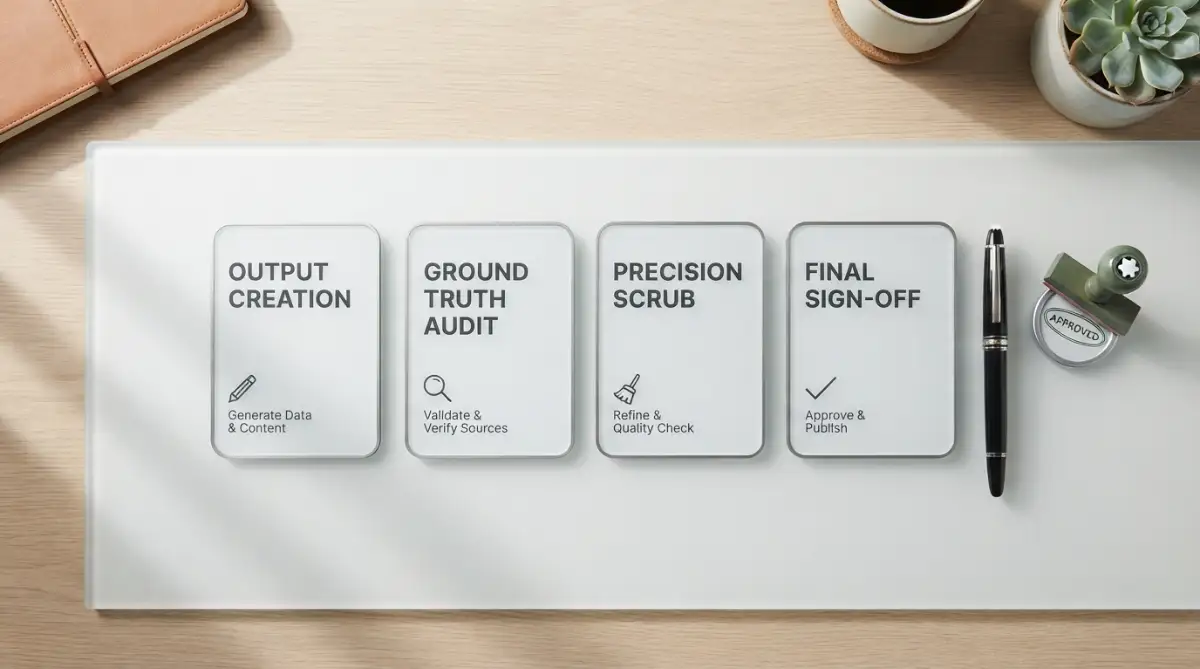
The simple workflow outlined above creates an easy-to-follow safety filter. It forces your team to confirm the origin of every claim before the document moves to the next desk.
Lower the Randomness Settings
If your business tools allow you to adjust underlying parameters, take advantage of the temperature slider. Temperature controls how creative or unpredictable the tool's word choices will be.
For creative writing, brainstorms, or marketing hooks, higher settings work nicely. However, for business documentation, contract summaries, and research briefs, you want the lowest setting possible.
Setting the temperature close to zero makes the model choose the most predictable, conservative words available. This significantly reduces wild guesses, keeps statements consistent, and produces more grounded, factual text.
Myth vs. Reality: The Temperature Setting
- Myth: Dragging your temperature down to zero guarantees 100% accurate facts.
- Reality: Temperature only controls word variety, not honesty. An AI running at zero will simply repeat the exact same fabricated number every single time with complete confidence. You still have to check the primary source yourself.
The Myth of Fully Automated Fact-Checking
Many software vendors claim their platform can autonomously fact-check complex reports without any human help. This is one of the most misleading myths in the software industry today.
An automated tool can search databases and match keywords, but it cannot evaluate business context, intent, or nuanced risks. A machine does not know if a slightly misquoted line will trigger a compliance review from your legal department.
Automated checkers should serve as your preliminary sorting mechanism, not your final approval step. Use software to catch obvious red flags, but always reserve the final green light for a skilled human reviewer who understands your company's standards.
Practical Human-in-the-Loop Verification Checklists
Every business team needs an ironclad checklist printed out or pinned to their project management boards. Before any research brief, client deliverable, or technical guide is approved, it must pass through four distinct checkpoints:
- The Entity Audit: Confirm that every named company, executive, product feature, and agency mentioned in the draft actually exists in the real world.
- The Math and Metrics Scrub: Pull out every number, growth percentage, and dollar figure into a quick scratchpad and match it directly against original source data.
- The Fresh Eye Read-Through: Have a team member who was not involved in prompting the software read the final output to catch subtle logic inconsistencies that the primary writer might overlook.
- The Provenance Log: Keep a shared record of where every key statistic came from, ensuring that your team can defend every slide and paragraph during high-stakes presentations.
Treating automated tools like junior interns rather than seasoned directors protects your brand from unforced errors. You would never send an unreviewed draft written by a brand-new trainee directly to your executive board without reading it first. Give your automated assistants that exact same healthy level of critical review.
When you apply these structured verification protocols, your business research becomes faster without sacrificing accuracy. You gain the speed of modern automation while keeping the airtight credibility that your clients and leadership team expect. Accuracy is never an accident; it is the natural result of disciplined habits and sensible review systems.
Deep Verification Tactics for High-Stakes Documentation
You need advanced protocols that systematically expose hidden model assumptions before a document reaches an executive inbox. Implementing these methods creates an active defense against the subtle errors that standard proofreading misses.
Multi-Step Chain Verification Workflows
One of the strongest ways to dismantle fabricated claims is a method researchers call chain verification. Instead of accepting an extended output all at once, you break down the research generation into distinct operational phases.
First, you instruct the software to produce the baseline draft based on your initial prompt. Once the draft is generated, you do not immediately review the prose for style or formatting.
Instead, you demand that the tool extract every individual factual statement into an isolated list of standalone claims. By stripping away narrative fluff, each metric, name, and timeline date stands entirely on its own.
Next, you force the system to generate a specific verification question for each individual item on that list. For instance, if a sentence claims a market segment expanded by forty percent, the verification question asks what specific ledger recorded that jump.
Finally, you run those individual questions against your verified company knowledge base or raw survey spreadsheets. This multi-step process isolates wild assertions that slip through when you read full paragraphs as a whole.
To make this seamless across your team, mastering prompt engineering for beginners get the best AI content helps staff structure these verification chains without confusion.
The Reverse Citation Pressure Test
A major weakness in automated research tools is their habit of inventing source titles to satisfy user queries. To expose this trick, you can apply what data analysts call reverse citation pressure.
When a tool hands you a statistic paired with a footnote, ask the tool to summarize the methodology of that exact cited document. Inquire about the sample size, the survey collection window, and the primary author credentials.
If the original footnote was fabricated, the system will quickly contradict itself or generate bizarre, conflicting secondary details. The moment the underlying story begins to wobble, you know the original reference never existed.
You can also run automated cross-referencing against trusted academic repositories like the arXiv research archives or official government databases. If an author name appears nowhere in peer-reviewed indexes, strike the claim from your company records immediately.
My 60-Second Reality Check for Any Cited Paper:
- Copy the full title into Google Scholar inside exact quotation marks.
- If nothing shows up, search the lead author alongside their stated university department.
- If both queries hit dead ends, delete the whole paragraph immediately. Never waste your afternoon trying to defend a ghost source.
Semantic Uncertainty Probing
Language models generate text based on mathematical probability distributions over words. When a system is confident about a fact, the statistical variance across multiple prompt runs remains extremely narrow.
When an engine is fabricating an answer, its internal certainty drops, causing the wording to shift wildly between attempts. You can exploit this weakness using semantic uncertainty probing.
Submit the exact same business research query five separate times in five clean workspace windows. Keep your prompt wording identical across each run, and do not provide leading hints.
Compare the specific numbers, dates, and names provided in each of the five independent outputs. If three runs show completely different market growth rates, you are witnessing an active hallucination.
Stable facts will stay consistent across multiple tries, while pure hallucinations will mutate with every click of the generate button. This simple check takes less than two minutes and saves hours of downstream correction.
Building Private Knowledge Sandboxes
If your team routinely generates internal documentation, you must build secure boundaries around your data inputs. Allowing public tools to pull from open web indexes invites random internet rumors straight into your technical briefs.
Modern teams increasingly connect their documentation engines to private databases using retrieval-augmented setups. This ensures the generative software only looks at vetted internal policy documents, signed vendor agreements, and verified product specifications.
When setting up these internal repositories, teams must maintain strict standards for protecting proprietary data risk management strategies for teams using generative AI tools. Keeping sensitive files partitioned prevents data leakage while grounding the output in certified business truth.
Establishing these internal technical boundaries aligns closely with the official recommendations published in the NIST AI Risk Management Framework. Following established safety frameworks helps your organization avoid expensive compliance penalties and operational embarrassments.
Maintaining clean training inputs also supports your frontline staff when you how to train AI chatbots for customer support without losing the human touch. Clean data inputs ensure your automated support agents never quote fake refund policies or wrong warranty timelines to angry buyers.

Costly Traps That Catch Most Business Teams Off Guard
Even smart professionals fall into dangerous traps when working with automated documentation assistants. The biggest risk is not that the software makes mistakes, but that human teams become lazy reviewers over time.
Recognizing these common operational traps will protect your business from costly public corrections, lost client contracts, and ruined internal credibility.
Falling for the Fluency Trap
The most common human mistake is equating linguistic fluency with factual accuracy. Human brains naturally associate clear, polished grammar with high intelligence and honesty.
When a software assistant outputs a beautifully balanced paragraph complete with professional jargon, our natural skepticism drops. We subconsciously assume that clean syntax implies thorough fact-checking.
In reality, language models excel at writing style long before they master factual precision. A completely fictional market projection can be written in the exact same confident tone as a Nobel prize winning paper.
Never let beautiful formatting distract your team from running hard data checks. Always strip away the adjectives and isolate the core numbers before signing off on any deliverable.
The Confirmation Bias Loophole
Team members often use automated tools to hunt for evidence that supports an existing opinion. If an analyst wants to prove that a new product feature will succeed, they ask the software to supply supporting industry data.
Language models are built to please the user, which means they happily produce data points that match your prompt expectations. If you ask for numbers showing industry expansion, the model will prioritize text patterns that confirm that expansion, even if the overall market is shrinking.
This dynamic generates echo chambers of bad research that can trick company leadership into poor investments. Teams must actively train in essential AI literacy skills every digital marketer needs to master for workflow automation to avoid this confirmation bias.
Prompt your tools to find counter-arguments, contradicting studies, and downside risks for every major business proposal. Actively seeking disconfirming evidence is the best way to uncover hallucinations before your competitors expose them.
Over-Automating the Audit Process
Another dangerous trap is relying on a secondary software tool to fully audit the work of your primary software tool. While automated filters catch basic syntax errors, they lack real-world business context.
A secondary software auditor will not know that a proposed vendor delivery date conflicts with your company holiday schedule. It will not realize that a quoted pricing tier violates an existing non-disclosure agreement with a partner.
When teams remove human judgment from the final review loop, bad data compounds silently across multiple document drafts. Over time, your shared company wikis become polluted with self-referential errors that nobody remembers how to trace.
This unchecked content decay explains the real reason your AI content workflow isn t ranking on Google across competitive search queries. Search algorithms and sharp business buyers both penalize thin, unverified text that lacks authentic human observation.
Essential Rules for Daily Business Research
To keep your research operations safe, share these clear operational rules across your entire department:
- Do not allow unverified software drafts to enter public slide decks, client emails, or regulatory filings.
- Do require team members to include direct reference links to primary source material for every factual claim.
- Do not assume an official-looking document title exists until an analyst confirms the link opens a legitimate host page.
- Do institute mandatory peer reviews for any research brief that influences company budgeting or legal positioning.
- Do not rely on automated summaries when analyzing complex financial disclosures or binding contracts.
- Do treat software outputs as a rough first draft that requires disciplined human editing and verification.
Reviewing these points in weekly team meetings builds a culture of personal accountability. When everyone understands the limits of automation, data quality stays consistently high.
A Reliable Action Plan for Tomorrow Morning
You do not need to overhaul your entire company infrastructure overnight to improve documentation standards. Real change happens through small, steady adjustments to your daily research routines.
Start by designating a primary source folder for every active research project on your team calendar. Before anyone opens an automated writing tool, ensure that folder contains verified source materials like official press releases, audited financial reports, or industry whitepapers.
Instruct your team to feed only those vetted documents into their writing assistants. Banning open-ended, unanchored web prompts for official documentation will immediately eliminate the majority of phantom citations.
Next, implement a simple peer verification swap for all important documents. Have an analyst spend ten minutes cross-checking numbers in a colleague draft against the original source folder.
This peer review step creates mutual accountability and catches simple oversights before they cause embarrassment. Over time, this discipline becomes second nature, allowing your business to move fast without losing its reputation for reliable accuracy.
Independent research groups, such as the Stanford Center for Research on Foundation Models, continue to demonstrate that human oversight remains the gold standard for catching system errors. Embracing that reality gives your organization a massive competitive edge over teams that trust machine outputs blindly.
I used to think fact-checking automated text was a tedious chore that slowed down my weekly workflow. Once I put these simple verification habits into practice, my confidence soared because I knew every number on my slides was solid. You have the tools and the blueprints right in front of you, so make strict verification your team superpower starting today.
Helpful Answers on Fact-Checking Business AI
Can automated tools ever completely stop making up false facts?
Current language software works through statistical word prediction rather than factual comprehension, meaning hallucinations cannot be fully eliminated by code alone. You can minimize false claims through grounded prompts and closed source data, but disciplined human review will always remain necessary for high-stakes business documentation.
What is the fastest way to check if a cited study actually exists?
Copy the full title of the study and the primary author name directly into a dedicated academic index or a major search engine wrapped in quotation marks. If the search returns zero exact-match results, the citation was almost certainly fabricated by the software pattern engine.
How does lowering software temperature reduce false statements?
Temperature controls the randomness of the model word choices during generation. Lowering the setting toward zero forces the software to select the most statistically conservative words, which restricts wild creative guesses and produces far more consistent factual text for business reports.
Should businesses ban automated writing tools to protect data accuracy?
Banning modern software tools puts your company at a speed disadvantage compared to industry peers who use automation effectively. The right strategy is to adopt strict fact-checking protocols, ground prompts in verified internal sources, and maintain rigorous human review before publishing any research brief.
Important Disclaimer
The information presented in this guide is intended solely for educational, workflow optimization, and informational purposes. While modern automated tools and fact-checking protocols significantly reduce data inaccuracies, large language models are inherently prone to probabilistic errors and statistical hallucinations. Business organizations must perform independent due diligence, legal reviews, and financial audits before relying on automated outputs for commercial, financial, or regulatory decisions. The author and publisher assume no liability for business losses, reputational harm, or regulatory issues arising from the implementation of these suggested verification workflows.