
The Breaking Point: When Hard Work Simply Fails You
You spent hours staring at a textbook, feeling completely ready for your big test. Then, the timer starts, and your brain just deletes everything. It sucks, right? I know exactly how that sudden panic feels. But trust me, your memory is not broken—you are just using it wrong. Let's fix that right now.
But when the invigilator said to begin, my mind went completely empty. I felt a cold sweat on my neck as I realized I could not remember a single formula.
The pain of putting in so many hours only to fail was completely crushing. My self-esteem hit rock bottom, and I seriously thought I just was not smart enough to pass.
This silent struggle is something so many of us face every single day. You sacrifice your sleep, your hobbies, and your social life, hoping it will pay off on the big day.
Instead, you are left with endless brain fog and a heavy sense of panic. This daily anxiety completely destroys your mental peace and makes learning feel like a terrible punishment.
The worst part is that you are probably making the exact same invisible mistakes I was making. We force our brains to work in ways they simply were not built to handle.
Quick Takeaways for Better Grades:
- Ditch the neon highlighters and start testing yourself from memory instead.
- Keep your phone in another room to stop wasting mental energy on constant distractions.
- Sleep is never optional—it is the exact moment your brain saves what you just learned.
- Build a dedicated study spot that instantly tells your brain it is time to work.
Rewiring Your Brain for Maximum Retention
Have you ever read an entire chapter only to forget the very first page by the time you finish? Why does our brain betray us when we need it the most?
The simple truth is that your memory is not broken or defective. Your daily routine is simply working against your natural biology.
We often confuse the feeling of being busy with the feeling of actually learning something. Just because you are sitting at a desk for six hours does not mean your brain is actively absorbing the material.
The Trap of Passive Highlighting
Most students love buying colorful highlighters to mark up their textbooks. We paint the pages bright yellow and pink, thinking we are saving the most important facts for later.
However, science tells us a completely different story about this popular method. Highlighting creates a dangerous illusion of competence inside your brain.
When you read a beautifully highlighted page, your brain recognizes the information because it is right there in front of you. You mistake this simple recognition for deep, long-term understanding.
But recognition is not the same as recall. If I ask you to close the book and explain the concept to me, you will likely stumble over your words.
This is exactly like watching someone else ride a bicycle and thinking you are suddenly an expert cyclist. You have to actually pedal the bike yourself to learn how to balance.
Instead of just coloring your books, you need to force your brain to dig for the answers. This process of pulling information out of your head is what actually builds strong neural pathways.
Quick Comparison: Are You Actually Studying?
| What You Are Doing | What Your Brain Thinks | A Much Better Alternative |
| :--- | :--- | :--- |
| Highlighting entire pages | "I'm just coloring. This is easy!" | Writing out key points on a blank paper from memory. |
| Re-reading the same chapter | "I've seen this before, I must know it." | Taking practice quizzes to find weak spots. |
| Watching a friend solve math | "Wow, that makes total sense." | Solving the problem completely by yourself. |
Pro Tip for Better Retention: I used to think highlighting every single line made me remember things better. But my biggest realization came when I swapped my neon markers for a simple piece of blank paper and started writing completely from memory. It was uncomfortable at first, but it completely changed my exam scores.
Forcing Your Brain into Active Recall
If reading is a passive activity, then active recall is your ultimate weapon against forgetting. Active recall simply means testing yourself before the actual exam does.
When you finish reading a page, close the book and ask yourself what you just learned. Try to explain the main idea out loud as if you are teaching a five-year-old child.
If you want a visual breakdown of how this active recall method actually works in real time, watch this quick and highly helpful video.
When you struggle to remember a detail during this self-test, your brain flags that information as highly important. The next time you check the book for the correct answer, it will stick in your memory much stronger.
Using flashcards is one of the easiest ways to build this habit into your daily routine. You look at a question, search your memory for the answer, and then verify if you were right.
The Hidden Cost of "Productive" Multitasking
We live in an era where everyone thinks they can do three things at once. You probably have your textbook open, your favorite music playing, and your phone resting right next to you.
You might feel incredibly productive, but your brain is secretly suffering from a massive energy drain. The human brain physically cannot focus on two complex tasks at the exact same time.
What you are actually doing is called context switching. Your attention rapidly jumps back and forth between your study notes and the text message you just received.
Every time you shift your focus away from your studies, it leaves behind something called attention residue. A small part of your brain is still thinking about that funny meme your friend sent you.
It takes an average of twenty minutes to regain your complete focus after a single interruption. If you check your phone three times in an hour, you have essentially wasted the entire study session.
To fix this, you need to hide your phone in a completely different room while you work. When the temptation is physically out of reach, your focus will naturally improve.
Starving Your Brain of the Rest Phase
There is a famous culture among students that glorifies staying awake all night to study. We consume endless cups of coffee and force our tired eyes to stay open until the sun comes up.
This is arguably the most destructive habit you can possibly have before a major exam. Sleep is not a luxury; it is a fundamental requirement for making your memories permanent.
Think of your short-term memory as a small holding area for information. Throughout the day, every single thing you read gets dumped into this temporary storage space.
If you do not sleep, this holding area becomes completely full, and your brain starts throwing away new information. You are basically pouring water into a glass that is already overflowing.
When you enter the deep stages of sleep, your brain acts like an organized librarian. It takes the facts from the temporary holding area and files them away securely in your long-term memory.
Cutting your sleep short by even two hours severely interrupts this natural filing process. You might study for ten hours, but without proper sleep, you will only remember a tiny fraction of it.
Real-Life Reality Check: I once tried surviving on three hours of sleep before a huge history final. My brain felt like a foggy mess, and I forgot names I had known perfectly for weeks. Science actually shows that going 24 hours without sleep makes your brain act like you are legally drunk. You would never take a test drunk, so stop taking tests sleep-deprived!
The Disaster of the Last-Minute Cram
We have all experienced the sheer terror of opening a textbook just two days before a massive test. You try to force an entire semester of knowledge into your head over a single weekend.
Cramming might help you pass a quick quiz the next morning, but it is terrible for true retention. Within a week, almost all of that forcefully packed information will disappear from your mind completely.
Your brain learns best when it is exposed to the same information over a long period of time. This concept is scientifically known as spaced repetition.
You have to water the plant a little bit every single day so it can absorb the nutrients slowly. Your brain handles new data in the exact same biological way.
Reviewing your notes for twenty minutes every day is incredibly more effective than studying for ten hours straight. It gives your mind the breathing room it needs to strengthen those fragile connections.
Studying in the Wrong Environment
Where you choose to study plays a massive role in how much information you actually retain. Many students love to study while lying comfortably in their warm beds.
The problem is that your brain strongly associates your bed with sleeping and deep relaxation. The moment your head hits the pillow, your body naturally begins to power down.
You will find yourself struggling to keep your eyes open, no matter how interesting the subject matter is. Even worse, studying in bed can eventually ruin your sleep quality because your brain gets confused about what the bed is for.
You need to build a dedicated zone that your brain instantly associates with high focus. It does not need to be fancy; a simple desk and a straight chair will work perfectly.
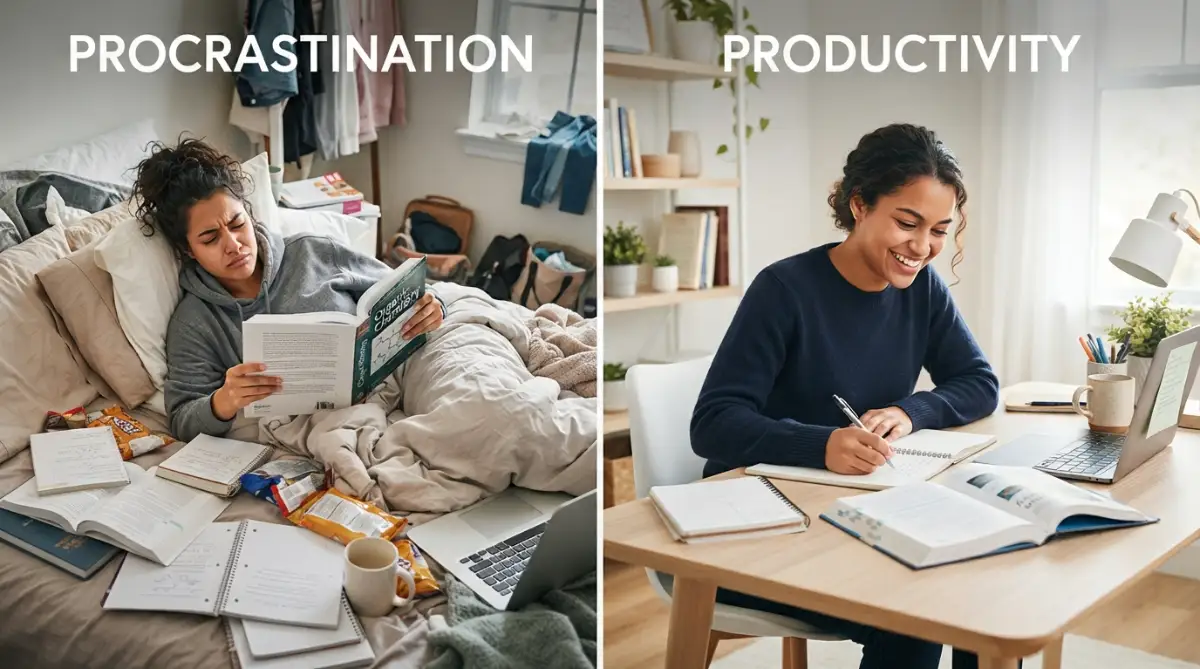
When you sit down at this specific desk, your brain receives a clear signal that it is time to work. Over time, you will find it much easier to drop into a state of deep concentration automatically.
Myth vs Reality: Breaking the Bad Rules
There is a lot of terrible advice floating around the internet about how to study properly. Let us clear up some of the most common misunderstandings right now.
By simply understanding these realities, you are already steps ahead of most students. It is all about working smarter and respecting how your body naturally operates.
The Sugar and Caffeine Rollercoaster
What you put into your body directly impacts how much information your brain can process. Before a big test, it is incredibly common to survive on sugary snacks and energy drinks.
These drinks give you a massive burst of artificial energy that makes you feel invincible for about an hour. Your heart races, and you feel ready to conquer the entire textbook in one sitting.
However, this temporary spike is always followed by a brutal crash. Suddenly, your brain fog returns worse than before, and your eyelids feel incredibly heavy.
Your brain consumes a huge amount of energy when it is trying to learn complex subjects. It needs steady, reliable fuel like water, healthy fats, and protein to keep functioning smoothly.
Instead of reaching for that third cup of coffee, try drinking a large glass of cold water. Staying hydrated is one of the easiest and fastest ways to banish that afternoon sluggishness.
The Fear of Making Mistakes
One of the biggest reasons we stick to passive reading is because it feels incredibly safe. When we simply read a book, we never have to confront the uncomfortable reality of being wrong.
Testing yourself with practice questions is scary because it exposes your weak points. Nobody likes looking at a test paper filled with red marks and incorrect answers.
But making mistakes during your practice sessions is exactly how rapid learning happens. Every time you get a question wrong, you are given a clear map of what you need to focus on next.
You must embrace the discomfort of struggling through a difficult math problem or a complex essay. That momentary frustration is just the feeling of your brain stretching and growing stronger.
Start taking mock exams seriously, and treat them as a friendly guide rather than a strict judge. The more mistakes you make at home, the fewer mistakes you will make on the actual exam day.
Redesigning Your Daily Routine
Changing your habits will not happen overnight, and that is perfectly okay. You have spent years studying a certain way, so it will take a little time to adjust to a better system.
Start by choosing just one bad habit from this list to eliminate this week. Maybe you decide to finally leave your phone in the kitchen while you read your next chapter.
Once that feels easy, you can start incorporating ten minutes of active recall at the end of your study sessions. Small, consistent changes are much easier to stick to than completely destroying your current routine.
Always remember to be highly patient with yourself during this adjustment period. The goal is progress, not absolute perfection.
Your memory is an incredibly powerful tool when you finally learn how to use it correctly. Stop fighting against your own biology, and watch how much easier your next exam season becomes.
Master-Level Strategies for Unbreakable Memory
Let us talk about the exact methods top-tier students use to lock information into their brains. They do not just study harder; they study with a clear intention and a strategic plan. You can easily adopt these pro-level secrets to make your memory nearly bulletproof.
One of the most effective techniques you can use is something called interleaved practice. Instead of studying one single subject for five hours straight, you mix different topics together in a single session. This forces your brain to constantly adjust its thinking, which builds much stronger mental flexibility.
If you want to understand the deep science behind this method, Stanford University offers excellent insights on how interleaving improves long-term learning. When you mix up your subjects, your brain naturally learns how to connect completely different ideas.
It is exactly like physical training at the gym for an athlete. You would never work out just your arms for an entire month while completely ignoring the rest of your body. Your brain needs that same well-rounded workout to perform at its absolute best.
Another incredible secret is teaching the material out loud to an imaginary audience. Stand up in your room, grab a whiteboard if you have one, and pretend you are giving a lecture to a group of beginners. When you speak the words out loud, you immediately notice the hidden gaps in your own understanding.
If you stumble over a specific concept, that is your immediate signal to go back and review the textbook. You cannot explain something simply if you do not understand it deeply yourself. This method alone will completely transform how you approach your daily study sessions.
Let us also talk about managing your mental stress during a heavy exam season. Sometimes, the biggest block to your memory is not the textbook, but real-life worries dragging you down. For example, if you are constantly worrying about money or wondering what to do right now if you can't make your car payment, your brain simply will not focus.
Financial stress or personal problems eat up a massive amount of your active working memory. Getting your outside life organized and peaceful is just as important as organizing your study notes. In fact, ignoring these hidden mental drains is similar to the silent reasons your personal loan application gets rejected every time; the real problem is happening entirely behind the scenes.
You must protect your mental space fiercely before a major test. If a friend asks for a huge favor that causes you unnecessary anxiety, you have to politely say no. You would definitely read this before you endorse a student loan for anyone because of the risk, so you should be just as protective with your limited study time.
To keep your brain sharp, you also need to fully optimize your physical environment. Natural sunlight and fresh air can dramatically improve your daily cognitive function. The National Institutes of Health explains how proper light exposure regulates your circadian rhythm, leading to significantly better focus and memory retention.
Let me share a quick scenario to explain how you should structure your study blocks. Imagine you sit down to study organic chemistry for three straight hours without stopping. The first thirty minutes feel completely fine, but by hour two, you are just staring blankly at the wall.
Your brain operates in natural energy cycles and desperately needs small, scheduled breaks to process new data. Try using the Pomodoro technique, where you focus intensely for twenty-five minutes and then walk away for five. During that five-minute break, do not look at another screen or check your social media.
Stretch your legs, drink a large glass of water, or just close your eyes and breathe for a moment. This brief pause acts like a mental reset button for your fragile attention span. It completely prevents the mid-afternoon burnout that destroys so many productive study sessions.
Always remember that building these new habits is a gradual and sometimes messy process. You might find yourself slipping back into old routines, and that is completely normal. Just gently guide yourself back to these active learning methods without feeling any unnecessary guilt.

The Dangerous Traps Destroying Your Exam Scores
Let us pivot and talk about the specific mistakes that are actively sabotaging your hard work. So many well-meaning students fall into these terrible traps because they simply look so productive from the outside. But inside your brain, these habits are causing massive damage to your memory.
The first major trap is relying entirely on group study sessions without preparing beforehand. Studying with your friends can be helpful, but only if you have already reviewed the material alone in your room. If you show up with zero knowledge, you will just nod along while the smartest person in the room does all the talking.
This creates a very dangerous and false sense of security. The American Psychological Association details how the illusion of competence tricks your brain into feeling falsely prepared when you watch others work. You leave the library thinking you understand the subject, but you were just a passive spectator.
It is exactly like reading life insurance terminology explained the ultimate beginner's guide and suddenly thinking you are a licensed broker. When you finally sit down for the actual exam, your friends will not be there to guide you through the tricky questions. You will stare at the paper and realize you never actually learned how to do it yourself.
Another terrible pitfall is treating every single fact in your textbook as equally important. Not all information is created equal, and trying to memorize every tiny detail will instantly overload your memory. This is a lot like debunking common myths about debt consolidation loans and credit scores; you absolutely have to separate the real facts from the useless noise.
You need to identify the core concepts first and build your basic understanding around them. Once that main foundation is completely solid, you can start adding the smaller details on top. If you try to memorize the complex details before understanding the big picture, the information will just fall apart.
We also need to seriously address the danger of digital distractions disguised as study aids. You might think you are researching a topic on your laptop, but suddenly you are watching unrelated comedy videos. An entire hour slips by, and you have absolutely nothing to show for your time.
Your daily willpower is a highly limited resource, and it gets weaker as the day goes on. Do not rely on pure willpower to keep you away from social media apps. Use website blockers to completely remove the digital temptation while you are trying to work.
Taking dangerous shortcuts when trying to understand difficult topics is another massive mistake. When you skip over a complicated chapter hoping it will not be on the test, you are gambling with your academic future. This kind of negligence is exactly like the secret fine print in travel policies that costs you thousands; the very thing you ignore always comes back to hurt you.
The emotional toll of these repeated mistakes is genuinely heartbreaking to witness in dedicated students. They convince themselves they are simply bad at a subject and completely give up on their biggest dreams. They change their majors or drop out of difficult classes just because they were using the wrong study techniques.
Imagine putting countless hours of effort into a project, only to watch it collapse because you used the wrong tools. That quiet frustration builds up over time and completely destroys your natural love for learning new things. Do not let these easily fixable mistakes steal your academic confidence away.
You must take full control of your learning environment and be brutally honest about what is not working. If a specific habit is consistently resulting in low scores, you have to be brave enough to drop it completely. Clinging to familiar but useless routines out of comfort is the absolute fastest way to fail.
Your Personal Blueprint for Academic Confidence
We have covered a lot of ground today, and I know changing your entire routine can feel a bit overwhelming at first. But you do not have to fix absolutely everything before tomorrow morning. The most powerful transformations happen when you make tiny, consistent adjustments to your daily life.
Start by taking a clear, honest look at your current study schedule and your desk setup. Pick just one of the master-level strategies we discussed and test it out for a single week. Maybe you decide to swap your colorful highlighters for blank flashcards, or you finally start protecting your sleep schedule.
Once you see your memory begin to actually improve, you will naturally feel motivated to try the next step. Success always creates its own positive momentum, and soon these new habits will feel completely effortless. You will actually start looking forward to testing your own knowledge because you know you are prepared.
Remember, academic success is not about being the smartest person in the room from day one. It is about being the most strategic and protecting your mental energy at all costs. Having a clear plan is just as comforting as the honest guide to filing a property damage claim without the stress; knowing exactly what to do removes all the anxiety.
You are fully capable of understanding complex topics and retaining that knowledge for the long haul. Your brain is an incredibly adaptable machine that just needs the right kind of fuel and proper direction. Stop punishing yourself with bad methods and start working in harmony with your natural biology.
I truly believe that once you implement these small shifts, your next exam season will feel completely different. I used to cry over my textbooks, feeling completely hopeless and exhausted by my own bad habits. But the day I finally threw away my passive reading routines, my grades—and my confidence—completely skyrocketed, and yours will too.
Common Questions About Fixing Your Study Routine
How many hours a day should I actually study?
You do not need to sit at your desk for ten hours to be a highly successful student. Three to four hours of highly focused, active recall will always beat a full day of distracted reading. It is completely about the quality of your focus, not the ticking clock on the wall.
Does listening to instrumental music help with memory?
Instrumental music is definitely better than songs with loud lyrics, but it still requires some brain processing power. If you are studying something extremely complex, complete silence is usually your absolute best option. However, soft background noise can help calm your racing thoughts if you feel overly stressed.
Why do I always go blank during the actual test?
Going completely blank is usually a symptom of severe test anxiety combined with passive learning habits. When your brain is stressed, it shuts down access to your memory banks to focus on surviving the immediate panic. Practicing mock exams in a timed, quiet environment at home helps train your brain to stay calm under pressure.
Is it too late to change my habits if my exam is next week?
It is never too late to start using better techniques, even if your test is just a few short days away. Switching to flashcards and practice questions right now will instantly boost your retention compared to just re-reading your old notes. Just focus heavily on active recall and make absolutely sure you get enough sleep the night before.
Disclaimer: The information provided in this blog post is for educational and informational purposes only and should not be considered professional academic, psychological, or medical advice. Always consult with a qualified educational counselor, therapist, or healthcare provider regarding severe test anxiety, chronic stress, or specific learning disabilities.