
The Shocking Reality of Fighting Insurance Companies
You pay your auto insurance premiums every single month without fail, thinking you are fully protected. Then a bad crash happens, and suddenly, you are holding a cold rejection letter instead of a check to fix your car. It feels like a massive slap in the face. Let me show you exactly why insurance adjusters secretly deny perfectly good claims and how you can outsmart them to get the money you deserve.
That specific moment of panic is exactly what thousands of innocent drivers experience every single week. You play by the rules, pay your heavy monthly premiums on time, and expect the insurance company to have your back when disaster strikes. But the harsh truth is that insurance companies are massive businesses focused heavily on protecting their profits.
Every dollar they pay out to you is a dollar they lose from their massive bottom line. Because of this, insurance adjusters are highly trained to look for any legal excuse to reduce your payout or throw your case out entirely.
Before We Go Further, Keep These Quick Survival Rules In Mind:
- Stop apologizing at the crash scene—adjusters will use your good manners against you.
- Go to a doctor on the exact same day of the accident to lock in your medical evidence.
- Keep your social media accounts totally private until your settlement check clears the bank.
- Never give a recorded phone statement to the other driver's insurance company.
The Secret Playbook: Why Adjusters Send That Dreaded Denial Letter
If you want to protect yourself and your family, you need to understand exactly how the other side thinks. Insurance adjusters are not necessarily bad people, but they follow a very strict corporate playbook designed to find flaws in your story. Let us break down the exact logical reasons why they legally reject perfectly valid cases.
Trap 1: The Innocent Apology at the Crash Scene
Right after a loud, terrifying crash, your adrenaline is pumping like crazy. Human nature naturally makes us want to make sure everyone is okay and avoid conflict. Because of this, you might step out of your smashed car and automatically say, "I am so sorry, I didn't even see you."
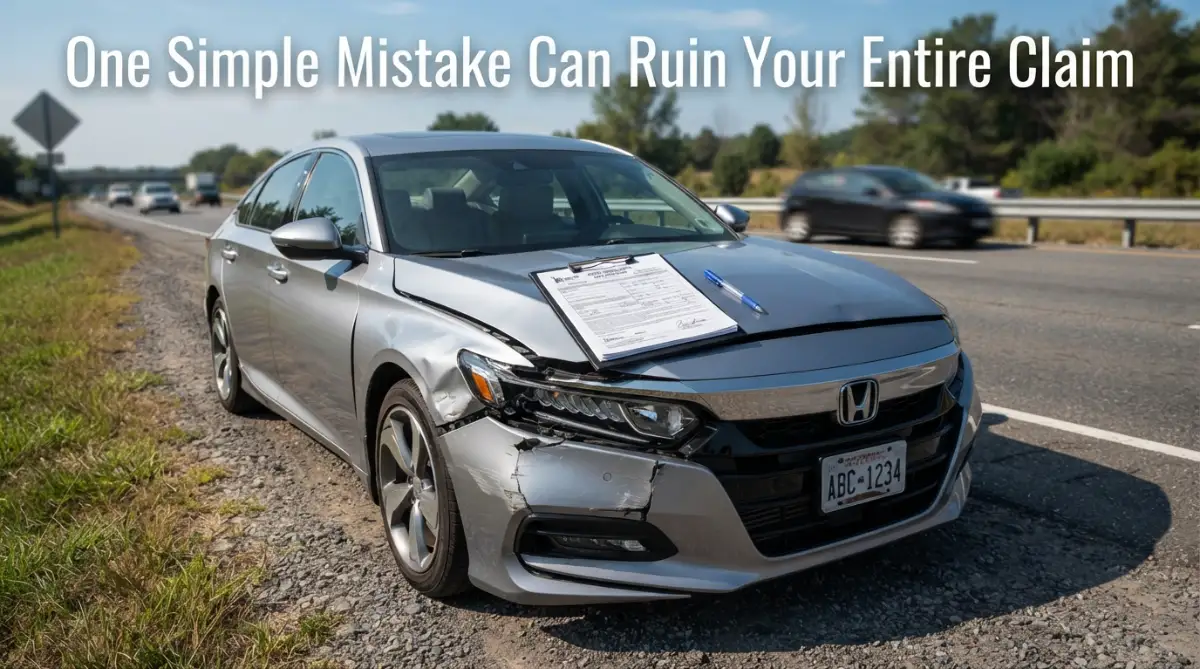
That single word "sorry" is absolute gold for an insurance adjuster. They will immediately use that polite apology against you to argue that you admitted fault for the entire collision.
Even if the other driver ran a stop sign and hit you, saying sorry gives the adjuster legal room to deny your payout. You must remember that the side of the road is not the place to be overly polite or discuss who is to blame. Simply exchange your basic information, call the police, and let the official accident report speak for the facts.
Quick Legal Reality Check:
Did you know that in many states, just saying "I am sorry" can be legally documented as an "Excited Utterance" by the police? This means the insurance adjuster can use your simple politeness as hard proof of guilt. If you want to protect your wallet, stick to asking, "Is everyone okay?" and wait quietly for the officers to arrive.
Trap 2: Delaying Your Medical Treatment
This is probably the most common mistake that ruins perfectly good settlements. After a crash, you might feel a little stiff but think you just need a good night of sleep to feel better.
You decide to wait a few days, hoping the neck pain or shoulder ache will magically go away on its own. When the pain finally becomes unbearable a week later, you finally decide to visit a doctor.
To an insurance adjuster, this gap in time is a massive red flag that they will exploit. They will argue that if you were truly hurt in the accident, you would have gone to the emergency room immediately.
They might even claim that you injured your neck doing something else during that one-week gap, like lifting a heavy box at home. To protect your rights, always get a full medical evaluation on the exact same day of the crash, even if you feel perfectly fine.

The Adrenaline Trap (What Doctors Want You To Know):
When a heavy car hits you, your brain floods your body with adrenaline. This natural chemical acts like a powerful painkiller and can completely hide a severe neck or back injury for up to 48 hours. I always tell my friends to go straight to an urgent care clinic right after a crash. Getting a doctor's note on day one destroys the adjuster's chance to say you got hurt somewhere else.
I completely messed up my own case by waiting four days to see a doctor because I thought my back pain was just minor soreness. I quickly learned that adjusters use any delay to accuse you of faking your injuries. My simple mistake gave the insurance company the exact ammunition they needed to initially reject my medical bills.
Trap 3: The Danger of the Recorded Statement
Within a few days of your accident, a very friendly sounding adjuster from the other driver's insurance will call you. They will ask how you are doing and request to record a quick statement just to clear up some basic facts.
Do not fall for this friendly routine. The main goal of a recorded statement is to lock you into a story before you fully understand the extent of your injuries.
They will ask tricky, leading questions designed to confuse you and make you give inconsistent answers. If you say "I am doing okay" as a polite greeting on the phone, they will use that recording to prove you are not actually injured.
Watch exactly how an expert breaks down this sneaky tactic in the video below so you know how to fight back.
Trap 4: The Social Media Betrayal
We all love sharing our daily lives, family trips, and happy moments on social media platforms. But when you are involved in an active insurance dispute, your Facebook and Instagram accounts become open hunting grounds for adjusters.
They actively hire investigators to monitor your online presence to find anything that contradicts your injury claims.
Let us say you claim to have a severe back injury from the crash that prevents you from working. A week later, your friend tags you in a smiling photo at a weekend barbecue holding a light cooler. The adjuster will print out that single photo, put it in your file, and formally deny your bodily injury claim.
They will boldly argue that a truly disabled person would not be out partying and lifting objects. During any active legal dispute, you should set all your profiles to completely private and stop posting entirely. Never assume that the insurance company is ignoring your digital footprint.
Myth vs. Reality: Understanding the Adjuster's True Role
There are a lot of dangerous myths floating around about how the claims process actually works. Understanding the difference between fact and fiction can literally save you thousands of dollars.
Myth: The insurance adjuster is assigned to help you get the maximum amount of money to fix your car.
Reality: The adjuster is an employee of a massive corporation, and their primary job performance is rated by how much money they save the company.
Myth: If the police report says the other driver is at fault, the insurance company has to pay you automatically.
Reality: Police reports are helpful, but insurance companies do their own private investigations. They can and will disagree with a police officer's opinion to avoid writing a check.
Myth: The first settlement offer they give you is the best they can possibly do.
Reality: The initial offer is almost always a lowball amount designed to see if you are desperate enough to take quick cash.
Trap 5: The "Pre-Existing Condition" Excuse
If you have ever had a medical issue before your accident, prepare yourself for a difficult fight. Adjusters love to blame your current pain on old injuries or past medical records.
If you hurt your lower back playing sports five years ago, they will dig up those old records. When you claim your back was injured in the recent car crash, they will instantly point to your past sports injury.
They will confidently state that the car accident did not cause your pain, and therefore, they are not legally responsible for paying your hospital bills. This is a very frustrating tactic because it forces you to prove that the new crash made your old condition significantly worse.
You need your current doctor to write a very detailed report explaining how the recent impact caused fresh trauma to your body. Without strong medical evidence separating the old injury from the new one, your chances of getting paid are incredibly low.
Trap 6: Failing to Understand Your Own Policy
Sometimes, the reason for a rejection has nothing to do with the accident itself, but rather the fine print in the contract. Many drivers have no idea what their actual coverage limits are until it is way too late.
For example, you might be hit by a driver who has absolutely no insurance at all. If you never specifically added "Uninsured Motorist Coverage" to your own policy, your own company will deny your request for help.
They will simply state that you did not purchase the specific product required for that exact scenario. Another common shock comes from rental car coverage.
People assume their policy will pay for a rental car while their main vehicle is sitting in the repair shop. If you did not pay the extra few dollars a month for rental reimbursement, the adjuster will quickly deny that expense.
How to Talk to Insurance Representatives Without Ruining Your Case
The words you use when speaking to any insurance representative matter more than you can possibly imagine. A simple conversation can easily turn into a legal trap if you are not carefully choosing your vocabulary.
Think of speaking to an adjuster like talking to a lawyer in a courtroom; everything is being noted. You should never guess or estimate facts like how fast you were going or the exact distance of the cars.
If you do not know the exact answer to a question, the only correct response is "I am not sure." Guessing leaves room for the adjuster to prove you are an unreliable witness to your own crash.
Here is a quick visual breakdown of what you should strictly avoid saying, and what you should say instead to protect your rights.
Trap 7: Missing Strict Deadlines and Paperwork Errors
The legal system and insurance industry operate on very strict timelines and rigid paperwork rules. Every single state has a specific time limit, known as a statute of limitations, for filing an injury lawsuit.
If you miss this deadline by even a single day, your right to demand money is gone forever. But beyond state laws, the insurance policy itself has secret deadlines buried in the complex contract terms.
Some policies strictly require you to report the crash to them within a specific number of days. If you wait too long to notify your own insurance company, they can legally deny coverage for the entire event.
Furthermore, filling out the official claims forms incorrectly can trigger an automatic administrative rejection from their software system. A misspelled name, a wrong date, or missing medical codes can cause the computer to throw your file in the trash. You must treat every single document with extreme care, double-checking every box before you sign your name.
The Role of Sneaky Evaluation Software
Many people imagine a human adjuster carefully reading their file and deciding on a fair amount of money. The chilling truth is that most major insurance companies rely on complex computer software programs, like Colossus, to evaluate your pain.

These rigid software programs are specifically designed to minimize human empathy and strictly focus on cold data. The adjuster simply types your medical billing codes into the computer, and the software spits out a low settlement range.
If your doctor did not use the exact proper medical codes to describe your severe muscle spasms, the computer will ignore them. The software does not care that you missed your daughter's graduation because you were confined to a hospital bed.
It only cares about hard medical data, x-rays, and specific legal terminologies. This means your fight is not just against a human adjuster, but against an algorithm designed to save the corporation money. Knowing how to legally outsmart this software requires submitting perfectly documented, overwhelming medical evidence.
Mastering the Claims Game: Insider Strategies to Protect Your Payout
Fighting an insurance denial often feels like playing a high-stakes chess match against a grandmaster. The adjuster already knows all the standard moves, so you have to step up your game to beat them. You cannot simply rely on the truth to win your case; you need hard, documented evidence.
One of the most effective strategies is treating your accident recovery like a strict part-time job. This means keeping a detailed, daily "Pain and Impact Journal" from the very first day of the crash. You should write down exactly how your injuries stop you from doing basic, everyday tasks.
Instead of just saying your back hurts, document that you could not bend over to tie your own shoes on a Tuesday morning. Note the exact times you had to skip playing with your children or missed a family dinner because of a severe migraine. When an adjuster reads highly specific, emotionally grounded details, they have a much harder time rejecting your suffering.
You also need to heavily prepare for the "Independent Medical Examination" (IME), which is a massive trap. The insurance company will legally force you to see a doctor they pay directly to evaluate your injuries. This doctor is definitely not your friend, and their main goal is to find reasons to say you are perfectly healthy.
During this exam, every single thing you do is being watched and judged from the moment you park your car. If you complain about severe knee pain but hop out of your truck with no problem, that doctor will write it down. You must be completely honest about your pain, but never exaggerate or perform physical tests that you know will hurt you. To better understand how your rights are protected during these mandatory exams, reviewing consumer resources provided by the National Association of Insurance Commissioners can be incredibly helpful.
Another secret weapon is learning how to gather your own aggressive evidence outside of the standard police report. If your crash happened near a gas station or a busy intersection, go back to the scene immediately. Look for security cameras on nearby buildings and kindly ask the business owners for a copy of the footage.
Many businesses delete their camera footage every few days, so acting fast is your best defense against a denied claim. Having actual video proof of the other driver running a red light completely destroys any argument the adjuster tries to make. You take away all their power when you hand them a video that shows exactly what happened.
You also need to learn how to manage your finances quietly while the insurance company drags their feet. Adjusters will intentionally delay your payout for months, hoping you get desperate enough to accept a tiny amount of money. If your vehicle is totaled, you might suddenly find yourself wondering what to do right now if you can't make your car payment while waiting for the settlement.
Building a small emergency fund or working with a trusted local mechanic for delayed billing can give you breathing room. The less desperate you look financially, the more power you hold at the negotiation table. They want you to panic, so staying calm and financially stable is your best form of revenge.

The Heartbreaking Blunders That Destroy Solid Cases
When you are drowning in medical bills and physical pain, making a simple mistake is entirely human. Unfortunately, the insurance industry shows absolutely zero mercy for these common human errors. One small slip-up can leave your family facing totally unexpected financial ruin.
The most devastating mistake people make is cashing the very first check the insurance company sends them in the mail. After a crash, you might receive a check for five hundred dollars with a note saying it is for your initial inconvenience. You are behind on bills, so you happily deposit that money into your bank account without thinking twice.
What you did not realize is that the back of that check had tiny legal text acting as a "Release of Liability." By signing and cashing that small check, you legally agreed to close your entire case permanently. You completely lost your right to ask for the remaining ten thousand dollars you actually needed for your upcoming physical therapy.
Another massive pitfall is signing a blank medical authorization form provided by the other driver's insurance adjuster. They will tell you this form is simply needed to verify your emergency room visit from the crash. But if you read the actual document, it often gives them the right to pull your entire medical history since birth.
They will dig through decades of your private health records looking for any old injury they can blame for your current pain. You should only ever authorize them to see medical records directly related to the exact date of your accident. Giving them unlimited access to your health history is like handing a thief the keys to your house.
I have seen so many innocent drivers accidentally ruin their lives by trusting the wrong people during a dispute. Some folks try to borrow massive amounts of money to cover their hospital bills, ignoring the long-term damage to their financial health. If you are ever forced to look for outside funding to survive a denied claim, you must be extremely careful. Taking a few minutes to read up on debunking common myths about debt consolidation loans can stop you from making a bad situation worse.
We also need to talk about the dangers of talking to the wrong people about your ongoing case. You might feel the urge to vent to your co-workers or neighbors about how much money you are demanding from the insurance company. Adjusters have been known to hire private investigators to interview people in your neighborhood about your daily activities.
If a grumpy neighbor tells the investigator they saw you carrying heavy groceries, your entire bodily injury claim could be thrown in the trash. Keep your legal business completely private and only discuss the details of your accident with your immediate family or legal representative. Staying quiet is the smartest thing you can possibly do.
Failing to understand official deadlines is another silent killer of perfectly valid accident claims. The law gives you a strict window of time to officially file a lawsuit, which varies wildly depending on where you live. If you miss this deadline, known as the statute of limitations, a judge will throw your case out, no matter how badly you were hurt. You can research general legal timelines through trusted legal hubs like the American Bar Association, but never assume you have unlimited time.
Many people assume that simply negotiating with the adjuster pauses this legal countdown clock. The insurance company will happily keep talking to you for months, completely aware that your deadline is approaching. Once that clock strikes zero, they will stop answering your calls because they legally owe you nothing.
Lastly, do not hide previous accidents from your own legal team or the medical doctors treating you today. People often lie because they are scared that a past fender bender will somehow ruin their current settlement. The insurance company already knows everything about your past driving record because they share massive national databases.
When you get caught lying about a past accident, you instantly destroy your credibility as a witness. The adjuster will argue that if you lied about your past, you are probably lying about your current injuries too. Always tell the full truth to your doctors so they can properly document why this new crash caused fresh, unrelated pain.
Your Action Plan to Outsmart the Insurance Industry
Taking on a massive insurance corporation might seem like an impossible mountain to climb, but you hold more power than you realize. The entire system is built on the assumption that you will get confused, tired, and eventually give up. By simply understanding their sneaky tactics, you immediately level the playing field and protect your family.
Start by organizing every single piece of paper related to your crash into a dedicated folder today. Keep a physical copy of your police report, all medical receipts, and printed screenshots of any emails from the adjuster. When the insurance company realizes you are highly organized and keeping strict records, they are much less likely to try dirty tricks.
Never forget that an initial denial letter is not the end of the road; it is simply the beginning of the negotiation. They want you to read that rejection letter, feel completely defeated, and walk away quietly. You have the absolute right to appeal their decision, demand a supervisor, or hire a professional to fight back on your behalf.
If your car is badly damaged and you are struggling with finances while fighting this battle, do not panic. Many people face sudden financial roadblocks when a settlement is delayed, leading them to look for alternative funding. Just make sure you understand the rules of borrowing, especially understanding why personal loans get rejected, so you don't add banking stress to your accident trauma.
You deserve to be fairly compensated for the pain, suffering, and property damage caused by someone else's negligence. Stay incredibly patient, refuse to be bullied over the phone, and let your solid medical evidence do the heavy lifting for you.
My own battle with an insurance denial taught me that standing up for yourself is always worth the effort. I almost gave up when they rejected my first medical bill, but choosing to fight back ultimately saved my family from massive debt. You absolutely have the strength to demand exactly what you are owed, so take a deep breath and start building your case today.
Smart Answers to Your Biggest Insurance Worries
Can an insurance company deny a claim if the police say I am not at fault?
Yes, they absolutely can. Insurance companies conduct their own private investigations and are not legally forced to agree with a police officer's opinion. They might find a small detail the officer missed and use it to argue you share some of the blame.
What happens if I was hit by someone who doesn't have any insurance?
If the at-fault driver has no coverage, you will have to rely on your own policy's "Uninsured Motorist" coverage to pay your bills. If you never added this specific protection to your plan, you might have to sue the driver personally to get your money.
How long does an adjuster legally have to respond to my claim?
State laws require insurance companies to process claims in a "reasonable" amount of time, usually between 15 to 40 days. However, they can legally pause this clock if they send you a letter requesting more specific information or extra medical documents.
Should I let the other driver pay me cash instead of using insurance?
Accepting cash at the scene of a crash is an incredibly bad idea for your future health and finances. You might feel fine today, but if you wake up tomorrow with severe back pain, that cash will never cover the massive hospital bills.
Why is the insurance company asking for my social media passwords?
Adjusters want to dig through your private photos and messages to find anything that proves you are not actually injured. You should absolutely never give them your passwords, and you should set all your accounts to completely private immediately after an accident.
Disclaimer: The information provided in this article is for educational and informational purposes only and does not constitute formal legal, medical, or financial advice. Insurance policies and local laws vary significantly by state and country. Always consult with a qualified attorney or licensed insurance professional regarding the specific details of your personal injury claim or insurance dispute before making any major legal decisions.