Why You Cannot Simply "Calm Down" (And How I Finally Found Peace)
Has anyone ever told you to "just take a deep breath" when you're on the verge of a meltdown? If you're like me, that advice probably made you want to scream. You can't just think your way out of a racing heart or a tight chest because your body's alarm system is physical, not logical. Let me show you how to actually hit your internal emergency brake using a hidden physical switch you already have.
Why does this happen to us? Are we just broken? The truth is, your body is doing exactly what it was designed to do to keep you safe.
When your brain senses danger, even if that danger is just an angry email from your boss, it floods your body with adrenaline. You get stuck in "fight or flight" mode. But the real tragedy is that nobody ever taught us how to turn this alarm system off. We walk around all day with our internal sirens blaring, wondering why we cannot focus or digest our food properly.
This is exactly why telling someone to just cheer up never works. You cannot simply think your way out of a physical stress response. You have to speak to your body in a language it actually understands.
Quick Takeaways: How to Actually Calm Down
- Your stress response is a physical reaction; you cannot logic your way out of it.
- The vagus nerve acts as your body's built-in brake pedal for immediate anxiety relief.
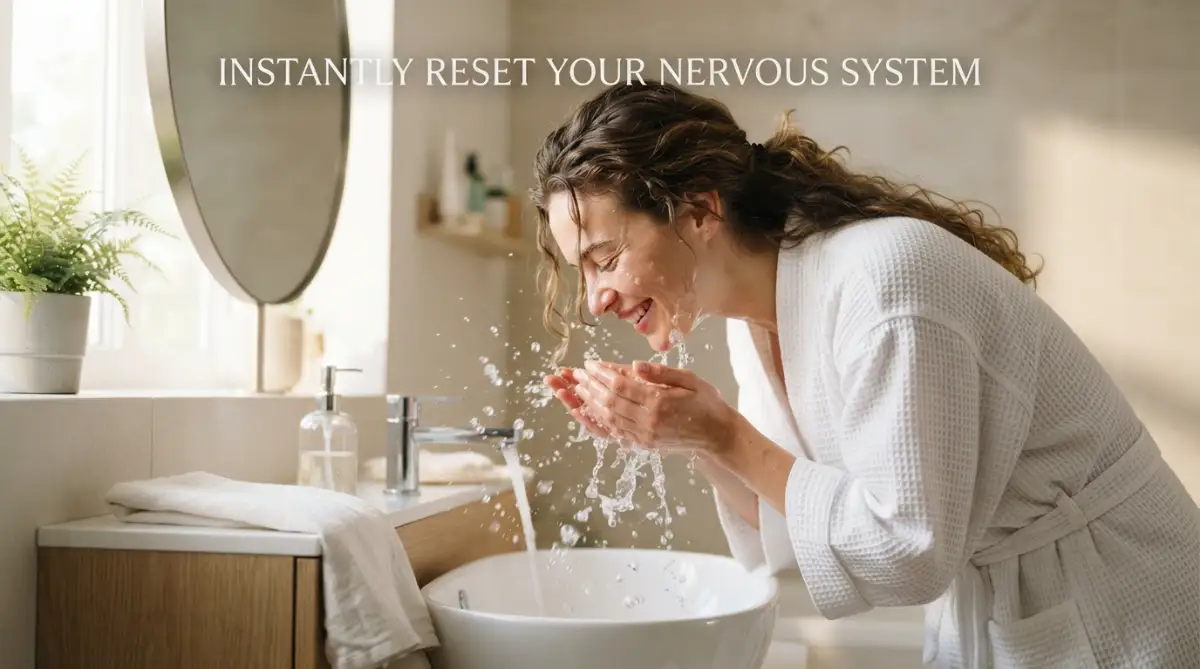
- Splashing cold water on your face drops your heart rate instantly via the mammalian dive reflex.
- Making your exhales longer than your inhales forces your nervous system to power down.
Understanding the Built-In Reset Button Inside You
Before we look at the specific exercises, you need to understand the basic mechanics of your own body. Inside you right now, there is a superhighway of nerves connecting your brain to your stomach, your heart, and your lungs.
This superhighway is known as the vagus nerve. It is the longest cranial nerve in your body. Think of it as the ultimate communication channel between your mind and your organs.
When you are stressed, your sympathetic nervous system takes over. This is your internal gas pedal. It speeds up your heart and makes your breathing shallow.
On the other hand, your parasympathetic nervous system is your internal brake pedal. It slows things down, helps you digest food, and tells your brain that you are safe.
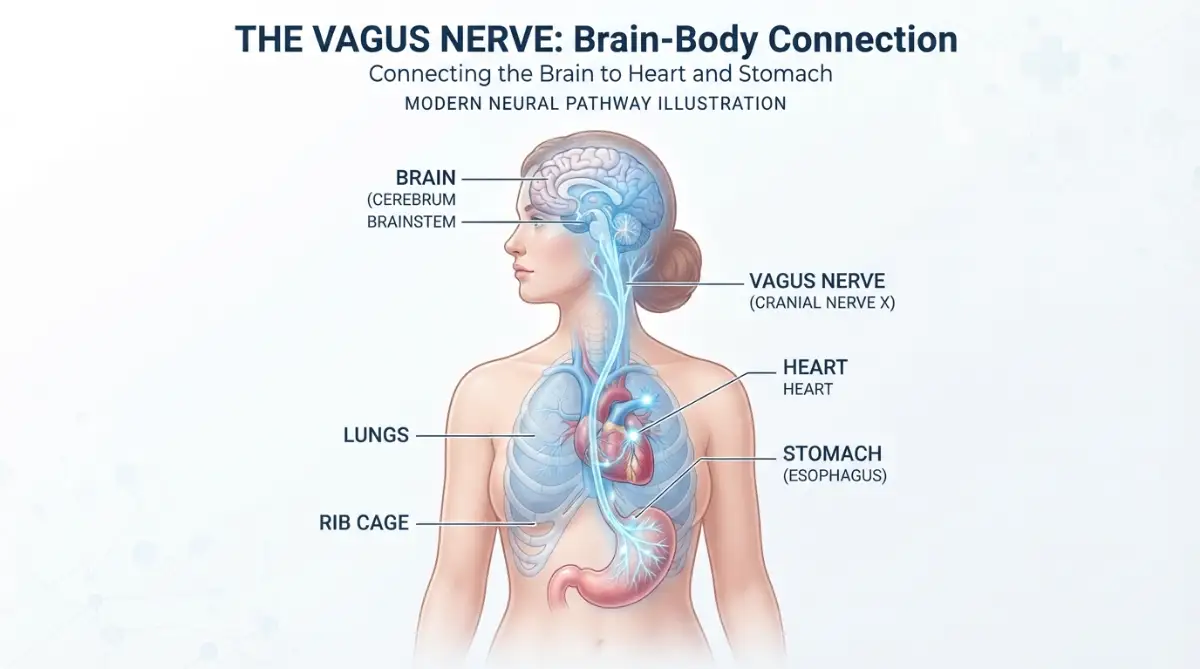
The vagus nerve is the main physical cable that controls this powerful brake pedal. By learning how to activate it, you can manually override your stress response.
Here is a quick look at how your body shifts gears:
Now that you know how the system works, let us look at exactly how to pull the emergency brake when you feel overwhelmed.
Cold Water Exposure: A Shock That Brings Instant Calm
One of the absolute fastest ways to stimulate your vagus nerve is through sudden temperature changes. Your body has a built-in reflex called the "mammalian dive reflex."
When cold water hits your face, especially around your cheeks and eyes, your body instantly assumes you are diving underwater. To conserve oxygen, your brain sends a massive signal through your vagus nerve to immediately slow down your heart rate.
You do not need to take a full ice bath to get these amazing benefits. You can do this easily in your own bathroom.
First, fill your sink with very cold water, and toss in a few ice cubes if you have them. Hold your breath and submerge your face in the water for about ten to fifteen seconds.
If dipping your face feels too intense right now, there is an easier modification. Just grab an ice pack wrapped in a thin towel. Hold it directly over your eyes and the top of your cheeks for one minute.
You will notice an almost immediate drop in your heart rate. It feels like a sudden wave of physical relief washing over your shoulders. This is a perfect trick to use right before a stressful public speaking event or a difficult meeting.
Deep Belly Breathing: The Fastest Way to Signal Safety
Most of us breathe completely wrong when we are anxious. We take short, sharp breaths high up in our chest. This shallow breathing actually tells your brain that a predator is chasing you.
To reverse this, you must change the mechanics of your breathing. The vagus nerve runs right through your diaphragm, which is the muscle sitting just below your lungs.
When you expand your belly to breathe, you massage this nerve physically. This sends a direct message to your brain that everything is perfectly fine.
Watch this incredibly helpful breakdown of how to breathe properly to instantly shift your nervous system into a state of deep calm.
The most effective method is called the 4-7-8 breathing technique. It is simple enough that you can do it sitting at your desk or waiting in line at the grocery store.
Start by exhaling completely through your mouth with a whooshing sound. Then, close your mouth and inhale quietly through your nose while counting silently to four.
Make sure your belly pushes outward like a balloon. Keep your chest perfectly still.
Next, hold your breath for a count of seven. Finally, exhale completely through your mouth, making a whooshing sound, for a full count of eight.
The long exhale is the secret ingredient here. Extending your exhale longer than your inhale is what actually flips the switch in your nervous system. Try doing this for just four breath cycles and notice how different your body feels.
My Personal "4-7-8" Troubleshooting Guide:
- Problem: I feel dizzy while breathing. -> Fix: You are blowing out too hard. Make your exhale extremely soft, like blowing air through a tiny straw.
- Problem: I can't hold my breath for 7 seconds. -> Fix: Speed up the count in your head (1-2-3-4), don't stress over actual clock seconds.
- Problem: My chest keeps moving up and down. -> Fix: Put one hand on your belly. Actively push your belly out against your hand when you breathe in.
Humming and Chanting: Creating Internal Vibrations
Your vagus nerve is directly connected to your vocal cords and the back of your throat. Because of this connection, you can literally vibrate your way into a calmer state of mind.
Have you ever wondered why traditional meditation often involves chanting a long "Om" sound? It is not just a spiritual practice; it is deeply rooted in human biology.
When you hum, sing, or chant, the vibrations in your throat physically stimulate the vagus nerve. This is why singing along to your favorite song in the car feels so incredibly good after a hard day at work.
I used to think that humming to relieve stress sounded totally ridiculous, so I completely ignored this advice for years. My biggest mistake was judging the technique before trying it, but once I started taking two minutes to hum deeply in the shower every morning, I noticed a huge drop in my daily anxiety levels.
To try this yourself, sit comfortably and take a deep breath in through your nose. As you slowly exhale, make a low, deep humming sound.
Try to make the sound resonate in your chest and the back of your throat. Keep the hum going until you are completely out of air.
Repeat this for about three to five minutes. You can do this with your favorite song, or just make a simple buzzing sound like a bee. The lower the pitch, the stronger the physical vibration will be.
Gentle Neck Massage: Releasing Hidden Tension
We carry massive amounts of stress in our neck and shoulder muscles. When these muscles get tight, they can actually restrict the space around your vagus nerve.
By manually releasing this physical tension, you free up the nerve to do its job properly. You do not need to hire a professional massage therapist to get these benefits.
You can perform a simple somatic release technique right on your own couch. Start by sitting up straight and dropping your shoulders down away from your ears.
Take your right hand and place it softly on the left side of your neck, just under your earlobe. Gently rub your fingers down the side of your neck towards your collarbone.
Do not press too hard. The vagus nerve responds best to light, soothing touches. Repeat this soft downward stroke ten times on the left side.
Then, switch hands and do the exact same motion on the right side of your neck. As you do this, you might suddenly feel the urge to yawn, sigh, or swallow.
Do not suppress these natural reactions. Yawning and swallowing are clear physical signs that your nervous system is finally shifting out of survival mode.
The "Half-Salamander" Eye Movement Technique
This next technique sounds a bit strange, but it is heavily backed by science. Your eye movements are deeply connected to the state of your nervous system.
When you are scanning a room for danger, your eyes dart around quickly. By intentionally moving your eyes in a specific way, you can force your body to relax.
Stanley Rosenberg, an expert in craniosacral therapy, developed a very simple eye exercise to engage the vagus nerve. It takes less than two minutes to complete.
Lie down comfortably on your back. Interlock your fingers and place both of your hands directly behind your head, resting the weight of your skull in your palms.
Keep your head perfectly still, pointing straight up at the ceiling. Now, without turning your head at all, look as far to the right as you comfortably can with just your eyes.
Hold your eyes in that far-right position. Wait patiently until you feel an involuntary sigh, a yawn, or a swallow. This usually takes about thirty to sixty seconds.
Once you feel that physical release, bring your eyes back to the center. Then, repeat the exact same process by looking to the far left.
Many people find that their stiff neck magically loosens up right after doing this simple eye movement. It is a powerful reminder that our brain and body are entirely connected.
Bilateral Stimulation: Tapping Your Way to Peace
Bilateral stimulation is a fancy term for alternating rhythmic movements between the left and right sides of your body. This concept is often used in trauma therapy to help process difficult emotions.
Why does tapping actually work? It is not magic. It is a biological process called "working memory taxation." When you focus on alternating left and right taps, your brain simply does not have enough processing power left to keep running your anxiety loop. The physical movement literally crowds out the panic.
When you tap the left and right sides of your body rhythmically, you force the left and right hemispheres of your brain to communicate. This cross-brain communication acts like a natural tranquilizer for an overactive mind.
The easiest way to do this is called the "Butterfly Hug." Cross your arms directly over your chest, so your right hand is resting on your left shoulder, and your left hand is resting on your right shoulder.

Close your eyes and take a very slow, deep belly breath. Now, begin tapping your shoulders alternately. Tap the left shoulder, then the right shoulder, left, right, left, right.
Keep a slow, steady rhythm, much like a resting heartbeat. Continue this alternating tapping for a full two minutes.
As you tap, imagine the physical stress slowly draining down your arms and out through your fingertips. This simple tapping trick is perfect for when you feel paralyzed by a sudden wave of panic.
Myth vs. Reality: Clearing Up Common Misconceptions
When people first learn about these physical body hacks, they often get confused by all the conflicting information online. Let us clear up a few common misunderstandings right now.
Myth: You have to meditate for an hour a day to see any real benefits.
Reality: Short, frequent moments of stimulation are actually much better. Doing a two-minute breathing exercise three times a day is highly effective and much easier to stick to.
Myth: If a technique does not work instantly the very first time, it is a scam.
Reality: Your nervous system is like a muscle. If you have been highly stressed for ten years, your vagal tone might be a bit weak. It takes consistent daily practice to build that tone back up.
Myth: You only need to do these exercises when you are having a panic attack.
Reality: The best time to practice these tools is when you are already feeling somewhat calm. By practicing during peaceful moments, you train your body to remember the pathway back to safety when a real crisis hits.
Learning to manage your internal alarms takes time and patience. You are essentially teaching your body a brand new language of safety.
Whenever you feel the tension creeping up into your jaw and shoulders, remember that you are not powerless. You have a highly advanced system built directly into your anatomy, just waiting for you to activate it.
Start by picking just one of these simple methods today. Maybe try splashing some cool water on your face before lunch, or practice the extended exhale while driving home. Small, consistent actions will eventually lead to massive changes in how you handle everyday pressures.
Beyond the Quick Fix: Building Long-Term Nervous System Resilience
Learning a few fast techniques to calm down is a great starting point. But if you want to experience true, lasting peace in your daily life, you need to think a little bigger.
You need to focus on improving something called your "vagal tone." Think of your nervous system exactly like a muscle in your body.
When you first go to the gym, lifting a ten-pound weight might feel incredibly heavy and difficult. But if you practice lifting that weight every single day, it eventually becomes effortless.
Your ability to handle stress works the exact same way. High vagal tone means your body acts like a car with excellent shock absorbers.
You will still hit bumps in the road, like a rude comment from a coworker or a sudden traffic jam. However, because your internal shock absorbers are strong, those bumps will not cause you to completely crash.
Your body will recognize the stress, process it safely, and return to a calm baseline almost immediately.
So, how do we build these strong internal shock absorbers for the long run? It all starts with understanding the hidden conversations happening inside your own body.
The Hidden Connection Between Your Stomach and Your Mind
Most people think of the brain as the ultimate boss that tells the rest of the body what to do. But when it comes to the vagus nerve, the communication actually goes the other way around.
This major nerve is essentially a massive biological information highway. Interestingly, about eighty percent of the traffic on this highway travels from your stomach up to your brain.
Your digestive system is constantly sending status updates to your mind. If your stomach is inflamed or unhappy, it sends emergency signals straight up to your brain.
This is exactly why you might feel highly anxious for absolutely no logical reason. Your mind is simply reacting to the physical alarm bells ringing in your gut.
Because of this, what you put on your plate directly impacts your daily anxiety levels. Eating highly processed foods or consuming excessive amounts of sugar creates physical stress inside your digestive tract.
If you want to maintain a calm mind, you must pay attention to how your meals affect your body. Making simple changes to stabilize blood sugar fast can dramatically reduce the false alarm signals sent to your brain.
For a deeper scientific look into how this works, you can explore detailed studies on the gut-brain communication pathways published by the National Institutes of Health.
When you heal your gut, you automatically calm your mind. They are two halves of the exact same system.
The Healing Power of Authentic Social Connection
We are biologically wired to feel safe when we are surrounded by trusted people. When you engage in a warm, friendly conversation, you activate a specific part of your nervous system called the ventral vagal complex.
This is the ultimate state of safety and connection. Have you ever noticed how talking to a good friend over a cup of coffee makes your heavy thoughts feel instantly lighter?
That is not just a psychological trick; it is a profound physical shift inside your body. Eye contact, a warm smile, and the soothing tone of someone’s voice literally tell your brain that you are out of danger.
In our modern society, we spend way too much time staring at screens and not enough time looking at human faces. This extreme isolation keeps our internal alarms on high alert.
Make it a daily habit to seek out real face-to-face interactions, even if it is just a friendly chat with the cashier at the grocery store. Laughing out loud is especially effective because it engages the vocal cords and the diaphragm all at once.
If you want to keep your internal alarms quiet, you cannot do it entirely alone. Your nervous system deeply craves the reassuring presence of other calm humans.
My Personal Pro Tip: I used to isolate myself completely whenever I felt overwhelmed, thinking I just needed quiet time to recover. What I eventually realized is that forcing myself to call a funny friend for just ten minutes completely reset my mood, proving that laughter really is the fastest biological hack for a stressed nervous system.
Rethinking How You Sleep and Rest
You might be getting eight hours of sleep, but if you wake up feeling completely exhausted, your nervous system is likely still working overtime. The physical position you sleep in can actually influence your vagus nerve.
Sleeping on your right side is often highly recommended for nervous system regulation. This specific position opens up your airways and takes the physical pressure off your heart.
When your heart does not have to work as hard to pump blood, your brain assumes you are in a safe, resting state. On the other hand, poor sleep habits act like a slow poison to your mental peace.
Lack of deep rest is one of those unexpected daily triggers that are secretly disrupting your hormonal balance. When your hormones are out of whack, your stress levels naturally skyrocket.
To improve your overnight recovery, try doing a slow breathing exercise right before you close your eyes. This signals to your body that the stressful events of the day are officially over.
The Harvard Medical School offers excellent insights into how triggering the relaxation response before bed can dramatically improve your overall sleep quality.
Make your bedroom a designated sanctuary for safety. Keep the temperature cool, eliminate blue light, and let your body fully power down.

Why Some People Fail to Find Relief (And What to Do Instead)
It is incredibly frustrating when you try a highly recommended breathing technique and it actually makes your heart beat faster. I know exactly how scary and discouraging that feels.
Many people give up on nervous system regulation because they accidentally make their anxiety worse. This usually happens when we misunderstand how the body processes panic.
If you are making these common mistakes, you might be unintentionally fighting against your own biology. Let us look at the biggest traps you need to avoid on your journey to peace.
Mistake 1: Forcing Deep Breaths During a Full Panic Attack
When your body is at a level ten of stress, your brain believes you are running away from a wild animal. If someone tells you to suddenly take a deep, slow breath, your body will reject it.
Taking massive gulps of air when you are already panicking can easily lead to hyperventilation. You end up blowing off too much carbon dioxide, which makes you feel dizzy and even more terrified.
Instead of forcing a deep breath when you are terrified, start by simply noticing the room around you. Name five things you can see, or splash ice-cold water on your face first.
You have to bring the panic down to a level five before slow breathing will actually work. Respect where your body is at in the moment.
Mistake 2: Trying to Learn How to Swim While Drowning
This is perhaps the most common trap we all fall into. We only try to use relaxation techniques when we are actively having a meltdown.
Imagine trying to learn how to swim for the very first time while you are caught in a violent ocean storm. You would fail instantly because the environment is way too chaotic.
You need to practice your vagus nerve exercises when you are already relatively calm. Practice the four-seven-eight breath while you are just watching television or waiting for your morning coffee to brew.
By practicing during peaceful moments, you build a strong neural pathway. Then, when a real crisis eventually hits, your body will remember exactly what to do automatically.
Mistake 3: Masking the Root Cause of Exhaustion
You cannot out-breathe a lifestyle that keeps you in constant survival mode. If you are surviving on three hours of sleep and ten cups of coffee, your body is genuinely exhausted.
Drinking excessive caffeine forces your adrenal glands to pump out stress hormones all day long. This is one of the many silent habits destroying your immune system without you even realizing it.
You cannot trick your brain into feeling safe if you are actively poisoning your system with artificial stress. You have to address your basic physical needs first.
Drink plenty of water, eat nutrient-dense foods, and limit your caffeine intake to the morning hours. If you ignore these basic pillars of health, no amount of humming or tapping will save you from burnout.
To understand more about how chronic exhaustion breaks down your bodily functions, you can read about the extensive chronic stress effects on the body outlined by the American Psychological Association.
Mistake 4: Expecting an Instant Miracle Cure
Healing a dysregulated nervous system is not like taking a painkiller for a headache. It is not an overnight magical fix.
If you have spent the last ten years living in a state of high anxiety, your internal alarms are heavily reinforced. Your body has literally forgotten what true safety feels like.
When you first start doing these exercises, you might not feel anything at all. Sometimes, you might even feel a little bit more agitated as your body adjusts to the new sensations.
Do not get angry at yourself if the progress feels slow. Consistency is much more important than intensity when it comes to retraining your brain.
Give yourself grace and commit to small, two-minute practices every single day. The subtle shifts will eventually compound into massive life changes.
Your Daily Blueprint for a Calmer, Happier Mind
We have covered a massive amount of ground today regarding how your body handles pressure. You now understand that anxiety is not a character flaw; it is simply a biological response trying to keep you safe.
You do not need to quit your job or move to a quiet cabin in the woods to find mental peace. The tools you need are already built entirely into your own anatomy.
By making small, intentional choices throughout your day, you can completely change how you experience the world. It starts with the way you breathe, the way you sleep, and the way you connect with others.
Remember that aging gracefully and staying healthy is deeply tied to your stress levels. In fact, chronic worry is the real reason your metabolism slows down prematurely.
Protecting your peace of mind is the ultimate form of preventative medicine. You hold the steering wheel, and you now know exactly how to hit the brakes.
Real Questions I Hear About Nervous System Regulation
How long does it take to actually feel a difference?
If you are doing a direct stimulation technique like the cold water splash, you will feel a physical drop in your heart rate within thirty seconds. However, building long-term resilience and changing your daily anxiety baseline usually takes about three to four weeks of consistent daily practice.
Can I do these calming exercises while I am at work?
Absolutely, and you definitely should use them during your workday. The simple extended exhale or the gentle neck massage can be done silently right at your office desk without anyone around you even noticing.
Why do I feel dizzy when I try the deep breathing methods?
Feeling lightheaded usually means you are pushing too hard and inhaling too much oxygen too quickly. Try to soften your belly, slow down your pace, and focus entirely on making your exhale much longer than your inhale to prevent dizziness.
Does improving vagal tone help with stomach issues like bloating?
Yes, it makes a massive difference because your digestive tract is entirely controlled by your resting nervous system. When you actively signal safety to your brain, your body finally redirects energy back into properly digesting your food and healing your gut.
Are these techniques safe for children who struggle with worry?
Yes, teaching kids how to regulate their physical responses is incredibly helpful for their development. Simple exercises like blowing imaginary bubbles to extend their exhale, or humming their favorite cartoon theme song, work wonderfully for young minds.
My own journey to finding peace was filled with a lot of trial and error, but the moment I stopped fighting my body and started listening to it, everything shifted for me. I truly hope these tools give you the exact same sense of freedom and relief that they gave me.
Disclaimer: The information provided in this blog post is for educational and informational purposes only and is not intended as medical advice. Always consult with a qualified healthcare professional before making any significant changes to your health routine, especially if you have an existing medical condition. This site may contain affiliate links or display advertisements, which means we may earn a small commission at no extra cost to you if you interact with them."The content is not intended to diagnose, treat, or cure any disease."