The Shock, Panic, and Unseen Struggles of a Fender Bender
Most drivers freeze up the second they hear that sudden crunch on the road. In under two minutes, you can either protect your bank account or accidentally hand thousands of dollars over to a dishonest stranger. I learned the hard way that accident claims are won or lost right on the asphalt before anyone even calls a tow truck. Here is my exact, step-by-step game plan to keep you calm, safe, and fully covered.
That experience taught me how incredibly stressful a so-called "minor" accident really is. You might walk away without a single physical scratch, but the mental toll begins the second you step out of your car.
This constant anxiety completely destroys your daily peace of mind. You lose sleep wondering if the insurance adjuster will actually believe your side of the story. Without clear proof, it becomes a simple game of your word against the other driver's word.
When a stressful situation hits, we naturally panic and forget to protect ourselves legally. People often drive away from minor bumps thinking everything will be totally fine, only to get a massive repair bill later.
⚡ Quick Roadside Action Plan (Save This to Your Phone)
- Safety first — hazards on, move off the road.
- Photos wide, then close — plates, signs, skid marks.
- Never say sorry, never take cash.
- Call the police and your insurer the same day.
Taking Control: A Practical Blueprint for Accident Documentation
Protecting yourself does not require a law degree or hours of complicated work. You just need a very simple, calm approach to gathering the right facts before you leave the scene. By following a clear set of actions, you can completely remove the guesswork and stress from the situation.
Let us walk through the exact, highly practical actions you need to take right after a bump. These are simple habits you can keep in the back of your mind, ready to use if you ever face this frustrating situation.
Finding Your Breath and Securing the Area
The very first thing you must do has nothing to do with cameras, paperwork, or insurance companies. You need to focus entirely on physical safety and calming your nervous system down.
When your heart is beating fast, you are going to make very poor, rushed decisions. Take three deep breaths, check yourself for injuries, and check on the people in your vehicle. If your car is in the middle of a busy highway and is still drivable, move it to the side of the road to avoid a second collision.
Always turn on your hazard lights immediately to warn other drivers approaching the area. Taking these simple safety actions gives your brain a few extra seconds to switch from pure panic mode into problem-solving mode.
Treating Your Smartphone Like a Personal Investigator
Your smartphone is the most powerful tool you have for protecting your legal rights and your wallet. However, most people take one blurry picture of a scratch and think their job is completely done.
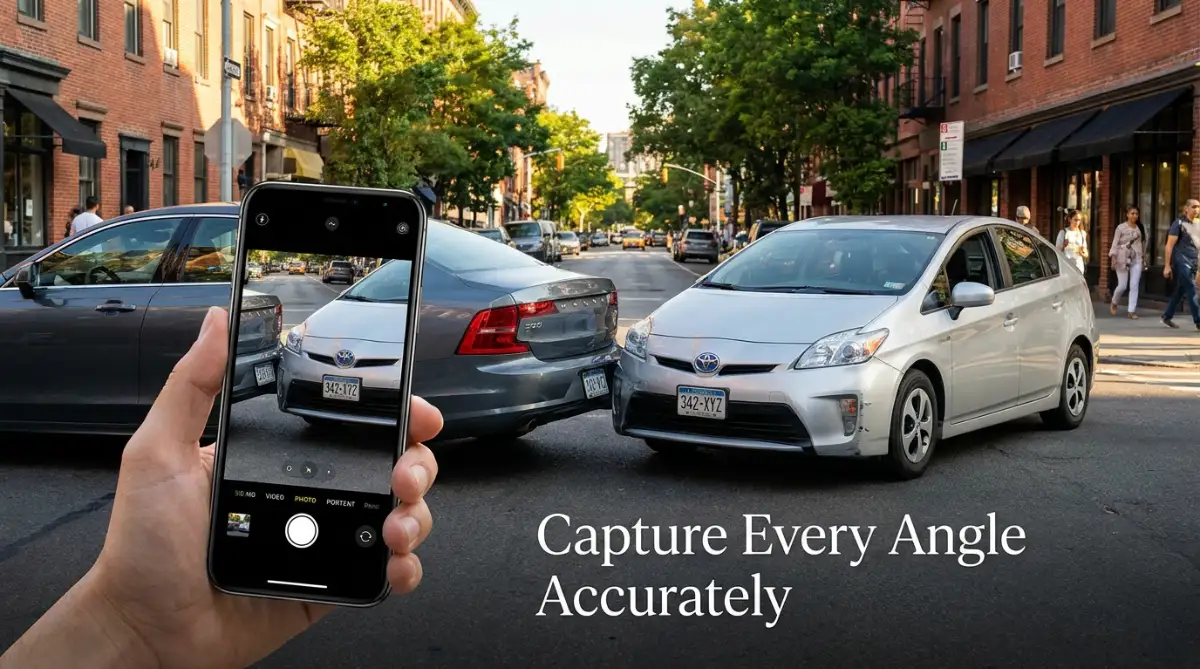
To build a truly solid insurance claim, you need to treat the scene like a professional movie set. Start by taking wide shots of the entire area, capturing where the cars ended up immediately after the bump.
Here is exactly how you should approach taking photos for strong evidence:
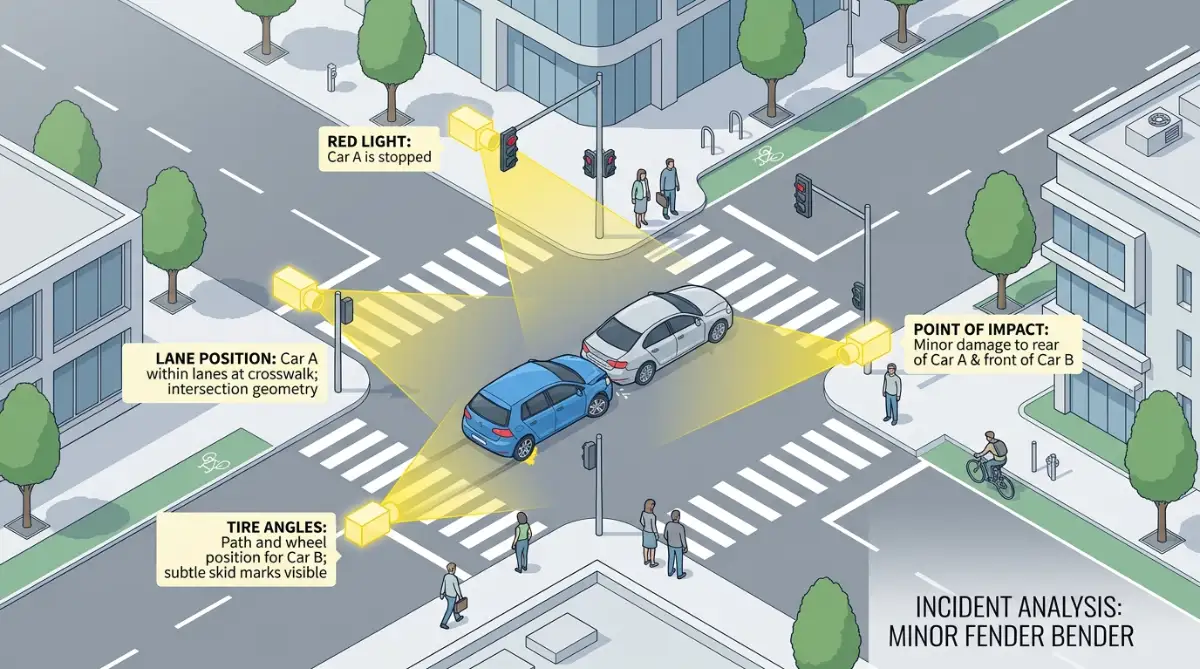
- The Wide Angles: Stand far back and take pictures showing the entire intersection, the traffic lights, and both cars in one single frame.
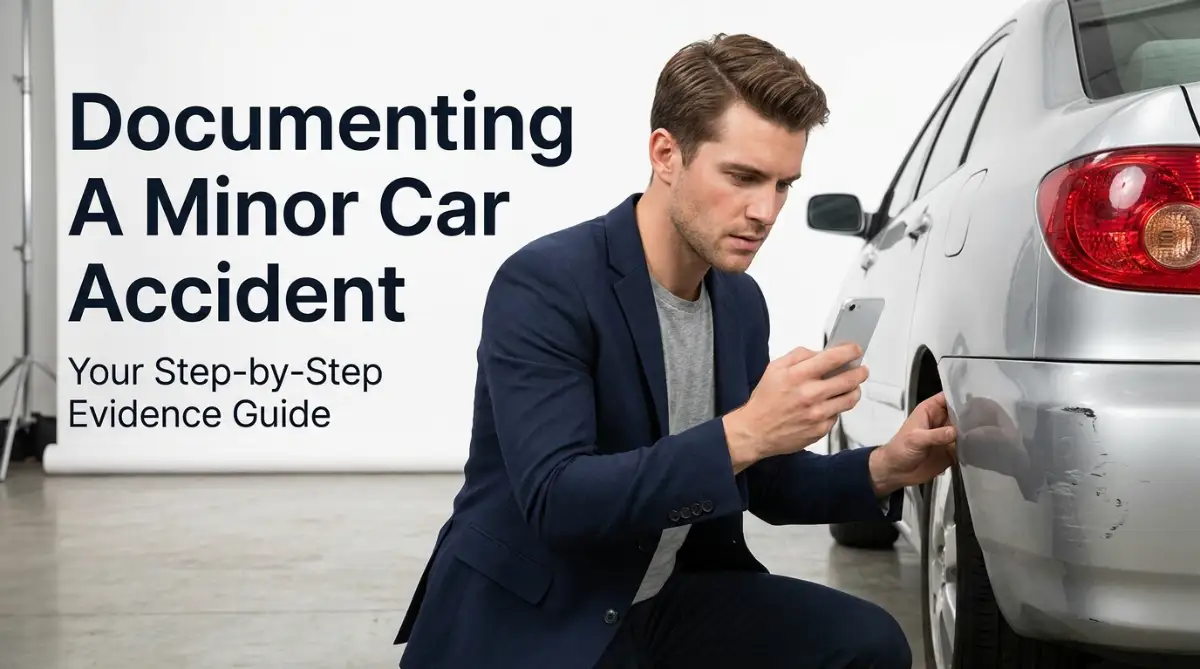
- The Close-Up Damage: Get very close to the scratched paint, dented metal, and broken glass.
- The Details: Take clear pictures of the other driver's license plate so they cannot drive away and disappear.
| What Most People Shoot | What Insurance Adjusters Actually Need | Why It Saves You Money |
| Just the scratched bumper paint | Wide shot showing curb distance & lane markers | Proves the other driver drifted into your lane |
| Broken plastic pieces on the ground | Steering wheel and front tire angles on both cars | Shows if the driver tried to brake or steer away |
| The other driver's car only | Both dashboard areas through the window | Proves whether they were using a phone or had a dashcam |
My 5-Photo Rule
- Wide shot — both cars, the road, and the lane markers.
- Close-up — every scratch, both plates, and the VIN.
- Context — street signs, traffic lights, and skid marks.
Five photos now beat five arguments later.
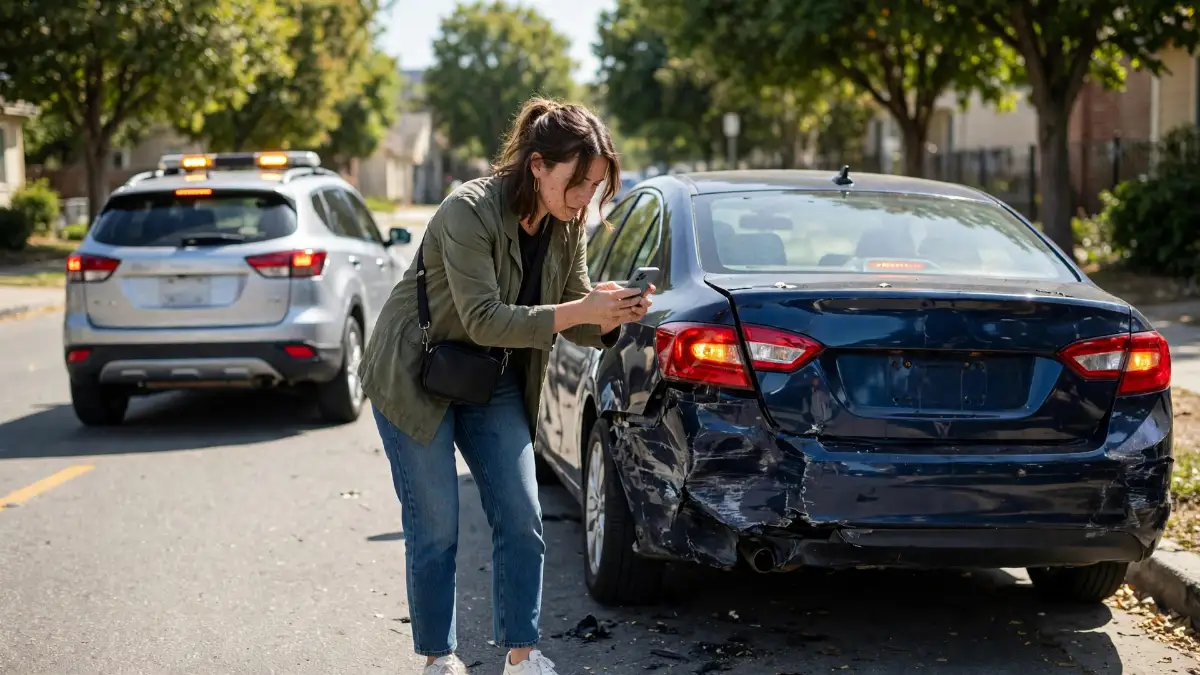
Pro Tip: I made a massive mistake during my first minor crash by only taking pictures of my own car's damage. I completely forgot to photograph the position of the other driver's tires, which would have easily proven they turned into my lane illegally. Always photograph the street lines, the tire directions, and the surrounding road signs to tell the complete story.
Taking pictures of the weather conditions and any visible skid marks on the road is also extremely helpful. These environmental details often explain exactly why the cars collided in the first place.
The Right Way to Exchange Information
Talking to the other driver can feel incredibly awkward, especially if they are upset or angry. Keep the conversation extremely short, polite, and focused entirely on gathering basic facts.
Never apologize or say things like "I am so sorry, I did not see you there." Insurance adjusters can easily twist an innocent apology into a full admission of legal guilt. Simply ask if they are okay, and then suggest that you both exchange your basic details for the insurance paperwork.
My 30-Second Roadside Script (Word-for-Word):
If the other driver gets aggressive or tries to blame you, do not argue. Use these exact three lines:
My 3 Lines for an Angry Driver
- "Are you okay?"
- "Let's exchange details for the insurance."
- "I'll wait for the police."
Short, polite, and nothing that sounds like guilt.
- "Let’s make sure everyone is safe and unhurt first."
- "I’m keeping my notes short so our insurance teams can handle the facts."
- "Let’s swap policy cards and driver’s licenses so we can both get on our way."
Watch this highly informative video to see exactly what to say and do when speaking with the other driver.
You need to collect their full legal name, their phone number, and their home address if possible. Always ask to see their physical driver's license and take a clear photo of it with your phone.
Next, ask for their specific insurance company name and their exact policy number. Do not forget to write down the make, model, color, and year of their vehicle. If they are driving a company truck or a commercial van, take a picture of the business logo on the side of the vehicle.
Myth vs. Reality in Information Gathering
Myth: You only need the other person's phone number to sort things out later.
Reality: People often give fake numbers or simply block you when they realize how expensive repairs are. Always get physical proof of their identity and insurance.
Myth: If the damage looks small, you do not need to exchange insurance details.
Reality: Modern cars have hundreds of hidden, expensive sensors behind those plastic bumpers. A tiny scratch can easily cost thousands of dollars to fix properly.
Approaching Strangers for Witness Statements
Independent witnesses are the absolute best friends you can possibly have after a minor collision. Since they have no personal connection to the accident, their version of events carries immense weight with insurance companies.
If you see people stopping on the sidewalk or walking out of nearby stores, approach them quickly but gently. You can simply say, "Excuse me, did you happen to see how that happened?"
If they agree that the other driver made a mistake, ask them nicely if they would be willing to share their contact info. Just get their first name and a phone number, telling them it will only take two minutes of their time later.
Most normal people are actually very happy to help out if they see someone in a stressful situation. Do not pressure them if they say no, just move on and look for someone else who might have seen the bump.
Looking Up for Hidden Digital Eyes
Sometimes, you cannot find a single human witness standing around the street corner. When this happens, you need to start looking up at the buildings, poles, and stores around you.
We live in a deeply connected world where cameras are recording almost every single public street. Look around for any gas stations, banks, or local shops that might have a security camera pointing at the road.
If you spot a camera, walk inside the store immediately and politely ask the manager if they saw the crash. Ask them if their outdoor security system might have caught the specific moment of impact.
Store owners usually delete their security footage very quickly, sometimes within just twenty-four hours. By identifying these cameras early, you or your lawyer can request that they save the footage before it gets wiped forever.
Also, look to see if the other driver has a dashcam installed directly behind their rearview mirror. If they do, that small detail is something you must absolutely mention to your own insurance provider later.
Why the Police Matter for Minor Bumps
A lot of people feel deeply hesitant about calling the local police for a tiny fender bender. They worry about bothering busy officers or getting in trouble over a simple scratched door.
However, getting an official, documented police report is one of the smartest legal moves you can make. When an officer arrives, they create a completely neutral, third-party record of exactly what happened on that street.
They will check both drivers for active warrants, verify the insurance documents, and write down their own professional observations. Even if the officer does not assign specific blame, having a formal report stops the other driver from changing their story the next day.
Some local police departments will not send an officer if there are no physical injuries and the cars can still move. If that happens, simply ask the dispatcher how you can file a basic incident report online or at the local station later.
Just having a formal reference number from the police department adds a massive layer of credibility to your personal story. It shows the insurance adjusters that you are completely serious and that you handled the situation professionally.
Creating Your Own Audio Memory Record
Human memory is incredibly fragile, especially when we are running on pure adrenaline and stress. By the time you wake up the next morning, the small details of the collision will start to become fuzzy and unclear.
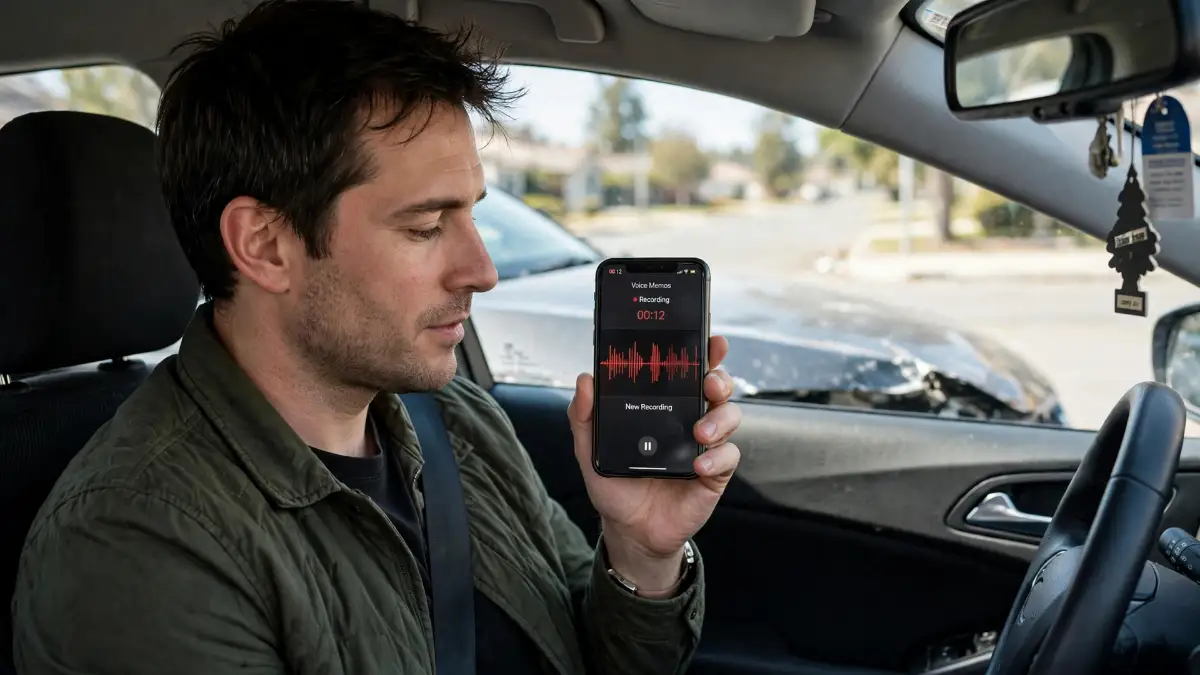
Before you drive away from the scene, sit quietly in your own car for five minutes. Open the voice recording app on your smartphone and just start talking to yourself about what just happened.
Record exactly which lane you were driving in, how fast you were going, and what the traffic lights looked like. Describe the exact weather, if the sun was glaring in your eyes, and what the other driver said to you immediately after the bump.
These small audio notes act as a perfectly preserved time capsule of the truth. When you finally sit down to fill out the long, boring insurance forms a few days later, you will be so thankful you recorded those thoughts.
Mapping Out the Exact Sequence of Events
You can also grab a piece of paper or use a simple drawing app on your phone to sketch a basic map. Draw the intersection, add some simple arrows showing where both cars were coming from, and mark a large 'X' exactly where they collided.
This simple visual drawing helps explain the mechanics of the crash much better than words ever could. It is incredibly helpful when you are trying to explain the situation over the phone to a busy insurance agent who cannot see the road.
By actively gathering this robust mix of photographs, witness details, and personal audio notes, you build an unbreakable wall of evidence. You completely remove the ability for the at-fault driver to lie, twist the truth, or try to blame you for their careless mistake.
Taking Your Evidence Game to the Next Level
Locking Down Your Digital Footprint Immediately
We carry incredibly powerful tracking devices in our pockets every single day. If you use a GPS app like Google Maps or Waze while driving, your phone actually records your exact travel speed and route. Taking a quick screenshot of your recent trip timeline can prove that you were not speeding right before the impact.
This digital data is incredibly powerful when the other driver falsely claims you were racing down the street. Always back up your accident photos to a secure cloud service before you even drive away from the scene. Phones can easily break or get lost, and losing those original photos means losing your only real proof.
If you want to understand how professionals evaluate these digital details, the National Highway Traffic Safety Administration offers excellent public resources on traffic data analysis. Their safety guidelines often highlight how accurate speed and location tracking helps recreate accident scenes perfectly.
The Hidden Power of Neighborhood Surveillance
I mentioned looking up for cameras earlier, but you also need to think about residential technology. If your minor bump happens in a quiet neighborhood, look closely at the front doors of the nearby houses. Almost everyone has a smart doorbell camera installed these days, and they often capture the street perfectly.
Do not be afraid to knock on a door and politely ask the homeowner to check their motion alerts. People are usually very friendly and highly willing to email you a short video clip to help out.
That tiny ten-second video clip from a stranger's porch can save you thousands of dollars in unfair insurance penalties. Having this clear video evidence is the ultimate secret to successfully filing a property damage claim without the stress.
Protecting Your Physical Health Records
Adrenaline is a massive painkiller that floods your body the second you hear the sound of a crash. You might feel absolutely fine while standing on the side of the highway exchanging information. However, the soft tissues in your neck and back can suffer tiny tears that do not hurt until three days later.
If you tell the police officer or the other driver, "I am perfectly fine," you might accidentally hurt your future medical claims. Instead, simply say, "I am feeling a bit shaken up right now, and I will see my doctor later to be sure."
Psychologists have extensively studied how sudden trauma and adrenaline completely mask our physical reality. You can read more about how stress hormones trick the human brain through resources published by the American Psychological Association. Going to an urgent care clinic the next morning creates a formal medical timeline that perfectly matches your accident date.
The Dashcam Investment Strategy
If you do not have a dashcam right now, you need to buy one immediately. A high-quality dashcam acts as an unblinking, unbiased witness that rides with you everywhere you go.
When you capture the other driver running a red light on video, the entire insurance argument ends in about five seconds. Just make sure you pull the memory card out of the camera as soon as you get home so the footage does not overwrite itself.
 The Dangerous Traps That Destroy Honest Claims
Even if you take perfect pictures, falling into common psychological traps can completely ruin your case. When we feel stressed out, we tend to make highly emotional decisions instead of logical ones. I want to clearly outline the biggest mistakes people make so you can easily avoid them.
These pitfalls might seem like tiny errors at the moment, but they create a massive financial disaster down the road. If you ignore these warnings, you could end up paying entirely out of pocket for a mistake you did not even make.
The "Handshake Deal" Nightmare
This is perhaps the most dangerous and common mistake you will ever encounter on the road. The other driver will look at the small scratch on your bumper and beg you to keep the insurance companies out of it. They might offer to hand you cash right then and there, or promise to pay your mechanic directly next week.
They play on your kindness, acting incredibly friendly and promising that they are good for the money. Never, ever agree to this handshake deal under any circumstances.
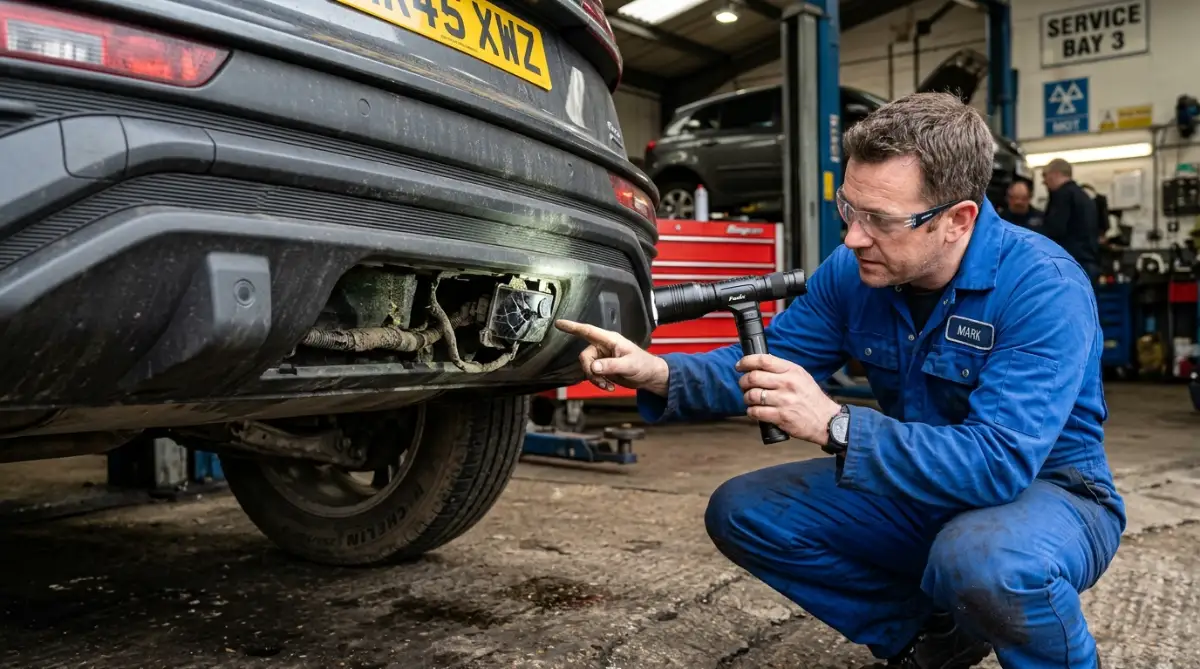
Here is exactly what happens in reality: you go to the auto body shop and find out that the tiny scratch actually cracked the expensive internal sensors. Suddenly, that simple repair costs two thousand dollars instead of two hundred.
When you call the friendly driver to ask for the money, their phone number goes straight to voicemail. Now you are stuck with a massive bill, and because you did not report the crash, you might start wondering what to do if you can't make your car payment this month.
The Apology Trap
We are raised to be polite, and saying "I'm sorry" is an automatic reflex for many nice people. You might step out of the car and say, "I am so sorry, traffic just stopped so fast!" You are just trying to calm the situation down, but the other person is secretly taking notes.
When they call their insurance provider, they will loudly announce that you admitted full guilt right at the scene. Insurance adjusters are heavily trained to look for any excuse to deny your payout, and your innocent apology is their favorite excuse.
If you want to dive deeper into how these adjusters think, you should understand exactly why insurance adjusters reject auto claims in the first place. You can be polite and check on their safety without ever uttering the word "sorry."
To understand how fault is legally assigned in these tricky situations, the Insurance Information Institute explains the claims process very clearly. They highlight how any admission of fault drastically changes your financial responsibility.
Waiting Too Long to Report the Incident
Another huge pitfall is deciding to wait a few weeks before officially notifying your insurance agent. You might feel too busy with work, or you might hope the damage is small enough to just ignore.
Every single insurance policy has strict time limits hidden deep in the paperwork. If you miss their specific deadline, they have the legal right to completely deny your claim, even if you were clearly not at fault.
Call your agent the very same evening while the details are still fresh in your mind. You do not have to file an official claim right away; you just need to put the incident on their radar.
Posting the Drama on Social Media
In our highly connected society, people love to share their dramatic moments on Facebook, Instagram, or TikTok. You might feel tempted to post a picture of your smashed headlight with an angry caption about the other driver.
Do not post a single word about your accident online.
Insurance investigators actively search social media to find reasons to ruin your claim. If you post a smiling selfie at the gym two days after the crash, they will argue that your neck injury is completely fake. Keep your entire situation entirely private until your vehicle is fully repaired and the final checks are cashed.
Your Roadmap to Post-Accident Peace of Mind
Remember, gathering good evidence is simply about protecting your hard-earned money and your daily peace of mind. It stops dishonest people from taking advantage of you and forces the insurance companies to play totally fair.
I know how overwhelming that sudden shock feels, but I also know that you are fully capable of handling it. My biggest hope is that you never actually need to use these tips, but if you do, you will be completely prepared to protect yourself.
Quick Answers to Your Post-Accident Worries
Should I move my car after a minor scrape?
Yes, if your car is safely drivable and blocking active traffic, you should absolutely move it to the shoulder. Just quickly snap a few wide pictures of the vehicles in their original resting positions before you move them out of the way.
Do I really need to call the police for a small dent?
Calling the local non-emergency police line is always the smartest move, even for tiny dents. Having an official officer document the scene stops the other driver from lying about the event to their insurance company later.
How long do I have to report the accident to my insurance?
Every insurance company has different rules, but you should ideally notify them within twenty-four hours of the bump. Waiting too long gives the adjuster a very easy excuse to deny your coverage based on policy technicalities.
What if the other driver refuses to give their details?
Do not argue or physically fight with an aggressive driver under any circumstances. Stay safely locked inside your car, take a clear picture of their license plate, and call the police immediately.
Can I claim for hidden damages later?
Yes, but this is exactly why you should never sign a settlement or accept cash at the actual scene. Let a professional mechanic inspect the vehicle first, because minor bumper scratches often hide thousands of dollars in severe structural damage.
Disclaimer: The information provided in this article is for educational and informational purposes only and does not constitute formal legal or financial advice. Every accident and insurance policy is unique. You should always consult with a licensed attorney or a qualified insurance professional regarding your specific situation and local traffic laws.