
The Day I Almost Lost Everything Because I Didn't Look Ahead
Let's be honest—checking your startup's bank account shouldn't feel like watching a horror movie. But a few years ago, I stared at a balance so low my stomach literally dropped. I thought I was doing great because my sales were climbing every week. What I missed was a very basic truth: making money on paper and actually having cash in your pocket are two completely different things..
My sales team was hitting their targets and I felt like a king. But when it came time to pay my office rent and my hard-working staff, the money just wasn't there. I was confused and honestly, I was terrified.
I had made a huge mistake that almost ended my dream forever. I was looking at my sales, but I wasn't looking at my future cash. I thought making money and having money were the same thing.
That was the hardest lesson I ever had to learn. My ego was bruised and I spent many nights wondering if I should just give up. I realized then that a business doesn't die because it lacks ideas; it dies because it runs out of gas.
If you are a new founder, I don't want you to feel that same panic. I want to share how I fixed my mess so you can stay safe. Trust me, ignoring your future bank balance is like driving a car with your eyes closed.
Before We Start: Quick Takeaways for Your Wallet
- Sales ≠ Cash: A sale only counts when the money physically hits your bank account.
- Know Your Runway: Always divide your current cash by your monthly expenses so you know exactly how many months you can survive.
- Look 12 Weeks Ahead: Ditch the 5-year plans. Focus strictly on mapping out your income and bills for the next 90 days.
- Avoid the Growth Trap: Growing too fast can bankrupt you if you spend money upfront for clients who pay late.
The Hidden Weight of Financial Uncertainty
Running a new business is already hard enough on your mind. You wake up thinking about growth and you go to sleep thinking about your team. But when you don't know where your money stands, a different kind of monster grows.
I have talked to so many founders who are living paycheck to paycheck within their own companies. They have thousands of dollars in "pending invoices," but zero dollars to buy more stock. This gap is where most startups go to die.

It’s a very lonely feeling. You can’t always tell your employees that you might not be able to pay them next month. You can't tell your investors you messed up the math. You just sit there, staring at a spreadsheet, hoping for a miracle.
This stress doesn't just hurt your business; it hurts your health. It ruins your focus and stops you from being the creative leader your company needs. Cash flow forecasting is the only way to kill that monster for good.
Myth vs. Reality: The Truth About Startup Money
How to See the Future of Your Bank Account
You don't need a fancy degree to understand your money. You just need to be honest with yourself about what is coming in and what is going out. Let’s look at how you can start protecting your venture today.
Track the Real Timing of Your Cash
The biggest trap is thinking a "sale" is the same as "cash." If you sell something today but the customer pays in 30 days, you have zero cash right now. You must record when the money actually hits your hand.
I used to celebrate every time a contract was signed. I felt rich on paper, but my wallet was empty. Now, I only count the money when I see it in my bank statement. This simple change saved my life.
Start by looking at your past three months. How long does it really take for people to pay you? If it's longer than you thought, you need to plan for that delay. This is the foundation of a real forecast.
Know Your Monthly Survival Number
Every business has a "burn rate." This is the total amount of money you spend every month just to keep the lights on. This includes rent, software, salaries, and even that coffee machine in the corner.
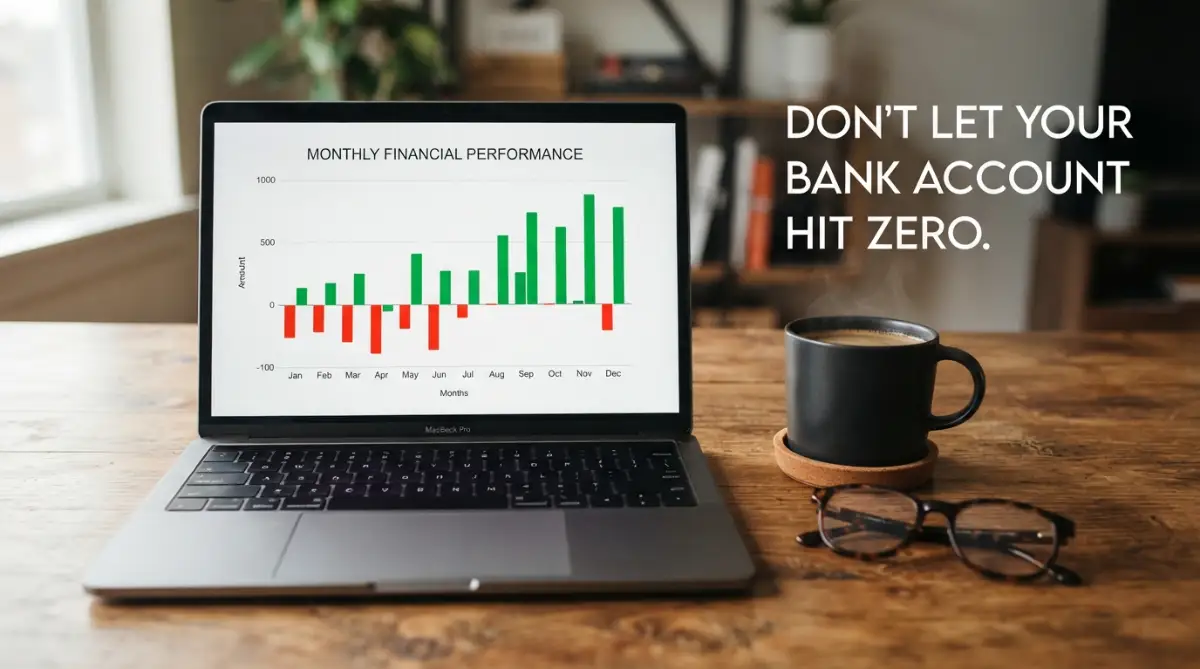
You need to know this number down to the last cent. If your burn rate is $5,000 and you only have $10,000 in the bank, you have two months to live. It is that simple and that scary.
Quick Look: The Burn Rate Reality Check
Here is a fast way to see how much time you actually have before the money runs out:
| Cash in Bank | Monthly Burn Rate | Your Runway (Time Left) | Action Needed |
| :--- | :--- | :--- | :--- |
| $20,000 | $5,000 | 4 Months | Warning zone: Start cutting extra costs. |
| $15,000 | $15,000 | 1 Month | Danger: You need sales or funding right now. |
| $50,000 | $2,000 | 25 Months | Safe zone: Focus on steady growth. |
Knowing this number gives you power. It tells you exactly how much time you have to make a pivot or find new sales. Never guess your expenses; always use the real numbers from your bills.
Pro Tip:
I used to round down my expenses to make myself feel better. I would say "Oh, marketing is about $200" when it was really $285. That extra $85 adds up fast and will bite you later. Always round your expenses up and your income down to be safe.
Watch This Simple Guide to Business Cash Flow
Before we move into the deeper steps, it helps to see this in action. The following video explains how to visualize your money flow without getting a headache. It’s perfect for anyone who hates math but loves their business.
This video will show you exactly how to map out your money so you never run out of cash unexpectedly.
Anticipate the "Dry Seasons"
No business makes the same amount of money every single week. There will be times when sales are slow. Maybe it's a holiday, or maybe your industry has a quiet month.
A good forecast looks at these slow times before they happen. If you know January is always slow, you can save extra money in November. This keeps your stress levels low when the phone stops ringing.
I used to think every month would be better than the last. That was just wishful thinking. Now, I plan for the worst-case scenario. If the worst doesn't happen, I just have extra money!
The Danger of the "Growth Trap"
This is something that catches many smart founders. You get a huge new order or a big new client. You are excited! But to serve that client, you have to hire three new people and buy new equipment.
You spend all your cash today to prepare for the work. But the client won't pay you until the work is finished in three months. Suddenly, you are broke because you grew too fast.
This is why cash flow forecasting is so important during growth. It helps you see if you can actually afford to take on that big new project. Sometimes, saying "no" to a big client is the only way to stay alive.
Real-World Example: The 90-Day Trap
Imagine you land a $20,000 contract today. You spend $8,000 on materials and freelancers this week to get the job done. But the client's contract says they pay "Net 90" (meaning they pay you 90 days after you finish). For three straight months, you are down $8,000. If you don't have that cash saved up, your business stops moving entirely.
Building Your First Simple Forecast Model
You don't need expensive software to do this. A simple spreadsheet is actually better when you are just starting out. It keeps you close to the numbers so you really understand them.
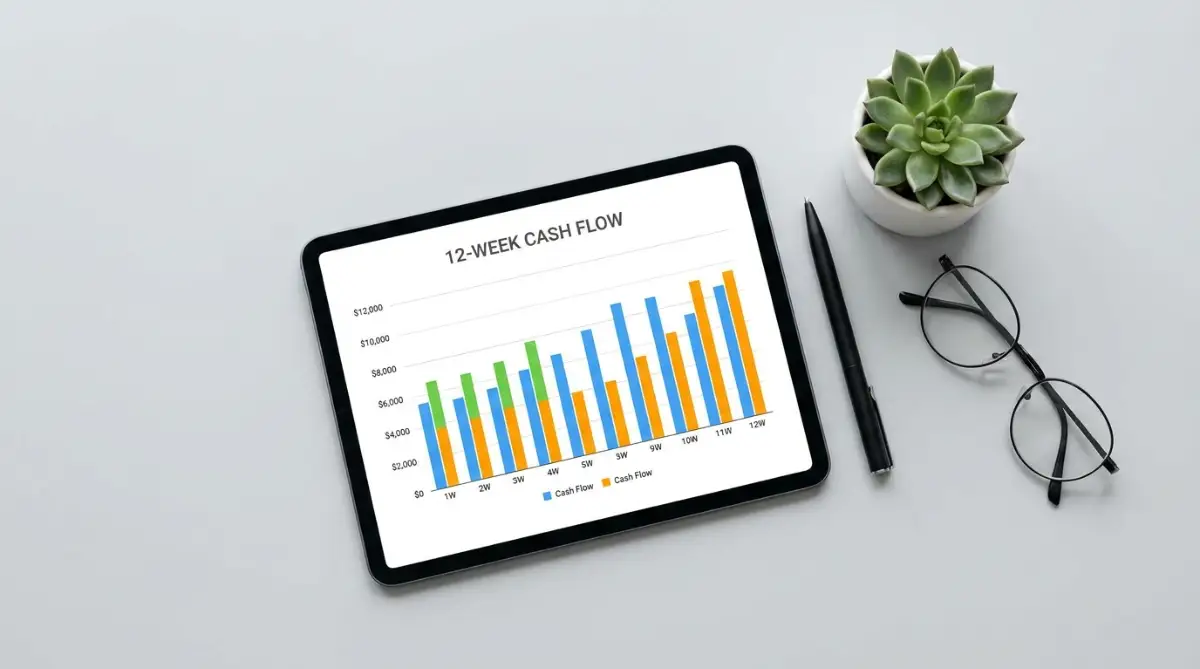
Create a 12-Week Rolling View
Don't try to predict the next five years. That is just guessing. Instead, focus on the next 12 weeks. This is a short enough time to be mostly accurate but long enough to give you a warning.
List your starting balance at the top of the first column. Then, list all the money you expect to receive each week. Below that, list every single bill you must pay each week.
At the bottom, calculate your ending balance. Then, carry that ending balance to the top of the next week. Do this for 12 weeks and see what the bottom line looks like.
Be Brutally Honest About Your Income
When we are excited, we tend to be too optimistic. We think that "maybe" client will definitely sign the deal next week. In your forecast, you should only include money that is 90% certain.
If a deal is just a "maybe," leave it out for now. It is much better to be surprised by extra money than to be devastated by money that never showed up. This keeps your plan grounded in reality.
I have seen businesses fail because they counted on a "sure thing" that fell through. They spent money they didn't have yet. Always wait for the notification from your bank before you trust that the money is yours.
The "Stress Test" Method
Once you have your 12-week plan, try a "stress test." What happens if your biggest client pays two weeks late? What happens if your main software doubles its price?
Change the numbers in your spreadsheet and see if you stay "in the black" (above zero). If your balance hits red in these scenarios, you need to build a bigger cash cushion.
This isn't about being negative. It’s about being prepared. A pilot doesn't just hope for good weather; they have a plan for a storm. You are the pilot of your startup.
Why Logical Planning Trumps Gut Feeling
Most founders run their business based on "gut feeling." They feel like they have enough money because the office looks busy. This is the most dangerous way to operate.
Your feelings can lie to you. Numbers do not. A forecast gives you a cold, hard look at the truth. Even if the truth is ugly, it is better to see it coming than to be hit by it in the dark.
When you have a plan, you can talk to your bank or your landlord early. People are much more likely to help you if you tell them two months in advance that you have a problem. If you tell them on the day rent is due, they won't be so kind.
Taking Control of Your Startup's Destiny
By now, you should see that cash flow forecasting isn't just about accounting. It’s about freedom. It’s about the freedom to sleep at night and the freedom to grow without fear.
You have worked too hard on your venture to let it die because of a simple math error. You don't have to be a math genius. You just have to be someone who looks ahead.
Start today. Spend just one hour looking at your bank statements and your upcoming bills. Put them into a simple list. That one hour could be the difference between a thriving business and a "closed" sign on your door.
You have the tools and the knowledge. Now, you just need to take action. Don't let your startup become another statistic. Be the founder who knew their numbers and stayed in the game.Strategies for Maintaining a Healthy Cash Reserve
Managing your money isn't just about survival; it’s about giving your business the power to grow when others are stuck. I have learned that the most successful founders don't just wait for money to arrive. They create systems that make money move faster into their hands and slower out of their pockets.
One of the best ways to keep your bank account happy is to look at your "accounts receivable." This is just a fancy way of saying "the money people owe you." If you give your customers 30 days to pay, many will wait until day 29 or even day 40. This delay can kill your rhythm.
I started offering a small discount for people who paid their bills within ten days. It was only a 2% difference, but you would be shocked at how fast people send money when they save a few dollars. This simple trick kept my cash flowing smoothly even during the quiet months.
You should also look at your "accounts payable," which is the money you owe to others. I always try to negotiate longer payment terms with my suppliers. If I can pay them in 45 days instead of 30, that keeps cash in my business for 15 extra days. Those 15 days can be the difference between making payroll or falling short.
Another pro-level secret is to keep a "cash cushion" that is separate from your daily spending. I call this my "sleep well at night" fund. Try to save enough to cover at least three months of your basic expenses. It sounds hard when you are just starting, but even saving $50 a week adds up over time.
Predicting the Unpredictable in Your Business
Most new business owners think they can't predict the future, so they don't try. But you can actually see a lot of problems coming if you look at the right data. For example, if you see that your website traffic is dropping, you can bet your sales will drop in a few weeks.
By watching these early signs, you can adjust your spending before you hit a wall. If I see a slow month coming, I immediately cut back on things like extra marketing or new office gear. This proactive approach is much better than waiting until the bank account is empty to make a change.
You might also consider looking at different types of funding before you actually need them. If you wait until you are desperate for cash, banks will likely say no. But if you apply for a credit line when your business is doing well, you have a safety net ready for a rainy day.
If you find yourself in a tight spot with personal bills while trying to save your business, you might need to know what to do right now if you can't make your car payment. Taking care of your home life is just as important as taking care of your company.
I also recommend using simple accounting tools that sync with your bank. These tools can show you a "cash flow graph" that updates every day. Seeing your money move in a visual way makes it much easier to understand than just looking at a list of numbers.
The Science of Managing Your Burn Rate
Your burn rate is the speed at which you are spending your startup's capital. If you have $50,000 and you spend $5,000 more than you make every month, you have ten months of life left. This is your "runway."
To stay in business longer, you must either increase your speed (sales) or lower your weight (expenses). I often see founders spending money on a fancy office or expensive software they don't even use. Every dollar you save on rent or tools is a dollar that buys you more time to succeed.
I once spent $300 a month on a software tool that I only used twice a year. When I finally sat down to look at my forecast, I realized that $300 could have paid for a part-time assistant for a few hours. It was a wake-up call that every cent matters.
If you are looking for ways to boost your business without using your own savings, you can explore how to get bank loans with no collateral online. This can give you the extra runway you need to reach your goals.
Always remember that your time is also an expense. If you are spending ten hours a week on manual data entry, you are losing money that could be spent on growing your sales. Automating small tasks is a secret way to improve your cash flow because it frees you up to make more money.

The Hidden Traps That Can Sink Your Business
One of the biggest mistakes I see is "optimism bias." This is when a founder believes that every sales lead will turn into a big check. They start spending money based on a promise. If that promise breaks, the business falls apart instantly.
I learned the hard way that a "handshake" doesn't pay the electric bill. I used to hire new staff because a client said they "intended" to sign a big contract. When they changed their mind, I was stuck with a bigger payroll and no way to pay it.
Another dangerous trap is mixing your personal money with your business money. It seems easy to just pay for a business dinner with your personal card, or vice versa. But this makes your forecasting almost impossible. You never truly know how much your business is making or spending.
If you have personal debts that are making your life hard, you should learn about debunking common myths about debt consolidation loans. Keeping your personal finances clean will give you the mental space to focus on your startup.
I also see people forgetting about their taxes. They see $10,000 in the bank and think it's all theirs to spend. They forget that a big chunk of that belongs to the government. When tax season arrives, they have to scramble for cash, which often leads to taking bad loans.
The High Cost of Ignoring Small Leaks
A small leak can sink a big ship if you ignore it long enough. In a startup, these leaks are usually small monthly subscriptions or tiny fees that you don't notice. $20 here and $50 there might not seem like much, but they add up to thousands of dollars over a year.
I suggest doing a "subscription audit" every single month. Look at every single charge on your business card. If you haven't used a service in the last 30 days, cancel it immediately. You can always sign up again later if you really need it.
Sometimes, people try to solve their cash flow problems by taking out high-interest personal loans. This is often a mistake because the interest can eat your profits faster than you can make them. It is much better to look for easy collateral-free business loans that are built for companies like yours.
Ignoring your numbers because you are "too busy" is another common path to failure. Being busy is not the same as being productive. If you don't have time to check your cash flow, you are essentially driving a car without looking at the fuel gauge. Eventually, you will stop moving.
Building a Future-Proof Financial Mindset
To win in the long run, you have to change how you think about money. It isn't just something to spend or save. It is a tool that you must manage with care. This means being disciplined even when things are going well.
When I started my first venture, I thought that once I reached a certain level of sales, all my problems would disappear. The truth is that bigger sales often bring bigger problems. You need even better forecasting as you grow, not less.
According to data from the U.S. Bureau of Labor Statistics, about 20% of new businesses fail during the first two years. A huge reason for this is simply running out of money. You can beat these odds by being the founder who cares about the details.
If you are a student or a young founder, you might be carrying the weight of education costs. It's very important that you read this before you endorse a student loan for someone else. Your credit score and financial health are your most valuable assets.
Stay curious and keep learning. The world of business finance is always changing. Read books, listen to podcasts, and talk to other founders about how they handle their cash. The more you know, the less likely you are to be surprised by a financial storm.
Steps to Take Right Now for Success
If you feel overwhelmed, start small. You don't need a 50-page financial plan today. You just need to know what is happening next week. Take 15 minutes every morning to look at your bank balance and your upcoming tasks.
This habit will change your life. It removes the fear of the unknown. When you know exactly where you stand, you can make decisions with confidence. You stop reacting to problems and start creating opportunities.
If your startup needs quick cash to bridge a gap, make sure you understand your options. You can look into how to get instant bank loans without collateral easily so you don't have to put your personal assets at risk.
Remember, you are not alone in this struggle. Every great company you see today had moments where they almost ran out of cash. The difference is that they had a plan to keep going. They used forecasting to see the light at the end of the tunnel.
I believe in you and your vision. You have the heart of a founder, and now you have the mind of a financial manager. Keep pushing forward, stay honest with your numbers, and watch your business thrive.
Common Questions About Managing Startup Cash
How often should I update my cash flow forecast?
You should look at your forecast at least once a week. In a very new startup, doing it every day is even better. This helps you spot trends early so you can react before a small problem becomes a disaster.
Is cash flow different from profit?
Yes, they are very different. Profit is what is left after all bills are paid on paper. Cash flow is the actual money moving in and out of your bank account. You can have a "profitable" month but still have zero cash if your customers haven't paid you yet.
What is the most common reason for cash flow gaps?
The most common reason is the timing difference between paying your bills and getting paid by customers. Most businesses have to pay for materials or staff before they can deliver a product and collect the money. Managing this "gap" is the secret to staying alive.
Can I use a credit card to fix a cash flow problem?
A credit card can be a temporary bridge, but it is dangerous because of high interest rates. It is better to use it as a last resort. Always have a plan to pay it off within 30 days so you don't get trapped in a cycle of debt.
Should I share my cash flow forecast with my team?
Sharing high-level numbers can help your team understand why you are making certain choices. It can motivate them to help save costs or push for faster sales. However, keep the most sensitive details to yourself and your trusted advisors.
Your Path to a Fearless Financial Future
To wrap things up, remember that cash flow forecasting is your superpower. It turns you from a person who "hopes" into a person who "knows." It gives you the clarity to lead your team through any challenge that comes your way.
I want you to take a deep breath and realize that you can master this. It’s okay to be nervous, but don't let that stop you from looking at your bank account. The numbers are just data points that help you build a better future.
I used to be terrified of spreadsheets, but now they are my best friends. They told me the truth when I didn't want to hear it, and they saved my business from a silent death. I am so glad I started this journey, and I know you will be too once you see your business growing steadily.
Disclaimer: This article is for informational purposes only and does not constitute professional financial or legal advice. Always consult with a qualified accountant or financial advisor before making significant business decisions.