
The Morning Panic and the Slow Drip Reality
So, you bought an electric car to skip the gas station, but now you feel held hostage by a slow wall plug. I get it. We have all stared at that 18% battery warning on a Monday morning, freezing with the heater turned off just to make it to work. Relying on a standard wall outlet is a quick way to ruin the fun of driving an EV. Let's skip the range anxiety and look at how you can easily turn your garage into a fast, safe, and reliable power station right now.
My heart instantly sank into my stomach. I had plugged the car into the standard wall outlet the night before, assuming it would magically give me enough juice for my heavy commute. Instead, the basic Level 1 charger had given me just a few miles of range after sitting plugged in for over ten hours.
I spent that entire morning driving without the heater on, freezing in the driver's seat, just to save enough battery to limp into my office parking lot. Range anxiety is a very real, heavy burden that completely ruins the joy of driving an electric car. You constantly find yourself checking your battery percentage instead of watching the road.
You end up planning your entire weekend around public charging stations, wasting hours sitting in grocery store parking lots while your family waits at home. It feels like you are chained to your car’s low battery warning. This everyday struggle drains your mental peace and turns a fun, futuristic car into a massive source of daily stress.
I knew I could not live like that anymore. I needed to wake up every single morning with a fully charged battery and total peace of mind. That is exactly when I decided to take control of my garage and figure out how to bring real, fast power right to my own home.
Quick Takeaways for a Fast Setup:
- Check your limits first: Ensure your main home breaker panel is at least 150 or 200 amps before buying any gear.
- Pick your connection: Choose between a plug-in (NEMA 14-50) for flexibility or a hardwired setup for maximum speed and outdoor safety.
- Never cheap out on parts: Standard $15 hardware store outlets will melt under heavy EV charging loads. Always demand industrial-grade outlets.
- Play it safe: Hire a licensed electrician and always pull a city permit to protect your home insurance policy.
Trading the Garden Hose for a Power Hose
Before we start buying fancy equipment, we need to understand exactly what we are dealing with. Upgrading your home charging system is basically like upgrading the plumbing in your house.
When you buy a brand-new electric vehicle, the dealership usually hands you a basic charging cable that plugs into a normal wall socket. This is known as Level 1 charging, and it operates on 120 volts of electricity. Think of this Level 1 cord as a tiny garden hose trying to fill up a massive swimming pool.
It works, but it only adds about three to five miles of range for every hour it is plugged in. If you drive a lot for work or errands, that slow drip simply cannot keep up with your daily life. A Level 2 EV charger, on the other hand, operates on 240 volts of electricity.
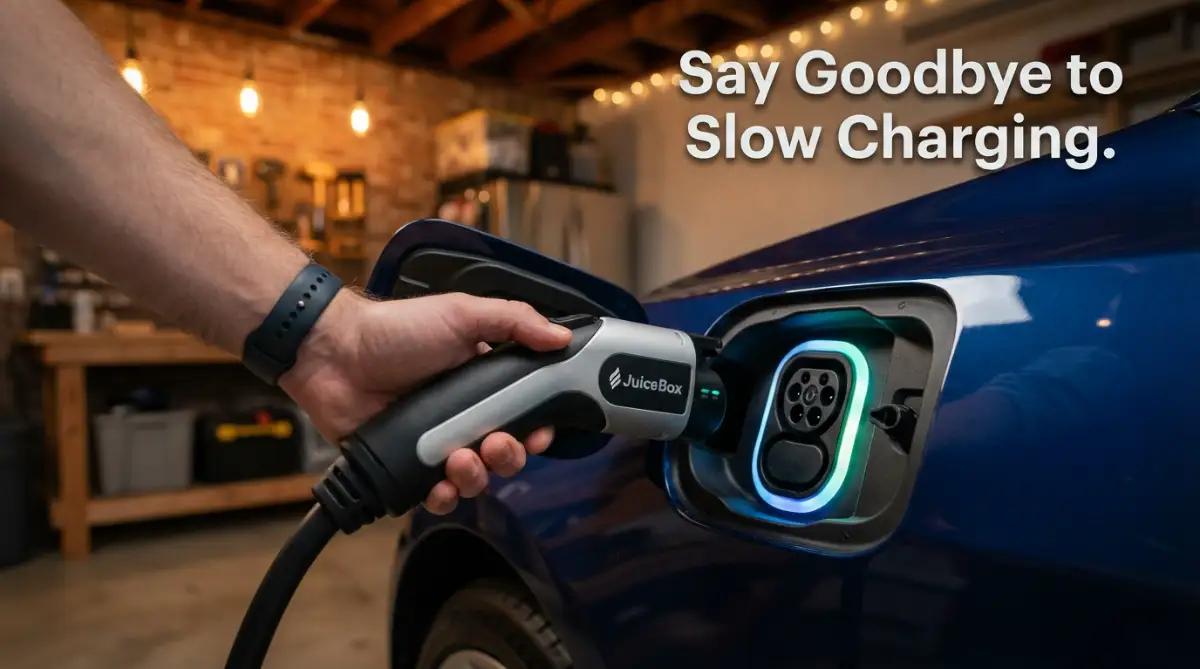
This is the exact same amount of power that your heavy-duty electric clothes dryer or your electric oven uses. Switching to this setup is like trading that tiny garden hose for a massive fire hose. You can easily add twenty to forty miles of range per hour, meaning you plug in at night and always wake up to a 100% full tank.
Quick Reality Check: Level 1 vs. Level 2
- Level 1 (Standard Plug): Adds 3–5 miles per hour. A full charge takes 40+ hours. (Cost: Free with the car).
- Level 2 (240V Setup): Adds 25–40 miles per hour. A full charge takes 6–8 hours. (Estimated Install Cost:
500–
500–
- 1,200 depending on your home).
- If you drive more than 40 miles a day, upgrading is not a luxury—it is an absolute must.
Opening the Metal Box: Reading Your Home’s Power Limits
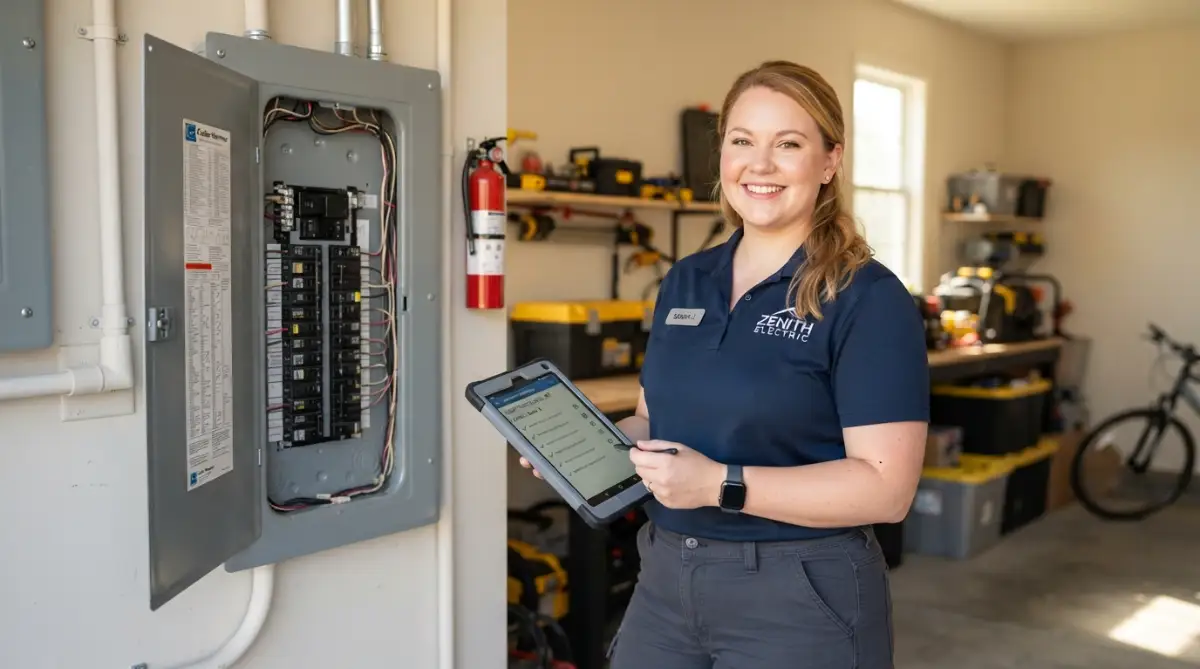
The very first action you must take involves a little investigative work in your own house. You cannot just buy a powerful machine, slap it on the wall, and expect your house to handle it safely. You need to inspect the electrical heart of your home, which is your main breaker panel.
Usually found in your garage, basement, or sometimes on the side of your house, this metal box controls all the electricity flowing into your rooms. Open the front door of the panel and look for the largest switch, which is typically located at the very top or the very bottom. This main switch will have a big number stamped right on the handle, usually 100, 150, or 200.
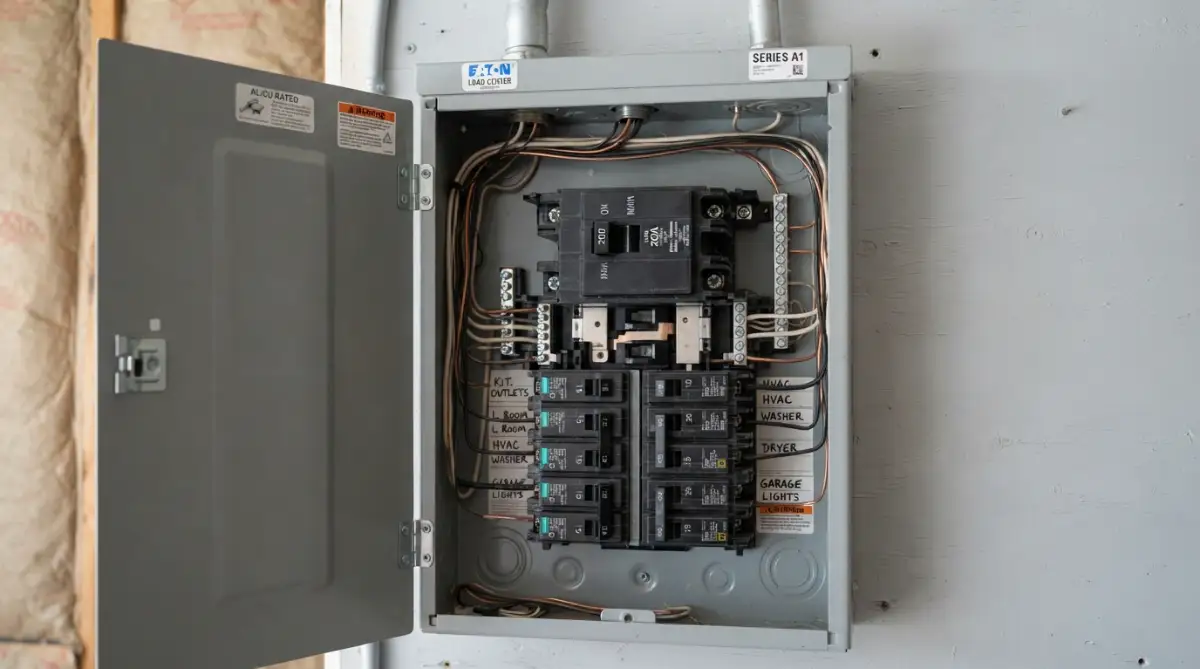
This number represents the total amps your home can safely draw from the utility company at one time. If you have a newer home, you likely have a 200-amp electrical panel, which gives you plenty of room to add heavy loads. If you live in an older house, you might only see 100 amps printed on that main breaker switch.
This is where many beginners make a huge mistake. A fast home charging station usually requires a dedicated 40-amp or 50-amp circuit all to itself. If you only have 100 amps for the whole house, turning on your air conditioning, your electric oven, and your car charger at the exact same time could completely shut down your power.
You might need to hire a professional to upgrade your entire panel before moving forward. Taking five minutes to check this number will save you massive headaches and keep your family safe from overloaded wires.
Before you even touch a single wire, check out this incredible visual guide on how to read your home breaker panel safely and correctly.
I learned about panel limits the hard way during my own journey. My house had an older 100-amp panel, and I completely ignored it, thinking I could just squeeze in another large breaker without checking the total math. I ended up having a long, humbling conversation with my electrician, realizing I was dangerously close to overloading my entire system and risking a serious hazard. Always respect the limits of your electrical box before buying equipment.
The Great Debate: Hardwired vs. Plug-in Setup
Once you know your home can handle the extra electricity, you face the biggest decision of the entire project. You have to choose exactly how your new charging station will connect to your home's power supply. There are two primary ways to do this, and both have very distinct benefits.
The first option is the Plug-in method. This means your electrician installs a heavy-duty 240-volt outlet on your garage wall. The most common type of outlet for this job is called a NEMA 14-50 receptacle.
Once the outlet is safely installed, you simply take your charging unit and plug it directly into the wall, just like a giant toaster. People love this option because it is incredibly flexible and easy to manage. If the charging machine ever breaks, or if you decide to move to a new house, you simply unplug the box from the wall and take it with you.
The second option is the Hardwired method. In this setup, there is no plug and no wall outlet at all. The electrical wires come directly out of your wall and connect permanently to the internal parts of the charging unit.
While you cannot easily pack it up and take it with you, hardwiring offers a much cleaner look on your garage wall. More importantly, hardwiring is often much safer for outdoor installations because there is no plug that can get ruined by rain or heavy snow. Furthermore, hardwired units can usually deliver slightly faster charging speeds because they are permanently bonded to the power source.
A Quick Look at the Two Options
Choosing between these two options comes down to your personal lifestyle. If you rent your home or plan to move soon, installing an outlet makes perfect sense. If you own your forever home and want the absolute fastest speeds available, going with a permanent connection is usually the smartest long-term investment.
The Secret Danger of Cheap Outlets
If you do decide to go with the plug-in route, there is a massive hidden danger that nobody warns beginners about. Not all wall outlets are built the same, even if they look completely identical on the outside.
If you walk into a local hardware store, you will easily find NEMA 14-50 outlets sitting on the shelf for less than fifteen dollars. These cheap outlets are designed for electric ovens and clothes dryers, which only draw heavy power for a short time. Your electric vehicle is a completely different beast altogether.
When you plug in your car, it pulls maximum electricity continuously for eight to ten hours straight. Those cheap, lightweight outlets simply cannot handle that kind of intense, continuous heat. Over time, the cheap plastic parts inside the outlet will literally melt, creating a terrifying fire hazard right inside your garage walls.
You must specifically ask your electrician to install an industrial-grade receptacle. Brands like Hubbell or Bryant cost significantly more, often around fifty to eighty dollars, but they are built with heavy-duty metal contacts that can handle continuous heavy loads. Spending that extra money on a high-quality outlet is the absolute best insurance policy for your home and your peace of mind.
Electrician Pro-Tip: Just buying a good outlet is not enough. Ask your electrician to use a "torque screwdriver" when tightening the wires inside the NEMA 14-50 plug. Loose wires create tiny sparks, which lead to melted plastic. Tightening them to the exact manufacturer specs prevents this entirely.
Planning the Perfect Wall Placement
Now that the technical details are sorted, you need to figure out exactly where this machine will live. Placement is highly important because it dictates how easily you can use the equipment every single day.
First, you need to look at your car and locate the actual charging port door. Different car brands put their charging ports in wildly different places. Some are on the front driver-side fender, some are on the back bumper, and others are hidden right on the front nose of the vehicle.
You want to mount the charging station on a wall that is closest to that specific spot on your car. If you mount the box on the wrong side of the garage, you will spend every single day dragging a heavy, dirty cable over the hood of your beautiful car.
Next, grab a tape measure and check the length of the cable that comes with the unit you want to buy. Most high-quality units come with a cord that is about eighteen to twenty-four feet long. You need to physically measure the distance from your planned wall spot to the car's charging port to ensure the cable will comfortably reach without stretching tight.
Always account for a little extra slack in the line. Sometimes you might have to park your car backward, or maybe you have to park in the driveway because the garage is full of boxes. A longer cord gives you amazing flexibility when life throws a messy garage at you.
Smart Features vs. Basic Power Boxes
When you start shopping for the actual charging unit, you will quickly realize there are hundreds of options on the market. They generally fall into two main categories: smart chargers and dumb chargers.
A "dumb" charger is exactly what it sounds like. It is a simple, highly reliable box that does one single job. You plug it into your car, it gives you electricity, and it stops when the battery is completely full.
These basic units do not connect to your home Wi-Fi network, and they do not have fancy smartphone apps. Many people love these basic models because there is less technology that can break or glitch out over time.
On the flip side, smart chargers connect directly to the internet and offer a ton of brilliant features. Through an app on your phone, you can track exactly how much electricity you are using and figure out exactly how much money it costs to fill your tank.
The biggest advantage of a smart charger is the ability to easily schedule your charging sessions. Many local utility companies offer massive discounts on electricity if you use power during off-peak hours, like the middle of the night. You can simply plug your car in right after dinner, but the smart app will wait until midnight to actually start pulling power, saving you hundreds of dollars on your electric bills over the year.
Navigating the Permit and Inspection Process
Let us talk about the most boring but incredibly necessary part of this whole journey. Any time you add a heavy 240-volt circuit to your home, you are doing major electrical work.
Many enthusiastic beginners think they can just watch a few online videos, buy some thick wire, and do the job themselves on a Saturday afternoon. Dealing with this level of electricity is incredibly dangerous and can easily cause fatal shocks or devastating house fires if done incorrectly.
You absolutely must hire a licensed, bonded, and insured electrician to handle the heavy lifting. More importantly, your electrician should pull a legal permit from your local city government before the work even begins.
A permit ensures that a neutral third party, the city electrical inspector, will come out to check the work once it is finished. The inspector will verify that the wires are the correct thickness, the breaker is sized properly, and everything meets strict national safety codes.
Myth vs Reality: Battery Degradation
One of the biggest fears new electric vehicle owners have is ruining their expensive battery. You will hear rumors that using a fast Level 2 charger every single day will slowly destroy your car's internal battery packs.
The Reality: This is completely false. Level 2 charging is actually the ideal, perfect speed for your daily driving needs.
It pushes electricity fast enough to be convenient, but slow enough that it does not generate dangerous levels of extreme heat. The real battery killers are the massive commercial fast chargers you find along the highway. Those giant machines pump hundreds of volts into your car in a matter of minutes, which does create heavy heat and strain.
Relying on your home setup for your daily power is incredibly safe and keeps your battery perfectly balanced. You can confidently plug your car into your wall every single night without losing a wink of sleep over battery health.
Getting the heavy equipment mounted on your wall is really only half the battle. If you want this machine to work flawlessly every single night, you have to treat it with a little bit of respect.
Many new electric car owners think they can just plug the car in and completely ignore the hardware for the rest of its life. This is exactly how you end up with weird charging errors or broken cables when you need them most.
Maintaining your new setup does not require an engineering degree or expensive tools. You just need to build a few simple habits that will dramatically extend the lifespan of your expensive equipment. Let us break down some advanced, practical strategies that most beginners completely overlook.
The Secret to Perfect Cable Management
Your charging cable is the main artery pumping life into your daily commute. If you abuse it, twist it, or let it drag across the dirty garage floor, it will eventually fail on you.
Think of this heavy cord just like a premium garden hose. If you twist a hose into tight knots, the water stops flowing smoothly and the rubber eventually splits open. The exact same thing happens to the thick copper wires hiding inside your charging cord.
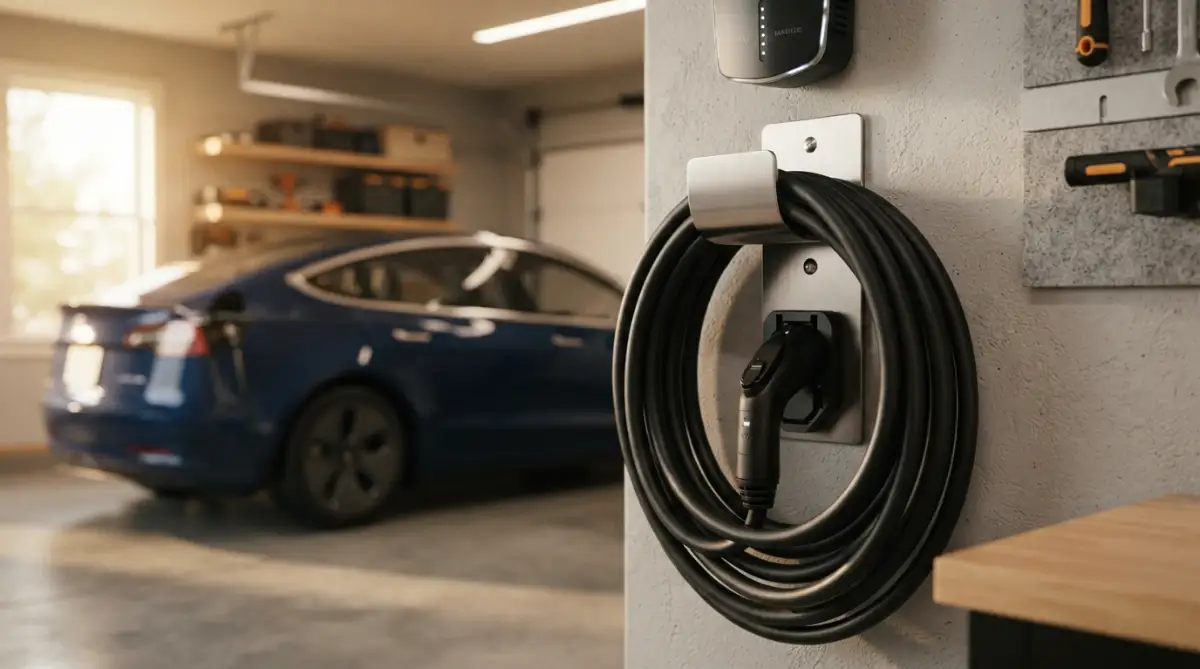
When you finish charging in the morning, do not just toss the cable loosely on the floor or wrap it tightly around your hand. Take a few extra seconds to loop it in large, gentle circles over the designated wall hook. Keeping those loops wide and loose prevents the internal wires from breaking, which directly helps in protecting your EV battery from inconsistent power drops.
Treat Your Charger Like Your Smartphone
If you decided to purchase a smart charger, you just brought another tiny computer into your home. Just like the smartphone sitting in your pocket, these internet-connected machines require regular software updates to stay healthy.
Manufacturers constantly release new firmware to fix hidden bugs, improve Wi-Fi connectivity, and optimize the overall charging speed. If you ignore these digital updates, you might wake up one morning to find that your machine dropped its internet connection and completely failed to charge your car overnight.
Make it a habit to open your specific charger brand’s smartphone app at least once a month. Navigate to the settings menu and look for a button that says "Check for Updates" or "Firmware." Taking three minutes to download the latest software directly from your provider ensures your machine always runs at peak efficiency.
Defeating the Invisible Enemy: Dust and Debris
Your garage is naturally filled with sawdust, dead bugs, flying pollen, and regular old dirt. Over time, these tiny particles love to settle right inside the small metal holes of your charging handle.
When dirt gets pushed into your car’s charging port day after day, it creates physical resistance between the metal connections. In the electrical world, resistance immediately creates unwanted heat, which can easily melt the plastic housing on a hot summer afternoon.
According to the official guides provided by the U.S. Department of Energy on home charging, keeping your equipment clean is highly recommended for optimal safety. Grab a cheap can of compressed air, the exact kind you use to clean your computer keyboard. Give the inside of your charging handle a quick spray every few weeks to blow out any hidden dirt, keeping those electrical connections perfectly clean and cool.
The Hidden Traps That Destroy New Home Setups
People get incredibly excited to drive their electric car without burning a drop of gas. In that wild rush of excitement, homeowners try to cut corners to save a few dollars on their electrical setup.
I have seen countless people make terrifying errors simply because they did not understand how continuous heavy power actually behaves. These are not just minor inconveniences; these are dangerous mistakes that can cause severe property damage or completely ruin your daily routine. Let us walk through the most common pitfalls so you can protect your home and your family.
The Danger of the "Double GFCI" Trap
If you choose to install a NEMA 14-50 plug-in outlet, the national electrical codes in many areas require your electrician to install a GFCI (Ground Fault Circuit Interrupter) breaker in your main panel. This special breaker prevents severe shocks if water somehow gets into your garage outlet.
However, almost every single high-quality EV charger on the market today already has its own GFCI safety switch built right into the machine. When you plug a GFCI-equipped machine into a GFCI-protected outlet, the two safety systems constantly fight against each other.
This creates a highly frustrating problem known as "nuisance tripping." You will plug your car in before bed, the two safety switches will falsely detect an error, and the breaker will randomly shut off the power while you sleep. To avoid waking up to an empty battery, ask your electrician to hardwire the unit directly to a standard breaker, completely bypassing the frustrating double GFCI conflict.
Ignoring the 80% Continuous Load Rule
This is easily the biggest mathematical error beginners make when buying equipment online. They see a machine advertised as a "50-Amp Charger" and instantly assume they just need to hook it up to a 50-amp circuit breaker.
Electricity simply does not work that way, especially for long, sustained periods of time. The Electrical Safety Foundation International (ESFI) strictly highlights that you must follow the 80% rule for continuous electrical loads. Since your car charges for many hours straight, the equipment is only legally allowed to use 80% of the circuit breaker's maximum rating.
If you want your car to pull 40 amps of power all night long, you absolutely must install a 50-amp breaker to handle the heat safely. If you try to pull a full 48 amps of power, you are required to have a massive 60-amp circuit breaker installed. Pushing a breaker to 100% of its capacity for eight hours straight will literally melt the plastic switches and create a massive fire hazard inside your walls.
Cheap Wires Cause Expensive Fires
When your hired professional goes to the supply store to buy the thick electrical cable for your garage, they have a choice between copper wiring and aluminum wiring. Aluminum is significantly cheaper, and some contractors will try to use it to save you money on the overall quote.
Never let anyone run aluminum wire for an electric vehicle charging station. When aluminum wire gets hot during an eight-hour charging session, the metal physically expands. When it cools down during the day, the metal shrinks back to its normal size.
This constant expanding and shrinking process slowly loosens the wire inside the terminal connections over a few months. Loose electrical connections create tiny invisible sparks, which rapidly turn into extreme heat right behind your drywall. If you want to avoid filing a stressful property damage claim due to a melted garage wall, always demand pure, heavy-duty copper wire for your installation.
Placing the Box in the Wrong Environment
Just because a machine says it can be installed outdoors does not mean you should leave it completely exposed to brutal weather. Many people mount their expensive chargers on the side of their house, facing the direct afternoon sun.
Modern chargers are incredibly smart and have built-in temperature sensors to protect themselves from overheating. If the heavy afternoon sun is beating down on the plastic box, the internal sensors will aggressively slow down your charging speed to prevent the hardware from melting.
If you must install your equipment outside in the driveway, try to mount it in a naturally shaded area or build a tiny wooden roof over the unit. The National Fire Protection Association (NFPA) notes that managing the physical environment around your electrical equipment heavily reduces long-term wear and tear. A little bit of shade ensures you get the absolute maximum charging speed, even on the hottest days of summer.
What Everyone Asks About Upgrading Home Charging
Do I actually need to upgrade my entire electrical panel to get Level 2 speeds?
Not always, but it heavily depends on your home's total power capacity. If you have an older 100-amp panel, you might not have enough room to safely add a heavy 50-amp breaker. A qualified electrician can perform a quick load calculation to see exactly what your current setup can safely handle.
Is it safe to leave my car plugged in for several days straight?
Yes, it is perfectly safe to leave your vehicle connected when you go away on a long trip. The smart computer inside your electric car automatically stops pulling electricity the exact second the battery reaches your set limit. It will only pull tiny drops of power occasionally to keep the battery comfortably warm during cold nights.
Will installing a permanent charger increase the value of my property?
Absolutely, modern buyers actively look for homes that are already prepared for electric vehicles. Having a dedicated 240-volt circuit perfectly installed in the garage makes your property highly attractive to the next generation of tech-savvy homeowners. You can easily view this upgrade as a smart investment, much like understanding how home upgrades attract new buyers.
Can I realistically install this equipment outside in the heavy rain or snow?
Yes, most premium units are specifically designed with heavy weatherproofing to handle outdoor elements. However, you should strictly choose the hardwired installation method instead of the plug-in method if it will live outside. Hardwiring removes the vulnerable wall outlet completely, ens