
I still remember the exact moment?
Opening your property tax bill can feel like a punch to the gut, especially when the numbers don't match what you think your home is worth. Many homeowners panic, thinking they’ve made a bad investment or that their property is losing value. The truth is much simpler: tax assessments and market prices are two completely different things that rarely speak the same language.
That single piece of paper completely ruined my sleep for weeks. I started questioning my real estate agent, thinking they were giving me false hope just to get my listing. I spent hours scrolling through online real estate platforms, desperately trying to figure out if my neighborhood was secretly losing value. The confusion made me feel totally helpless and stressed out.
The mental toll of this confusion is heavy. You start doubting your financial security and your future plans. You might even delay selling your house, thinking the market is bad, when in reality, your house is sitting on a goldmine of hidden equity. The gap between what a tax office says and what a human buyer will actually pay creates unnecessary panic in our daily lives.
Quick Cheat Sheet: What You Need to Know
- Ignore the Tax Bill: Your tax assessment is for government revenue, not for setting your home's sale price.
- Watch the Market, Not the Mail: Use recent comparable sales (comps) to figure out your true value.
- Don't Over-Improve: Large structural permits can alert the tax office; focus on cosmetic updates instead.
- Stay Calm: If your assessment is high, check if it matches market data before panicking.
The Big Misunderstanding: What Are You Actually Looking At?
Before you let a piece of mail ruin your day, we need to clear up the core difference between these two numbers. They sound like they should mean the same thing, but they belong to entirely different worlds. One number is used to collect taxes, and the other is used to build your bank account.
| Feature | Tax Assessed Value | Market Price |
| :--- | :--- | :--- |
| Purpose | Funding local services | Real estate sales |
| Driver | Public data & math | Emotion & current trends |
| Frequency | Every few years | Daily/Weekly changes |
When the local government looks at your house, they are not trying to buy it. They just need a baseline number to figure out your share of the community bills. This is what we call the assessed value. It is a highly mathematical, deeply unromantic calculation based on old data.
Think of it like this: your tax bill is a receipt for the neighborhood services you use, like schools and roads. Your home's market price is a price tag based on what a buyer is willing to trade for your lifestyle and future memories. They aren't even looking at the same map.
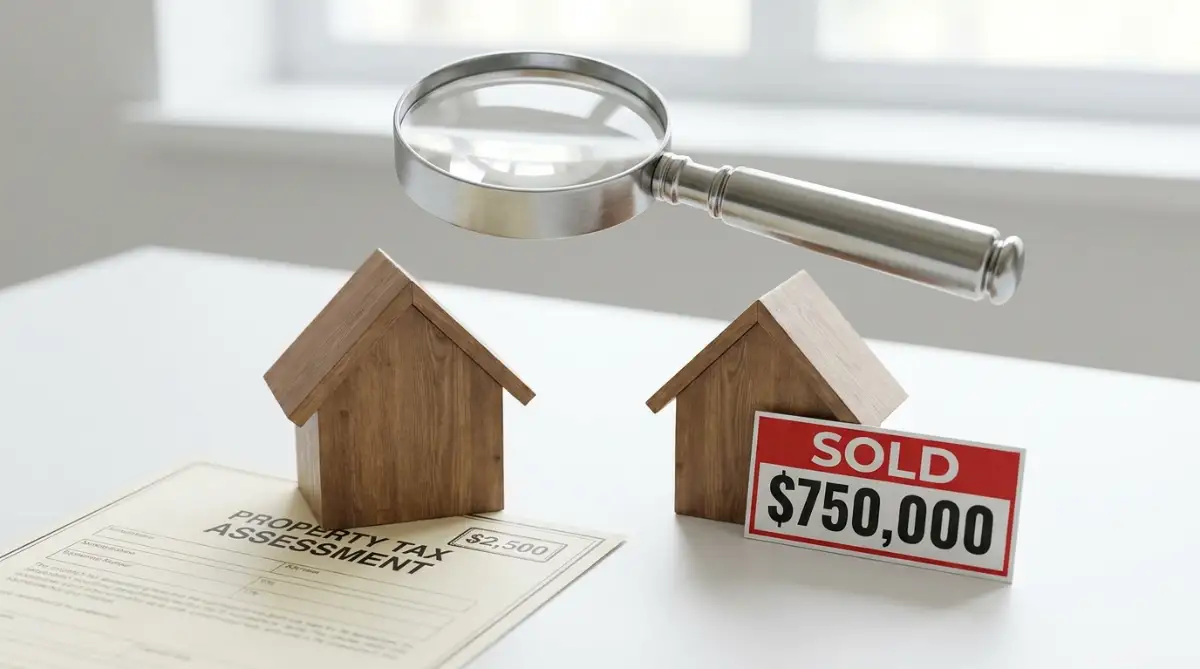
On the other hand, a home buyer is looking for a place to live, raise a family, or host holiday dinners. This is the market price. It is driven by human emotion, current trends, and the immediate supply of homes on your street.
How Local Governments Calculate Your Tax Bill
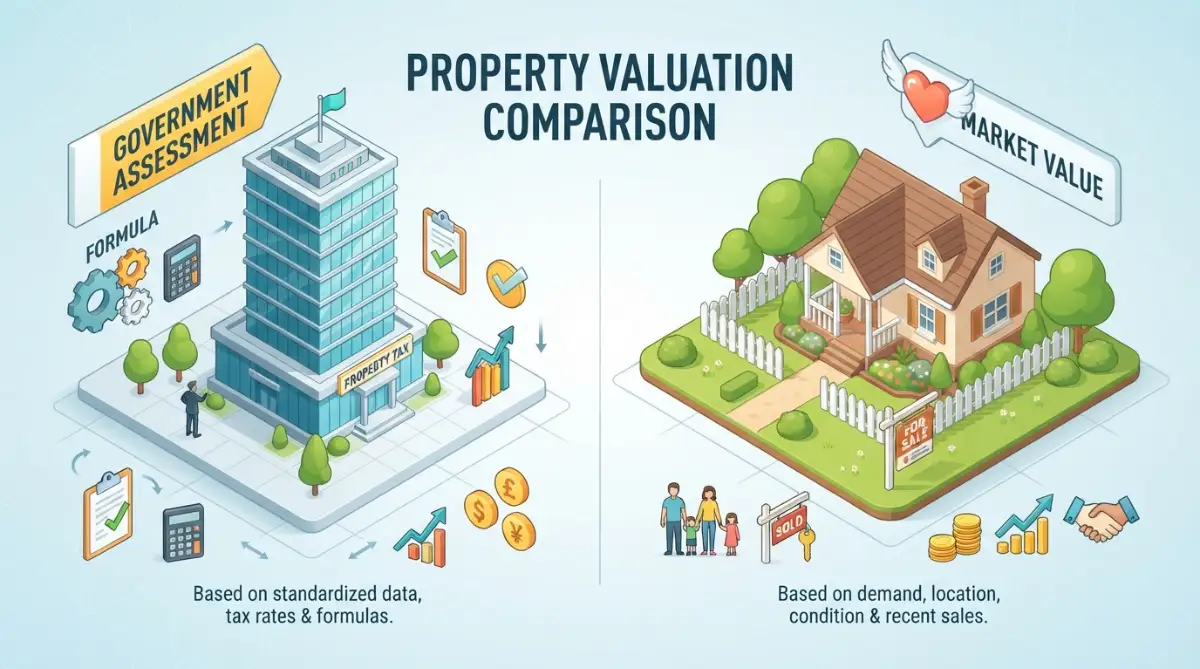
Let us talk about the assessor who works for your town or city. Their job is not to figure out how beautiful your kitchen looks with its new quartz countertops. Their job is strictly to fund the local budget.
If your town needs a certain amount of money to pay for schools, police stations, and road repairs, they divide that cost among all the homeowners. To do this fairly, they assign a basic value to every house. They look at public records like the size of your lot, the total square footage, and the number of bedrooms.
They also look at the general sales in your area over the past year or two. They put all this basic data into a massive computer system. The computer then spits out a number for your property.
Watch this quick breakdown to see exactly how your local tax office views your home compared to a real estate agent.
The Lag in Government Timing
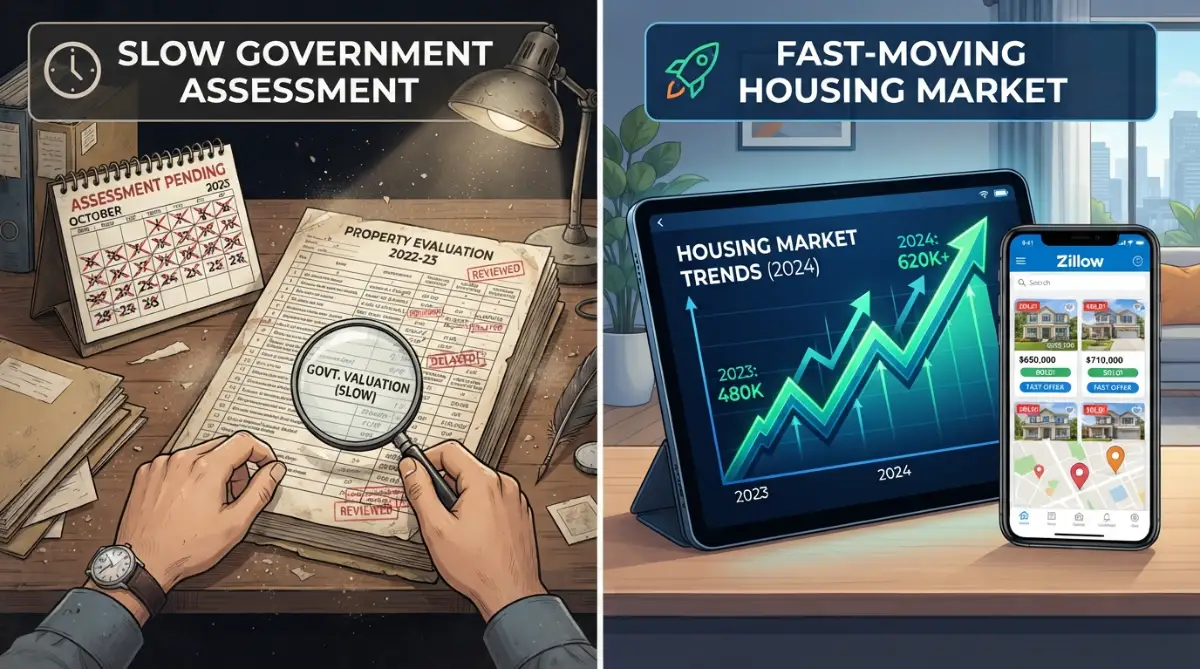
One of the biggest reasons these numbers do not match is simply the calendar. Local governments do not evaluate your home every single day. Most municipalities only reassess properties every few years.
If your town last assessed homes two years ago, your assessed value is stuck in the past. It reflects what the neighborhood was like back then, not what is happening right now.
Real estate markets move incredibly fast. A new shopping center nearby can drive up home prices in a matter of months. Buyers will happily pay a high market price for that convenience today, but your tax bill will not show that change until the next official assessment cycle.
Why the Inside of Your House Does Not Matter to the Assessor
The tax assessor usually never sets foot inside your house. They do a basic "drive-by" inspection or simply look at aerial maps and building permits. They have absolutely no idea how nicely you have decorated the interior.
If you spent your weekends painting the walls, replacing the old carpets, and making the house smell like fresh vanilla, the assessor does not care. Those aesthetic upgrades do not officially exist on their spreadsheets.
However, when a buyer walks through your front door, those details mean everything. A buyer feels an emotional connection to a beautiful, well-maintained home. They will willingly offer thousands of extra dollars on the market price just because the house feels "move-in ready" and welcoming.
I once made a completely embarrassing mistake when I tried to appeal my property tax bill. I actually printed out a bunch of high-quality photos of my neighbor's ugly backyard and sent them to the tax office, thinking it would lower my home's assessment. The clerk kindly informed me that they don’t base taxes on whose yard looks prettier, and I realized how little I knew about the system!
The Emotion Factor: Why Buyers Pay More Than The Paper Says
To truly understand the gap between these values, you have to look at the psychology of a homebuyer. Buying a house is rarely a purely logical decision. It is an incredibly emotional journey.
Imagine a young couple looking for a house in a very specific school district because they want the best education for their kids. There are only two houses available in that district this month. They are going to fight other buyers to get one of those homes.
This creates a bidding war. When multiple people want the same limited resource, the market price skyrockets. The couple will end up paying a premium just to secure their children's future.
Location, Lifestyle, and Human Desires
The tax office sees a house as a box made of wood, bricks, and pipes. A buyer sees a house as a lifestyle upgrade. If your home has a large deck that is perfect for summer barbecues, a buyer will imagine their friends gathering there.
They are paying for that future experience. The market price reflects these human desires. Elements like natural sunlight, a quiet street, or friendly neighbors add immense hidden value that no government formula can ever calculate.
Even something as simple as the color of your front door can influence a buyer's subconscious mood. When they fall in love with the vibe of the house, they stop caring about the exact price per square foot. They just want the keys.
Structural Data vs. Curb Appeal
Let us break down exactly what each side cares about. Understanding this difference will save you a lot of headaches when you go to sell. The assessed value is heavily tied to raw structural data.
This includes things like the age of the building, the type of foundation, and whether you have a garage or not. If your house has three bedrooms and two bathrooms, the assessor compares it to other basic three-bedroom, two-bathroom houses. It is a very dry, clinical process.
Market price, on the other hand, is heavily influenced by "curb appeal." This is how your house looks from the street the moment someone pulls into the driveway. If your lawn is perfectly manicured and your windows are sparkling clean, buyers assume the house is in perfect condition.
The Illusion of Perfection
Curb appeal creates an illusion of high quality. A house with beautiful landscaping will always command a higher market price than an identical house with a dead lawn next door. Yet, ironically, their assessed values might be exactly the same.
This is why real estate agents always tell you to clean up your yard before listing your home. They know that buyers judge a book by its cover. The tax assessor, however, does not care about the cover; they only care about the page count.
The Danger of Pricing Your Home Based on Assessed Value
Now that we know why the numbers differ, we need to talk about the biggest mistake you can make as a seller. Never, under any circumstances, use your tax assessment to set your listing price.
If your assessed value is much lower than the actual market value, listing it at the assessed price means you are throwing money away. You are essentially giving a massive discount to a stranger for absolutely no reason. You could be leaving tens of thousands of dollars on the table.
Some homeowners think that pricing it low will attract more buyers. While it might bring in more people, it also sends a signal that something is fundamentally wrong with the property. Buyers will wonder why it is so cheap and might get suspicious of hidden problems.
When Assessed Value is Higher Than Market Price
Sometimes, the opposite situation happens. You might open your tax bill and see a number that seems incredibly high. This often happens in neighborhoods where property values are dropping rapidly, but the tax assessor has not updated their records yet.
If you try to sell your house based on that highly assessed value, it will sit on the market forever. Buyers are looking at current conditions, not what the government thought the house was worth two years ago. They will see your overpriced home and simply move on to the next listing.
In this scenario, a high tax assessment is a double penalty. You are paying too much in property taxes, and you cannot even sell the house for that amount. This is when you should definitely consider appealing your property tax bill with the local government.
How to Find Your True Market Price
If the tax bill is useless for selling, how do you actually know what your house is worth? The answer lies in finding the true market price through real-time data. You need to look at what is happening in your neighborhood this exact week.
The best way to do this is by looking at "comps," which is short for comparable sales. These are recently sold homes in your immediate area that are similar to yours in size and condition. You want to look at homes that closed in the last three to six months.
This data tells you what real human beings with real bank accounts were willing to pay recently. It is the most accurate reflection of current market conditions.
The Role of a Professional Appraisal
If you want a more official number before selling, you can hire a private appraiser. A private appraiser works differently than a tax assessor. They actually come inside your house and inspect everything carefully.
They note the quality of your materials, the upgrades you have made, and the overall condition of the home. They then combine this physical inspection with recent comparable sales data. The number they give you is usually very close to the true market price.
Keep in mind that even a private appraisal is just an educated estimate. At the end of the day, a house is only worth what a buyer is willing to hand over on closing day.
Myth vs. Reality: Common Homeowner Traps
There are so many myths surrounding these numbers that confuse people. Let us bust a few of the most common ones right now.
Myth 1: If I lower my asking price, my property taxes will go down.
Reality: Your local government does not monitor your real estate listing. Lowering your asking price has zero immediate effect on your tax bill. The assessor only cares about finalized sales data across the whole neighborhood over a long period.
Myth 2: My tax assessed value is exactly 80% of my market value.
Reality: There is no universal fixed percentage. While some towns try to assess at a certain percentage of market value, the fast-moving real estate market makes this impossible to maintain accurately. The gap could be 10%, or it could be 50%.
Myth 3: A buyer's mortgage lender will use the tax assessed value.
Reality: Banks completely ignore the government’s assessed value when giving out loans. The bank will always order their own private appraisal to determine if the market price is fair. They want to ensure their investment is safe based on today's reality.
Stop Worrying About the Gap
The most important takeaway for your mental health is to stop stressing over the gap between these two numbers. It is completely normal for them to be vastly different. In fact, a low assessed value is actually a good thing for your daily life.
A low assessed value means you pay less in property taxes every year. It keeps your monthly expenses down and leaves more money in your pocket. You should quietly celebrate a low tax assessment while confidently knowing your home will sell for much more.
When it comes time to sell, put the tax documents in a drawer and focus entirely on the market. Work with professionals who understand local buyer behavior and current trends. Your home is a valuable asset, and its true worth is defined by the people who want to live there, not a government computer program.
How to Master Your Property Valuation Strategy Like a Pro
Now that we clearly see the divide between a government tax calculation and actual buyer emotion, we need a game plan. You cannot just sit back and hope these numbers magically work in your favor. If you want to protect your financial future, you have to be proactive.
Most homeowners just pay their tax bills and ignore the local real estate trends until the exact month they decide to sell. That is a massive missed opportunity. Staying ahead of the curve means understanding how to legally manage your taxes while secretly building your home equity.
Here are some advanced strategies to keep your money safe. These are the practical, everyday moves that real estate professionals use to maximize their profits without tipping off the local tax office.
The Stealth Renovation Approach
One of the best things you can do to increase your true selling price is to update your home. However, you need to be very careful about how you handle large renovations. If you add a massive extension or a brand-new detached garage, you usually need to pull city permits.
When you pull major structural permits, it acts like a giant alarm bell for the local tax assessor. They will see that permit and immediately trigger a reassessment of your property. Suddenly, your low tax bill shoots up to match your new structural additions.
Instead, focus heavily on high-return cosmetic updates that generally do not require heavy structural permits. Updating kitchen cabinets, applying fresh paint, and installing modern light fixtures will dramatically boost what a buyer is willing to pay. The best part is that the tax assessor rarely notices these internal aesthetic changes.
Knowing Exactly When to Challenge the Government
Many people assume they should always fight their property tax bill to save a few dollars. This can actually backfire terribly if you do not know what you are doing. You need a solid strategy before you ever pick up the phone to call your local government office.
Before you file an appeal, you must check the current market conditions in your specific neighborhood. If homes around you are selling for wildly high prices, the tax office might look closely at your file during the appeal process. Sometimes, they send an inspector who discovers a finished basement that was never on their official records.
If that happens, they will actually raise your assessed value instead of lowering it! A good rule of thumb is to only appeal if you have solid proof that the assessor made a factual error. For example, if they listed your house as having four bedrooms but you only have three, that is an easy and safe win.
Building Your Own Private Data File
Do not wait for a real estate agent to tell you what is happening on your street. You should create a simple digital folder on your computer to track your own neighborhood data. Every time a house sells within a few blocks of yours, write down the final sale price and save a few photos of their interior.
Over time, this creates a deeply accurate picture of your local market. You will start to notice patterns that online algorithms completely miss. You might realize that houses with fenced-in backyards sell significantly faster in your specific zip code.
Understanding these local trends gives you immense power. It helps you navigate the confusing world of understanding property taxes because you can clearly separate tax data from actual neighborhood reality. You become your own neighborhood expert.
Leverage Professional Appraisals Wisely
If you are ever in serious doubt about your financial standing, consider bypassing the free online tools entirely. A certified professional appraisal gives you the most grounded reality check available. These experts are trained to look at both the structural facts and the emotional appeal of a property.
You can learn more about how certified experts evaluate homes by checking resources from the Appraisal Institute, which sets high standards for real estate valuation. Having an official appraisal document in your hands gives you incredible peace of mind. It removes the guesswork and gives you a solid number to work with for your future planning.
Just remember that an appraisal is only a snapshot of that specific month. Markets shift rapidly based on the economy and interest rates. Keeping an eye on how mortgage rates work will help you anticipate when buyer demand might suddenly push market prices higher or lower.

The Biggest Valuation Traps Homeowners Fall Into
Understanding the theory is great, but avoiding real-world disasters is even better. People lose tens of thousands of dollars every single day because they misunderstand the relationship between tax values and market prices. These mistakes are heavily tied to human emotion and panic.
When you are dealing with your largest financial asset, even a small error in judgment can set your retirement plans back for years. Let us walk through the most common, painful traps that sellers fall into. If you can avoid these, you are already way ahead of the average homeowner.
Blind Trust in Automated Online Estimates
We all love the convenience of typing our address into a massive real estate website to see a magic number pop up on the screen. It feels good when the number is high, and it ruins our day when the number is low. However, these automated valuation models (AVMs) are often wildly inaccurate.
These websites use algorithms that pull basic public tax records and blend them with recent sales. The problem is, a computer has never walked through your front door. It does not know that your house smells like dog urine, or conversely, that you just installed a stunning $50,000 chef's kitchen.
Relying on these automated numbers to plan your financial future is extremely dangerous. For a deeper look into housing data realities, you can explore the house price index reports provided by the Federal Housing Finance Agency (FHFA). If you price your home based on a faulty internet algorithm, you will either scare buyers away with a high price or give away your hard-earned equity for free.
The Over-Improvement Disaster
This is an incredibly heartbreaking scenario to watch. A family decides they want to increase their home's market value, so they pour all their savings into luxury upgrades. They build a giant swimming pool, install imported marble floors, and add a massive outdoor kitchen.
They assume that spending $100,000 on renovations automatically adds $100,000 to their market price. Unfortunately, real estate does not work like simple math. Every neighborhood has a hidden "price ceiling," which is the maximum amount any sane buyer will pay to live on that specific street.
If you have a million-dollar house in a neighborhood where every other home is worth half that amount, buyers will simply not pay your asking price. They would rather buy a million-dollar house in a million-dollar neighborhood. You will never get that renovation money back, regardless of what your tax assessment says.
Ignoring Obvious Red Flags Before Selling
Some sellers get so caught up in debating their market value that they completely ignore the physical condition of their property. They fight with their real estate agent over listing prices while their roof is actively leaking. This is a massive mistake that buyers will spot instantly.
When a buyer walks in, they are not just looking at the pretty staging furniture. They are looking for hidden disasters that will cost them money later. If they spot water damage or electrical issues, they will instantly drop their emotional attachment to the house.
This completely destroys your market price power. To protect yourself, you must be extremely proactive about maintenance. Always pay attention to the first-time home inspection red flags long before a buyer ever sets foot on your driveway.
Pricing Based on What You "Need"
This is perhaps the most emotional trap of all. Sometimes a seller decides on a market price simply because they "need" a certain amount of money to buy their next dream house. They completely ignore local comparable sales and the town's assessed value.
They tell their agent, "I cannot accept anything less than $500,000 because I need that money to pay off my debts." The harsh reality is that the real estate market does not care about your personal debt or your future plans. Buyers are only going to pay what the house is actually worth today.
When you price a home based on personal needs rather than market reality, it sits empty on the internet for months. The longer a house sits unsold, the more buyers assume there is something terribly wrong with it. Eventually, these desperate sellers have to drop their price far below the actual market value just to get rid of it.
Letting Tax Panic Dictate Your Timeline
I have seen homeowners completely panic when a newly reassessed tax bill arrives in the mail. If the town suddenly raises their property taxes by a large margin, they freak out and decide to sell the house immediately. They think they can no longer afford to live there.
Selling your house purely out of tax-induced panic usually results in a rushed, poorly planned listing. You might skip important cleaning and staging steps just to get the house on the market fast. This sloppy presentation kills your curb appeal and directly lowers your final market price.
Before you let a tax bill force you out of your home, take a deep breath and run the actual numbers. Sometimes, exploring options like getting unsecured loans with bad credit or adjusting your monthly budget is a much better temporary fix. Never make a massive, life-altering real estate decision while you are in a state of financial panic.
Your Next Steps for a Stress-Free Sale
At the end of the day, understanding your home's worth should not feel like trying to solve a complicated math equation in the dark. It is simply about separating the cold, hard government data from the warm, emotional human experience. Once you accept that these two numbers live in completely different universes, the stress instantly melts away.
Your local government is just trying to balance a budget using a generic formula. Let them have their spreadsheets and their outdated files. Your main focus should always be on maintaining your home beautifully and understanding the real humans who might want to buy it.
When you focus on curb appeal, sensible maintenance, and tracking actual neighborhood sales, you take all your power back. You will never again open a piece of mail and feel like your financial future is ruined. You are now equipped with the exact knowledge needed to confidently navigate any real estate transaction.
I personally spent far too many sleepless nights agonizing over a tax document that meant absolutely nothing to the lovely family who eventually bought my home. I want you to completely let go of that unnecessary anxiety today. Trust the current market, keep your home looking its absolute best, and confidently watch your true equity grow!
Clear Answers to Your Valuation Worries
Can my assessed value ever be higher than the actual market price?
Yes, this absolutely happens, especially in a declining housing market. Because local governments only update assessments every few years, your tax bill might reflect older, higher neighborhood values. If you suspect this is happening, you should gather recent neighborhood sales data and file an appeal to lower your taxes.
Will remodeling my kitchen immediately increase my property taxes?
Generally, no. Tax assessors usually do not know about internal cosmetic updates like new cabinets or countertops unless you pull major building permits. These beautiful upgrades will heavily increase your market price for buyers, but your assessed value will likely remain safely unchanged.
Should I show potential buyers my low property tax bill as a selling point?
Yes! A low property tax bill is a fantastic marketing tool for your real estate agent. Buyers love knowing that their monthly living expenses will be lower after they move in. It makes your house much more attractive compared to similar homes in towns with higher tax rates.
Do real estate agents use the assessed value to set my asking price?
A professional real estate agent will completely ignore the government's assessed value when pricing your home. Instead, they run a Comparative Market Analysis (CMA) based on homes that sold in your neighborhood over the last ninety days. They focus purely on what active buyers are willing to spend right now.
How often do true market prices actually change?
True market prices change constantly, almost week by week. Factors like national interest rates, local job markets, and even the weather can influence how many buyers are shopping. This is why a market valuation from six months ago might be completely useless today.
Disclaimer: This article is for informational and educational purposes only and does not constitute official financial, legal, or real estate advice. Real estate markets and tax assessment laws vary significantly by location. Always consult with a licensed real estate agent, certified appraiser, or tax professional in your specific local area before making any major financial decisions regarding your property.