The Silent Struggle Behind Our Glowing Screens
Ever caught yourself squinting at a simple text message just to read it? We have all been there. You spend eight hours staring at a work monitor, only to unwind by scrolling on your phone for another three. Before you know it, your eyes feel like they are packed with sand, and falling asleep feels completely impossible. Let’s talk about why our glowing screens are doing this to us, and more importantly, how you can fix it today without throwing your favorite devices in the trash.
We all love staying connected, but our bodies are paying a really heavy price. You probably know that heavy, dry feeling in your eyes after a long day of office work or endless scrolling. It usually starts as a mild annoyance. You rub your eyes a few times and think nothing of it.
But soon enough, it turns into sharp headaches that drain your energy entirely. You might find yourself squinting while trying to read a simple text message from a friend. Focusing on a computer screen starts to feel like looking directly into a bright flashlight.
This constant strain makes us irritable, tired, and completely unable to enjoy our evenings with family. We just want to close our eyes, hide in a dark room, and escape the harsh glare. It deeply affects our mood and our ability to be present with our loved ones.
Even worse, this hidden problem messes with our minds and natural sleep patterns. You lie in bed, completely physically exhausted, yet your brain refuses to shut down. The artificial glow from our beloved devices tricks our bodies into thinking the sun is still shining.
As a result, finding peace and getting a night of restful sleep becomes a massive daily struggle. We wake up feeling grumpy, reach for a strong cup of coffee, and start the painful cycle all over again.
What You Will Learn in 3 Minutes:
- Why your eyes feel so dry and heavy after a long workday (and the easiest way to fix it).
- How to practice the 20-20-20 rule without actually having to think about it.
- The exact distance you should keep your phone, laptop, and TV from your face.
- Why using "Dark Mode" all the time might actually be giving you worse headaches.
How Artificial Screen Glare Messes With Your Body
We spend most of our waking hours staring at glowing rectangles. Whether it is a smartphone, a television, or a work monitor, these screens emit a specific type of high-energy light. This light scatters very easily, which means your eyes have to work extra hard just to focus on the text or images.
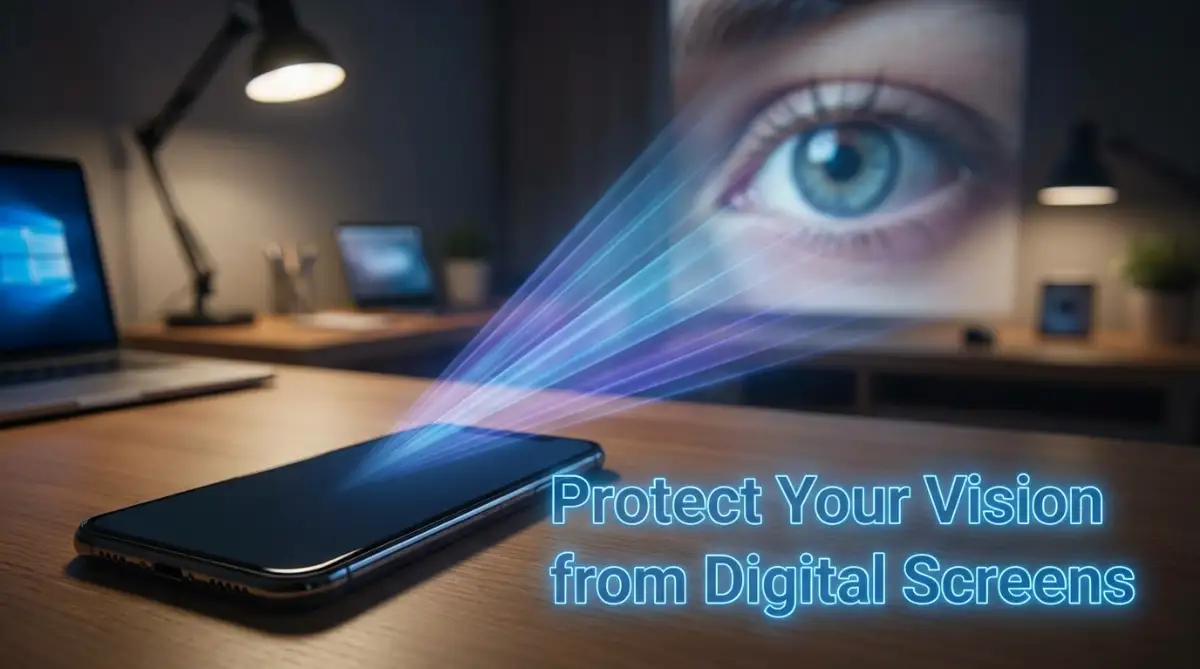
This happens because we actually forget to blink when we are highly focused on a digital display. Normally, humans blink about fifteen times a minute. But when scrolling through videos or reading emails, that number drops to just five or six times.
The Sleep Thief Hiding in Your Bedroom
Your body has an internal clock that tells you when to sleep and when to wake up. This natural rhythm relies heavily on the lighting around you. When the sun goes down, your brain naturally starts producing melatonin, a hormone that makes you feel sleepy and relaxed.
However, the bright screens we use at night completely confuse this internal system. When you look at your phone in a dark bedroom, the intense light tells your brain that it is still daytime. Your melatonin production stops instantly, leaving you wide awake.
You end up tossing and turning for hours. The next morning, you feel completely drained and unable to focus on your work. It is a frustrating cycle that destroys your energy levels and long-term health.
Realistic Habits to Shield Your Vision Every Single Day
Protecting your eyes does not mean you have to throw away your phone or quit your office job. You just need to build a few smart habits into your daily routine. Small changes can make a massive difference in how your eyes feel by the end of the day.
Instead of fighting technology, we can learn how to manage it in a way that respects our physical limits. Let us look at some highly practical changes you can start making right this minute. These methods are simple, free, and incredibly effective.
Your 60-Second Device Setup Checklist:
- For your phone: Turn on 'Night Shift' (iOS) or 'Eye Comfort Shield' (Android) from sunset to sunrise.
- For your laptop: Enable 'Night Light' (Windows) or 'Night Shift' (Mac) and set the strength to about 40%.
- For your room: Swap your overhead bright white bulb for a soft, warm-toned desk lamp during evening hours.
Give Your Eyes a Mandatory Recess
Just like your legs get tired from running, your eye muscles get exhausted from focusing on close-up objects. You would never run a marathon without taking a water break. So, why do we force our eyes to stare at spreadsheets for four hours straight?
You need to actively give your vision a chance to reset. One of the best ways to do this is by practicing a very simple timing method. It is incredibly easy to remember and takes almost zero effort to do.
The Simple 20-20-20 Rule Explained
Eye care professionals highly recommend the 20-20-20 rule for anyone who works with digital screens. Every 20 minutes, you should look away from your screen. You then focus on an object that is at least 20 feet away from you.
You need to keep looking at that distant object for a full 20 seconds. This short break allows the muscles inside your eyes to completely relax. It feels almost like a deep stretch for your vision.
At first, you might forget to do this while you are busy working. I suggest setting a gentle alarm on your phone to remind you. After a few days, it will become an automatic and refreshing habit.
Adjusting Your Digital Environment for Comfort
Your workspace setup plays a massive role in how your eyes feel. Most people sit in rooms that are either way too bright or terribly dark. Both of these extremes force your vision to work much harder than necessary.
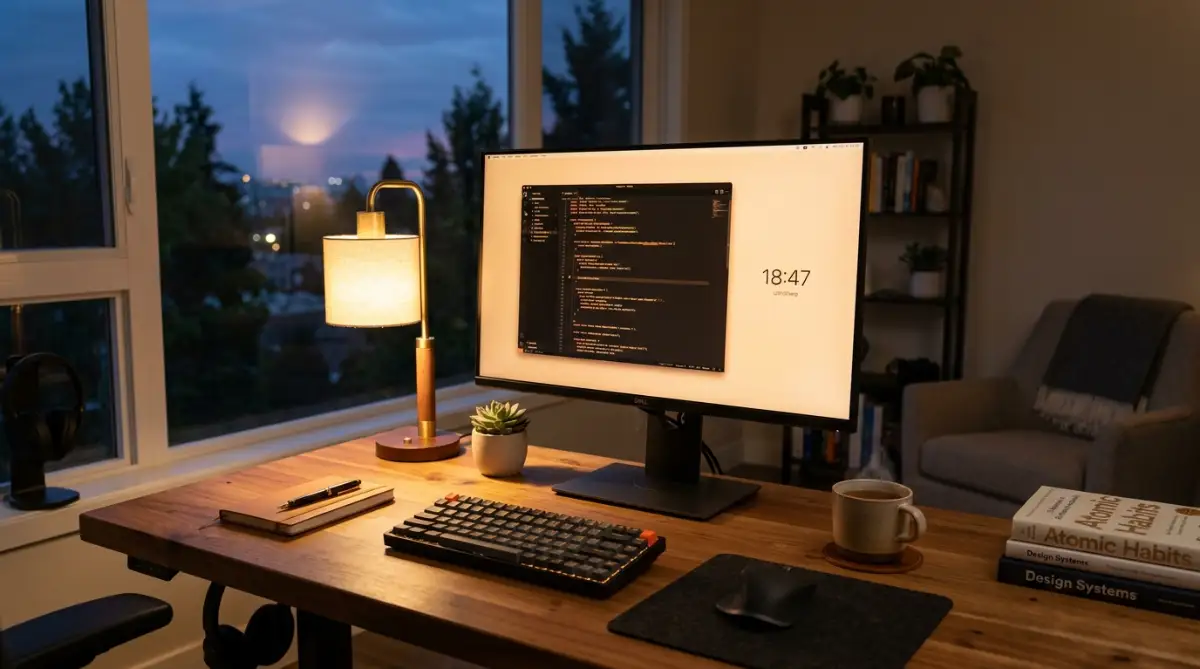
You want the lighting in your room to match the brightness of your screen. If your computer looks like a bright lightbulb shining in a dark cave, your room is too dark. If your screen looks dull and washed out, your room lighting might be too intense.
Try to place your desk so that windows are beside you, rather than directly in front of or behind your screen. This stops sunlight from bouncing off your monitor and hitting you right in the face. A simple desk lamp with a warm bulb can also help balance the lighting in your room.
Turning Down the Brightness Is Not Enough
Many people think just sliding the brightness down on their phone solves the problem. While it definitely helps, a dim screen in a pitch-black room still causes a huge amount of contrast. Your eyes struggle to adjust to the bright spot in the middle of the darkness.
Instead of just dimming the screen, try turning on a small bedside lamp when reading at night. This softens the contrast and creates a much more comfortable viewing experience. You will notice that your eyes do not sting nearly as much.
Creating a Screen-Free Evening Routine
We are so used to checking our messages right up until the second we close our eyes. This habit is exactly what ruins our rest and damages our vision over time. We have to learn how to disconnect before jumping into bed.
Creating a calm, low-tech evening routine is the absolute best gift you can give your tired eyes. You need to create a physical boundary between your digital life and your resting space.
Want to know exactly how screen glare disrupts your natural sleep hormones? Watch this quick breakdown that changed the way I look at my phone at night.
Try to put your phone on a charger in another room at least one hour before you sleep. If that feels too difficult, start with just thirty minutes. Use this time to do something that does not require a glowing screen.
You could read a physical book, listen to a relaxing podcast, or just talk with your family. Your brain will finally have the chance to cool down. You will be amazed at how quickly you fall asleep when your eyes are not being bombarded by light.
Physical Barriers That Actually Work
Sometimes, changing your habits is simply not enough. If you work a job that requires eight hours of computer time, you need extra physical protection. Luckily, there are many tools designed specifically to make screen time less painful.
These tools act like a shield between the harsh digital world and your sensitive eyes. They reduce the intensity of the light before it ever reaches your face.
Why People Are Buying Protective Eyewear
You have probably seen people wearing glasses with a slight yellow tint. These are designed specifically to filter out the high-energy light coming from digital monitors. They are incredibly popular among heavy computer users and gamers.
These glasses work by absorbing the harsh glare and softening the visual impact. When you wear them, the screen looks slightly warmer and much more natural. It takes the sharp edge off the bright white backgrounds we look at all day.
I used my own pair for a week and was honestly shocked by the results. The afternoon headaches I used to get completely vanished. My eyes felt fresh even after staring at a massive spreadsheet for three hours.
I used to think turning on 'dark mode' on my apps was completely enough to protect my vision at night. But my eyes kept burning until I realized the actual brightness level and distance from my face mattered way more than just making the background black. You have to combine good software habits with physical distance for it to really work.
Software Filters You Already Have on Your Devices
If you do not want to buy new glasses, you can use built-in tools on your current devices. Almost every modern smartphone and computer has a setting designed to change the screen color temperature. These features are amazing and completely free to use.
On iPhones, this is called Night Shift, while Windows computers call it Night Light. When you turn these features on, the screen slowly shifts from a cool blue tone to a warm orange tone. This warm tone is much gentler on your visual system.
You can actually set these filters to turn on automatically when the sun sets in your city. This means you never even have to think about it. Your phone will naturally adjust its light output to protect you as the evening approaches.
Debunking Common Myths About Screen Time
There is a lot of confusing information out there about how screens affect our health. When you understand the actual facts, it becomes much easier to protect yourself. Let us clear up some of the most common misunderstandings people have.
Many people believe that sitting too close to the television will make you permanently blind. This is actually a very old myth our parents used to tell us. Sitting close to a screen will definitely cause temporary fatigue, but it does not cause permanent physical blindness.
However, that temporary fatigue is exactly what causes the headaches, dry eyes, and blurred vision we suffer from. So while you will not go blind, you are still actively choosing to suffer by ignoring good habits.
Another common myth is that only computer screens are harmful. The truth is, the smartphone you hold right up to your face is often much worse. Because we hold our phones so incredibly close to our eyes, the light intensity is highly concentrated.
The Real Impact on Children and Teenagers
Children often do not know how to explain that their eyes are feeling tired. Instead, they might rub their eyes constantly, complain about headaches, or have trouble paying attention in school. Parents sometimes confuse these symptoms with bad behavior or a lack of focus.
We need to teach younger generations how to interact with technology safely. Encouraging them to play outside gives their developing eyes a chance to focus on distant objects. It is a natural and fun way to practice the 20-20-20 rule without them even knowing it.
Understanding Different Types of Screens
Not all screens are created equal when it comes to eye comfort. The technology inside your device plays a huge role in how much strain you feel. Knowing the difference can help you choose better devices for reading and working.
Here is a quick look at how different screen types affect your daily comfort:
As you can see, if you love reading books on a digital device, an E-ink reader is a fantastic investment. These screens do not shine light directly into your face. Instead, they rely on the natural light in your room, making them look exactly like real paper.
If you have to use an LCD monitor for work, taking regular breaks becomes even more necessary. Since these older screens use powerful backlights, they push a massive amount of light toward you at all times.
Why Proper Hydration Matters for Your Vision
You might be surprised to learn that drinking water helps your eyes. Our eyes need to remain moist to stay comfortable and clear. When you are dehydrated, your body cannot produce enough tears to keep the surface of your eye properly lubricated.
Combine dehydration with the fact that we rarely blink while looking at screens, and you have a recipe for disaster. The dry air in air-conditioned offices makes this problem even worse. Your eyes simply dry out like a leaf in the hot sun.
Keeping a large glass of water on your desk is a great physical reminder. Every time you take a drink, close your eyes tightly for just a second to re-moisturize them. It is a tiny habit that provides massive relief throughout a long workday.
You can also use simple, over-the-counter lubricating eye drops. These are not medical treatments, just artificial tears that add a quick burst of moisture. A single drop in each eye before you start your afternoon work session can prevent that gritty, burning feeling entirely.
Taking Your Eye Protection to the Next Level
Once you have mastered the basic habits of screen management, it is time to look at some advanced strategies. These are the daily practices that truly separate those who suffer from digital fatigue from those who feel fresh all day. I learned these the hard way after realizing that just dimming my screen was not fixing the root problem.
Your eyes need active defense mechanisms, both from the inside out and from the outside in. Building a stronger visual system actually starts on your dinner plate, long before you ever open your laptop. The foods you eat directly determine how well your eyes can filter out harsh artificial lighting.
You might not know this, but your eyes have built-in internal sunglasses. This protective layer sits right at the back of your eye, and it relies heavily on specific nutrients to stay thick and healthy. If you do not feed your body the right vitamins, this natural shield becomes weak and thin over time.
Building Your Internal Screen Shield With Nutrition
To build up this natural defense, you need to focus on two very specific antioxidants called lutein and zeaxanthin. These amazing nutrients act exactly like a physical light filter inside your retina. They actively absorb harmful light rays before those rays can damage the sensitive cells in your eyes.
You can find high amounts of these nutrients in dark leafy greens like spinach, kale, and Swiss chard. If you hate eating salads, you can easily blend a handful of spinach into a morning fruit smoothie. You will not even taste the greens, but your eyes will get the exact raw materials they need to stay strong.
Eye Nutrition: Myth vs. Fact
- Myth: Eating tons of carrots will magically fix your screen-damaged vision overnight.
- Fact: While carrots have Vitamin A, your eyes actually crave Lutein and Zeaxanthin to block out digital glare. You get these powerful nutrients mostly from spinach, egg yolks, and pistachios.
Researchers looking into vision health have discovered that a diet rich in these greens significantly reduces the physical symptoms of screen fatigue. In fact, comprehensive guidelines provided by the American Optometric Association on dietary vision defense highlight just how powerful these specific antioxidants are for heavy computer users. It is amazing how much a simple change in your daily meals can improve your physical comfort.
The 1-2-10 Distance Rule for Every Device
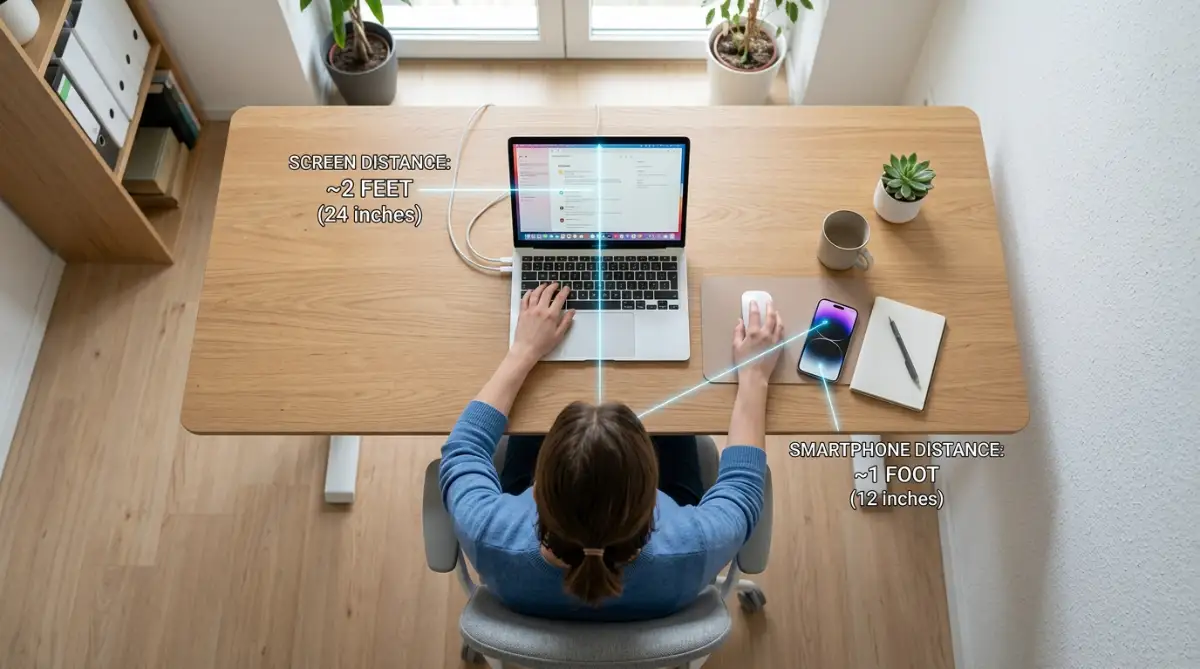
Another pro-level secret is mastering the physical distance between your face and your glowing screens. Most of us hold our phones incredibly close to our noses without even realizing it. This forces the tiny focusing muscles inside your eyes into a state of extreme tension.
Optometrists often recommend a very simple trick called the 1-2-10 rule to keep your eye muscles relaxed. You should keep your mobile phone exactly one foot away from your face at all times. Your laptop or desktop monitor should be pushed back to at least two feet away, which is roughly an arm's length.
Finally, your television should be at least ten feet away from where you are sitting on the couch. By sticking to these exact distances, you prevent your eyes from overworking. Just like you might struggle to heal a damaged skin barrier from over-exfoliation, you must stop over-straining your vision if you want it to recover properly.
Automating Your Home Lighting for Better Sleep
We often focus entirely on the screen itself, but the lighting in your surrounding room is equally important. When you look at a bright display in a completely dark room, your pupils dilate, allowing maximum harmful light into your eye. You need to create a smooth transition between daytime working hours and nighttime relaxation.
Smart home LED bulbs are an absolute game-changer for digital workers. You can program these affordable bulbs to automatically change their color temperature as the sun goes down outside. During the afternoon, they can mimic bright, cool daylight to keep you highly focused and energetic.
But as evening approaches, the bulbs will slowly shift into a warm, amber glow. This gentle amber light sends a powerful signal to your brain that it is time to start producing sleep hormones. According to detailed sleep science explained by the Harvard Medical School's division of sleep medicine, reducing bright artificial room light is the absolute fastest way to restore your natural sleep rhythm.

Where Most People Go Wrong With Digital Eye Care
Even when people try to fix their screen habits, they often fall into a few very common traps. Trying to solve eye strain with the wrong methods can actually make the pain much worse over the long run. I made several of these exact mistakes when I first started trying to protect my own vision.
We naturally look for quick fixes to solve our physical discomfort. But some of these highly advertised quick fixes completely ignore the underlying biology of how our eyes actually function. Let us walk through the most dangerous pitfalls you need to avoid starting today.
The Hidden Danger of "Dark Mode" Reliance
Almost everyone believes that switching their phone and computer to "Dark Mode" instantly completely solves the problem. Dark mode makes the background of your apps black and turns the text white. While this definitely feels less blinding in a dark room, it introduces a completely new set of issues.
When you look at a black screen, your pupils naturally open much wider to let in more light. Because the white text on your screen is still emitting high-energy rays, those rays now have a larger opening to enter your eye. This means you might actually be exposing your retina to more intense scattered light than before.
Additionally, reading white text on a black background forces your eye to work harder to focus on the edges of the letters. This causes an optical effect called "halation," where the white letters seem to bleed into the dark background. This subtle blurring effect is a massive hidden cause of afternoon headaches for office workers.
Becoming Addicted to "Redness Relief" Eye Drops
When your eyes look red and tired after a long gaming or working session, reaching for eye drops feels natural. However, there is a massive difference between artificial tears and drops designed specifically to remove redness. Redness relief drops use harsh chemicals to temporarily shrink the blood vessels on the surface of your eye.
This makes your eyes look clear and white for about an hour or two. But once the chemicals wear off, those blood vessels expand even larger than before, creating a vicious cycle called "rebound redness." You end up needing more and more drops just to look normal, completely ruining your natural tear production.
Instead of those harsh chemicals, you must only use preservative-free artificial tears. Finding the perfect brand for your specific dry eyes is very much like trying to choose the right skin moisturizer for your skin type—it takes a little trial and error to find what feels best. Medical experts at Johns Hopkins Medicine strictly advise against redness-relieving drops for anyone suffering from daily digital screen fatigue.
Positioning Your Monitor Totally Wrong
Take a quick second to look at exactly how your computer screen is positioned right now. Most people place their laptops or external monitors so they have to look slightly upward. This is an absolute disaster for the moisture levels on the surface of your eye.
When you look straight ahead or slightly upward, your eyelids have to open extremely wide. This exposes a massive amount of your eyeball to the dry, air-conditioned air in your room. Your tears will evaporate almost instantly, leaving you with that terrible gritty feeling by 2 PM.
You should always position your screen so that the top edge is directly at your natural eye level. This forces you to look slightly downward at a gentle 15-degree angle while you work or read. Looking slightly down naturally lowers your eyelids, which physically protects the moisture on your eyes from drying out.
Treating Vision Health as a Low Priority
The biggest mistake of all is simply ignoring the warning signs your body is giving you. We often push through the daily headaches and burning sensations because we have deadlines to meet or shows to binge-watch. We treat our eye health as something we will worry about later in life.
But eye strain compounds over time, much like bad financial decisions. Ignoring daily eye fatigue is exactly like ignoring a growing pile of debt; eventually, the system breaks down completely. Taking the time to build good habits now is just like taking the time to understand how mortgage rates work before signing a contract—you are actively protecting your future.
If you continue to abuse your visual system, you will eventually face chronic dry eye disease or severe tension migraines. These conditions can force you to take weeks off work and spend thousands on medical treatments. Preventing the damage today is infinitely cheaper and easier than trying to cure it tomorrow.
The Final Action Plan for Healthier Eyes
You now have a complete understanding of how artificial screens are silently impacting your physical and mental well-being. More importantly, you have a toolkit full of highly effective, completely free methods to fight back. You do not have to become a victim to the glowing devices that run our modern lives.
Start small by picking just one or two habits to implement this week. Maybe you will start setting a timer for the 20-20-20 rule during your workday. Or perhaps you will finally ban your smartphone from the bedroom to protect your natural sleep cycle.
Whatever you choose, stick with it until it becomes completely automatic. Your eyes are incredibly resilient, and they will start to feel better almost immediately once you give them the break they deserve.
I honestly wish I had known all of these simple tricks years ago before I spent so many nights struggling with dry, painful eyes. My energy levels, my sleep quality, and my daily focus have completely transformed since I took control of my screen habits. I know that if you apply these steps, you will experience that exact same relief and wake up feeling ready to conquer your day.
Common Questions About Digital Screen Strain
Do blue light blocking glasses actually work for everyone?
Yes, they are highly effective for people who spend more than four hours a day looking at bright screens. While they do not cure existing eye conditions, they significantly reduce the harsh glare that causes tension headaches. Think of them as a physical shield that makes your screen feel much softer and warmer.
Is it completely bad to look at my phone in the dark?
Looking at a bright phone in a pitch-black room is one of the worst things you can do for your vision. The extreme contrast forces your eye muscles to work incredibly hard, causing rapid fatigue and dryness. Always turn on a small bedside lamp to balance the lighting before scrolling.
Will eye strain from computers cause permanent blindness?
No, digital eye strain will not cause you to go completely blind. However, it can cause severe chronic dry eyes, blurred vision, and debilitating migraines that ruin your quality of life. It is a daily physical stressor that you need to manage actively.
How long does it actually take to recover from screen fatigue?
If you implement the 20-20-20 rule and take a proper break from screens in the evening, your eyes can feel better the very next morning. Your visual system recovers quickly when given the proper amount of rest and natural moisture. Consistency is the key to keeping the pain away permanently.
Disclaimer: The information provided in this article is for educational and informational purposes only and does not constitute medical advice. Always consult with a qualified eye care professional or optometrist before making any changes to your health routines or treating any physical symptoms."The content is not intended to diagnose, treat, or cure any disease."